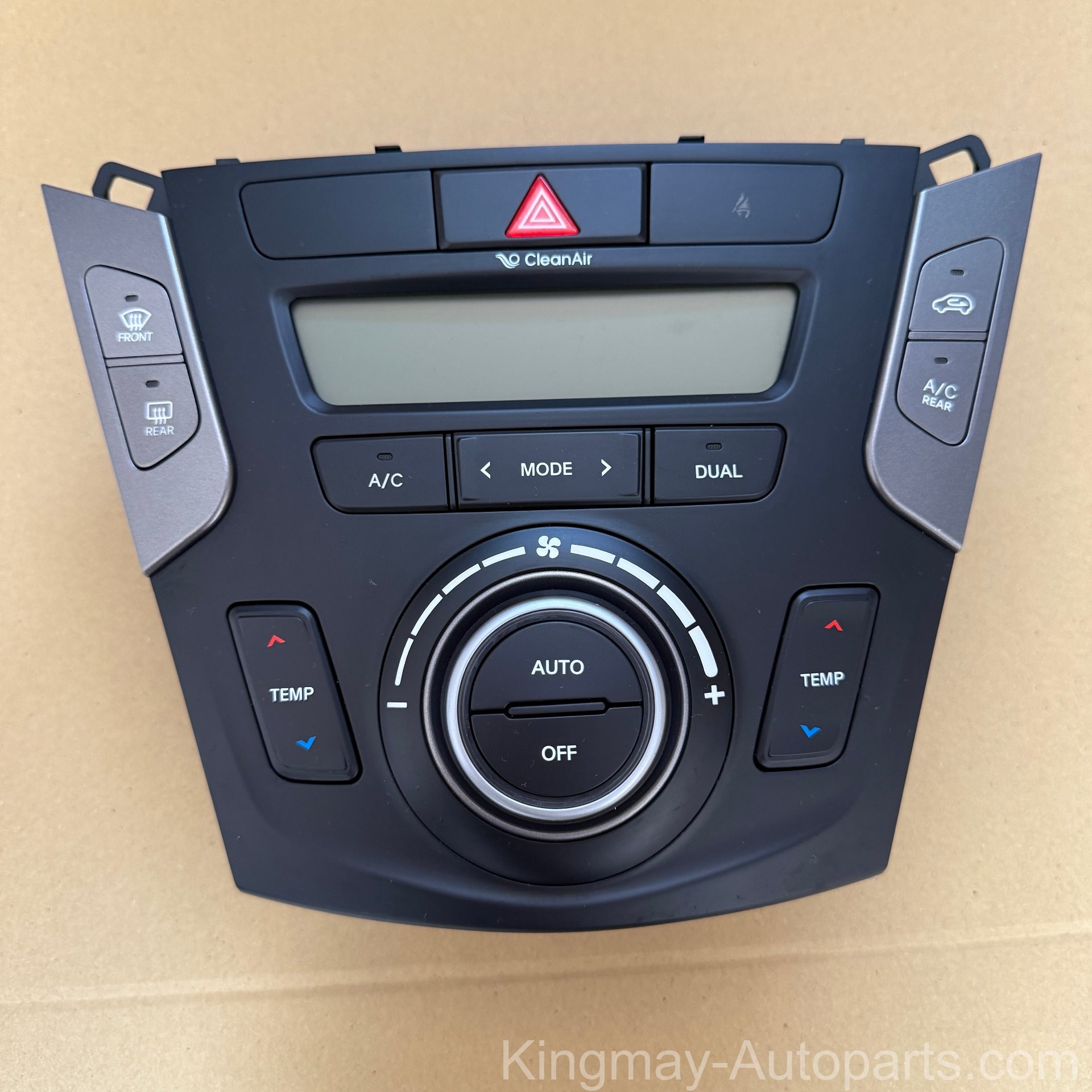
Understanding the Hyundai Santa Fe DM Climate Control Panel
The Hyundai Santa Fe DM (known in some markets as the ix45, produced from 2013 to 2016) uses a central A/C heater climate control panel mounted in the dashboard centre stack. This electronic module integrates multiple subsystems: dual-zone automatic temperature control for driver and passenger sides, A/C compressor activation logic, heater blend door control, blower motor speed regulation (5-speed), air distribution mode selection (face, bi-level, feet, defrost, feet-defrost combination), and seat heating control for both front seats. The panel also features the CleanAir ionization indicator — a distinctive Hyundai feature that signals the cabin air purification system is active.
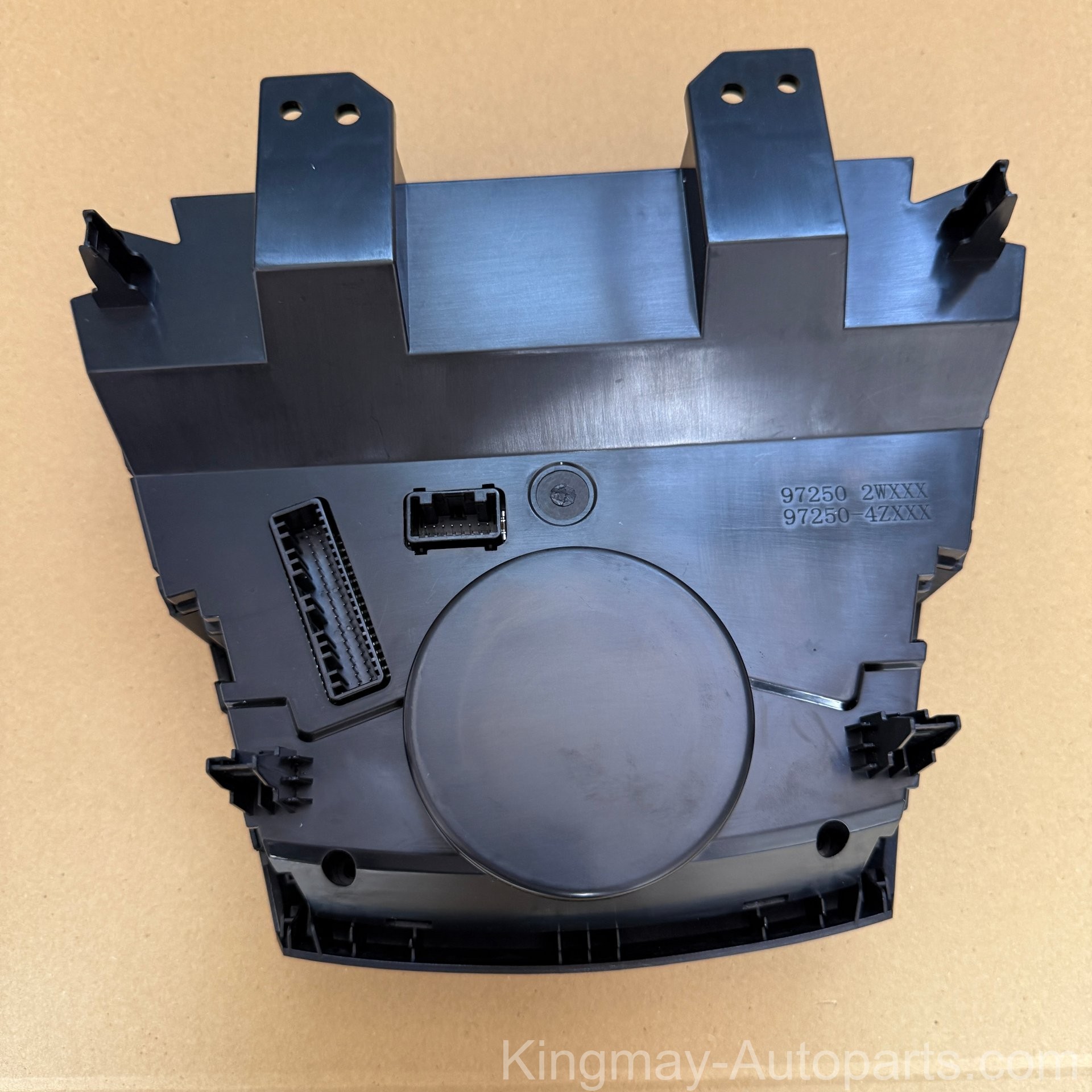
The panel communicates with the vehicle ECU via CAN-bus (Controller Area Network), meaning it is not a simple switch panel but an intelligent electronic module with embedded microcontroller firmware. This is why generic aftermarket replacements frequently fail: the CAN-bus protocol and PID (Parameter Identifier) mapping must match the exact model year and regional specification of the vehicle. The OE part numbers for this panel are 97250-2W360 and 97250-2W350 — both functionally identical, differing primarily in minor regional firmware calibrations.
In the Middle East market — UAE, Saudi Arabia, Qatar, Kuwait, Oman, Jordan, Iraq — the Santa Fe DM remains one of the most common mid-size SUVs on the road. Hyundai sold these vehicles in large volumes across the Gulf Cooperation Council (GCC) region, and with many units now 10-13 years old, climate control panel failures have become a high-frequency repair item for workshops and parts distributors.
Top 6 Common Failure Symptoms of the Santa Fe Climate Control Panel
Based on repair volume data from workshops across the Middle East, here are the six most commonly reported failure modes for the Hyundai Santa Fe DM climate control panel:
| # | Symptom | Likely Cause | Frequency |
|---|---|---|---|
| 1 | Buttons stop responding — pressing A/C, AUTO, or mode buttons produces no reaction | Tactile switch contact oxidation/wear; carbon track degradation on PCB after 8-10 years of use | Very High (40% of cases) |
| 2 | Backlight fails partially or entirely — LCD display dims, button illumination flickers or dies | LED driver IC degradation; solder joint fatigue on backlight circuit (thermal cycling damage) | High (25% of cases) |
| 3 | Fan speed stuck at one level — blower runs only on maximum or minimum regardless of speed setting | Rotary encoder detent failure; resistor network damage from moisture ingress | Medium (15% of cases) |
| 4 | Temperature display shows incorrect readings — panel displays 35C when cabin is actually cold | Infrared temperature sensor calibration drift; sensor lens contamination | Medium (10% of cases) |
| 5 | Air distribution mode stuck on one position — cannot change between face, feet, defrost modes | Mode selector switch failure; CAN-bus command not reaching HVAC actuator | Low-Medium (7% of cases) |
| 6 | Complete panel dead — no display, no backlight, no response from any control | Main power supply failure; voltage regulator IC blown; in extreme cases, PCB corrosion from prolonged high-humidity exposure | Low (3% of cases) |
OE Part Numbers: 97250-2W360 vs 97250-2W350
Hyundai assigned two OE part numbers to the Santa Fe DM climate control panel, and the difference between them is a common point of confusion for parts buyers:
| Specification | 97250-2W360 | 97250-2W350 |
|---|---|---|
| Fitting Period | 2013-2016 Santa Fe DM (all trims) | 2013-2016 Santa Fe DM (mid-to-high trims) |
| Dual-Zone Auto A/C | Yes, full dual-zone | Yes, full dual-zone |
| Seat Heating Control | Driver + Passenger (2-stage) | Driver + Passenger (2-stage) |
| CleanAir Ionization | Yes (LED indicator present) | Yes (LED indicator present) |
| AUTO/OFF Control | Rotary encoder with push-to-toggle | Rotary encoder with push-to-toggle |
| Backlight Colour | White/Amber mixed LED, PWM-dimmable | White/Amber mixed LED, PWM-dimmable |
| Connector Pin Count | 24-pin (2x12 pin header) | 24-pin (2x12 pin header) |
| Cross-Compatibility | Physically and electrically interchangeable with 2W350 | Physically and electrically interchangeable with 2W360 |
Practical takeaway: The two part numbers are functionally interchangeable. The 97250-2W360 is the more widely catalogued version, while 97250-2W350 appears on mid-to-high trim Santa Fe DMs in specific GCC markets. If your original panel carries either number, both replacements will work with identical functionality and no coding or reconfiguration required.
Troubleshooting Before You Replace
Ordering a replacement climate control panel is an investment — especially when sourcing from China to the Middle East with shipping lead times of 7-15 days by express or 25-35 days by consolidated sea freight. Before placing an order, eliminate these external causes that can produce identical symptoms:
- Check the HVAC blower motor resistor. If the fan speed issue is the only symptom and the display works normally, the blower resistor (located behind the glove box, Hyundai part 97179-2W000) is statistically more likely to have failed than the control panel.
- Scan for HVAC DTCs with an OBD-II scanner. A generic OBD-II scanner may not read Hyundai-specific HVAC codes, but a scan tool with Hyundai/Kia protocol support (such as Launch X431, Autel MaxiSys, or Thinkcar) can pull stored HVAC trouble codes. Codes B1241-B1245 point to temperature sensor faults; B2406 points to mode actuator failure — both are external to the control panel.
- Perform a visual inspection of the panel connector. Disconnect the battery negative terminal, remove the panel (two screws beneath the lower trim and pry gently from the bottom edge), and inspect the 24-pin connector for corrosion, bent pins, or signs of liquid ingress. A corroded connector pin can cause intermittent symptoms that mimic panel failure.
- Test with a known-good panel if available. Workshops with multiple Santa Fe DMs in their customer base can swap a panel from a functioning vehicle for a quick 5-minute verification. This is the most definitive pre-purchase diagnostic step.
Step-by-Step Replacement Procedure
Replacing the Hyundai Santa Fe climate control panel is a straightforward procedure that any qualified technician can complete in approximately 20 minutes. The replacement panel requires zero programming, zero coding, and zero configuration — it is true plug-and-play when using an OEM-grade replacement with the correct CAN-bus firmware.
- Disconnect the battery. Remove the negative (-) terminal from the battery. This is mandatory — the climate control panel receives constant 12V power even with the ignition off, and working on a powered circuit risks shorting the panel or blowing a fuse.
- Remove the dashboard centre trim bezel. Using a plastic trim removal tool, gently pry the bezel surrounding the climate control panel and the infotainment screen above it. Work from the bottom edge upward. The bezel is held by 6 metal spring clips — apply steady outward pressure, not twisting force.
- Unscrew the panel. The climate control panel is secured by four Phillips-head screws at each corner. Remove all four and set aside.
- Disconnect the 24-pin harness connector. Press the locking tab on the top of the connector and pull straight out. Do not pull by the wires — grip the connector body.
- Install the new panel. Connect the 24-pin harness to the replacement panel until the locking tab clicks audibly. Position the panel in the dashboard opening and secure with the four screws.
- Reattach the trim bezel. Align the spring clips with their corresponding slots and press the bezel firmly until all six clips snap into place.
- Reconnect the battery and test. Turn the ignition to ON (do not start the engine yet). Verify that the panel display illuminates, all buttons respond to presses, the temperature display reads a plausible value, and the fan speed control cycles through all 5 speeds. Start the engine and verify A/C compressor engagement and temperature change.
Why Middle East Climate Conditions Accelerate Panel Failures
The Middle East presents an unusually aggressive operating environment for automotive HVAC control electronics. Three factors combine to accelerate climate control panel degradation beyond what is seen in temperate markets:
- Thermal cycling amplitude: A Santa Fe DM parked outdoors in Riyadh or Dubai during July experiences cabin temperatures reaching 70 degrees C (158 degrees F) on the dashboard surface by mid-afternoon. When the A/C is turned on, the panel cools to approximately 25 degrees C within 5 minutes — a 45-degree C thermal shock. Over 10 years of daily use, this represents roughly 3,650 thermal cycles through a range that stresses solder joints, PCB traces, and plastic switch mechanisms far beyond design specifications.
- Dust and fine sand ingress: Gulf-region atmospheric dust (particulates smaller than 10 microns) penetrates even sealed electronic enclosures over time. These conductive particulates settle on PCB traces and switch contacts, gradually increasing contact resistance and eventually causing intermittent or failed switch operation. This is the primary root cause of "buttons stop responding" failures in Middle East vehicles.
- High-humidity coastal environments: In coastal cities — Dubai, Abu Dhabi, Doha, Muscat, Jeddah — the combination of 45-plus-degree C outdoor temperature, high humidity, and rapid A/C cooling creates persistent condensation on electronic surfaces inside the dashboard. Over years, this moisture exposure corrodes copper traces, oxidises connector pins, and degrades solder pad adhesion.
These environmental factors explain why replacement demand for Santa Fe climate control panels is exceptionally high in the Middle East compared to other markets. A panel that lasts 15 years in Germany or Japan may fail in 8-10 years in the Gulf. This is precisely why Kingmay developed an independently tooled OEM-grade replacement — the original Hyundai supply chain simply could not meet Middle East demand.
Where to Source OEM-Grade Replacement Panels
Kingmay Auto Parts (a division of Globalucar Group, Guangzhou, China) is currently the exclusive independent supplier of OEM-grade Hyundai Santa Fe DM climate control panels for the Middle East market. Key supply details:
- Product: Hyundai Santa Fe DM/ix45 A/C Heater Climate Control Panel, OE 97250-2W360 and 97250-2W350
- Quality: Independently tooled mold, full validation cycle completed, production quality stable
- Testing: 100% of units undergo multi-cycle function verification: tact switches, rotary encoders, LCD backlight uniformity, IR temperature sensor calibration, and CAN-bus communication handshake with ECU emulator
- Packaging: Anti-static ESD bag with custom-cut foam insert
- MOQ: 10 pieces (sample available for evaluation)
- Shipping: Express (DHL/UPS, 7-10 days to GCC) or consolidated sea freight (25-35 days)
- Private labeling: Available for volume buyers — MOQ 50 pieces for custom brand packaging
Contact: Miss UU — Kingmay Auto Parts | Email: ku@kingmay-autoparts.com | Phone/WhatsApp: +86 13302408528 | Address: Shop 7#, No.1542 Guangyuan East Road, Yuexiu District, Guangzhou, China
View Hyundai Santa Fe Climate Panel OE 97250-2W360 Product Page
View Hyundai Santa Fe Climate Panel OE 97250-2W350 Product Page
Browse All Kingmay Auto Parts — Engine, Cooling, Suspension, Electrical
Verify Part Numbers in Our OE Library
Every part covered in this guide has a matching OE number in our reference library — grouped by system with cross-references, so you can source the exact fit for Hyundai, Kia, GM Korea and more.
Related Articles

Related Products
From our Cooling System catalog — 4 products ready for export