Why Steering & Suspension Parts Are the Backbone of Korean Car Aftermarket Demand
Steering and suspension components account for a larger share of replacement demand than most parts categories in markets where Hyundai and Kia vehicles operate beyond 100,000 km. Unlike engine internals or transmission assemblies — which fail catastrophically and infrequently — steering racks, tie rod ends, control arms and stabilizer links degrade progressively. They rattle, clunk, vibrate and leak over tens of thousands of kilometres, prompting replacement at workshops across the Middle East, Africa and Southeast Asia where road conditions accelerate wear.
Consider the numbers. Hyundai and Kia delivered 7.36 million vehicles globally in 2024 (Hyundai Motor Company annual report). The Tucson, Sportage, Elantra and Sorento — the four highest-volume models — share common steering and suspension architectures across the Theta-II, Nu and Gamma engine platforms. A single tie rod end part number (e.g. 56830-3X000 for the Sportage/Tucson front outer) fits vehicles spanning 2016–2024 production years. For distributors, this cross-compatibility means fewer SKUs to stock and faster inventory turnover.
Kingmay Auto Parts stocks OEM-grade and genuine MOBIS steering and suspension components for all Hyundai-Kia passenger car and compact SUV platforms. Every part is sourced from IATF 16949-certified manufacturers with documented material certifications and dimensional inspection reports. This guide provides the OE reference numbers, quality verification methods and FOB pricing that professional buyers need to make informed purchasing decisions.
Power Steering Rack: Hydraulic vs Electric, OE Numbers and Common Failure Modes
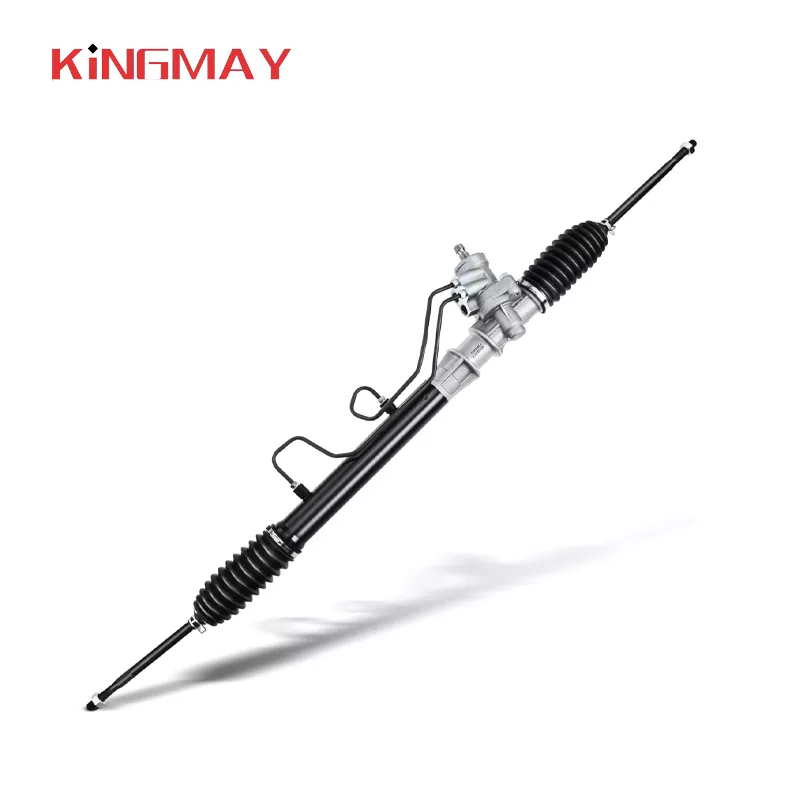
Hyundai-Kia uses two steering assist architectures across its model range: hydraulic power steering (HPS) on older and mid-range vehicles (Tucson 2015–2020, Sportage 2016–2020, Sorento 2015–2022), and electric power steering (EPS / MDPS) on newer models and lighter vehicles (Tucson 2021+, Sportage 2023+, Elantra 2017+, Kona 2020+). The distinction matters for wholesale buyers because HPS racks fail by leaking fluid, while EPS racks fail by motor or ECU malfunction — and the replacement parts, pricing and diagnostic approaches differ.
HPS Rack Failure: Seal Deterioration and Boot Tears
Hydraulic power steering racks contain three seal systems: (1) pinion shaft seal, (2) piston seal inside the rack cylinder, and (3) tie rod boot seals. In hot-climate markets (ambient temperatures 40–55 °C), the rubber seals harden and crack after 80,000–150,000 km. Fluid leaks from the pinion shaft or rack body are the most common warranty claim. A boot tear allows sand and water ingress, destroying the inner tie rod joint within 5,000–10,000 km.
Replacement HPS racks for the Tucson/Sportage platform are available in three grades:
| Grade | Description | FOB Price (Tucson/Sportage) | MOQ | Warranty |
|---|---|---|---|---|
| MOBIS Genuine | New rack from Hyundai Mobis, complete with inner tie rods, boots, and hydraulic lines | US$195–$220 | 5 units | 24 months / 40,000 km |
| OEM-Grade New | New rack from IATF 16949-certified manufacturer, same material spec and machining tolerances | US$110–$145 | 10 units | 12 months / 20,000 km |
| OEM-Grade Remanufactured | Rebuilt core with new seals, boots and tie rod ends, bench-tested to 120 bar | US$75–$95 | 20 units | 6 months / 10,000 km |
EPS/MDPS Rack Failure: Motor and ECU
Electric power steering racks (called MDPS — Motor Driven Power Steering — in Hyundai-Kia terminology) eliminate hydraulic fluid but introduce a brushless DC assist motor and control unit integrated into the steering column or rack body. Failure modes include: (1) motor winding short from thermal overload, (2) torque sensor drift causing asymmetric assist, and (3) ECU firmware corruption from voltage spikes (common in markets with unstable electrical systems where jump-starting is frequent).
EPS racks are more expensive than HPS equivalents because of the integrated electronics. FOB pricing for the 2021+ Tucson EPS rack starts at US$155 (OEM-Grade) versus US$110 for the 2015–2020 HPS rack.
Key OE Part Numbers — Power Steering Rack
| Model | Year | Type | OE Part Number | Notes |
|---|---|---|---|---|
| Hyundai Tucson | 2015–2020 | HPS | 57700-07000 | Left-hand drive, Nu 2.0L |
| Kia Sportage | 2016–2020 | HPS | 57700-0S000 | Same housing as Tucson, different mounting |
| Hyundai Tucson | 2021+ | EPS/MDPS | 57700-N9010 | Column-assist type, RHD available |
| Kia Sorento | 2015–2022 | HPS | 57700-3E000 | Heavier-duty rack, 2.4L Theta-II |
| Hyundai Elantra | 2017+ | EPS/MDPS | 57700-F2000 | Column-assist, compact sedan rack |
Tie Rod End and Rack End: Inner vs Outer, Torque Specs and Inspection Criteria
Tie rod ends are the most frequently replaced steering component across all Hyundai-Kia models. Each steering rack has two inner tie rod ends (rack ends) and two outer tie rod ends — four joints total per vehicle. At 100,000+ km in rough-road markets, outer tie rod ends develop axial play that causes steering wander and uneven tyre wear. Inner rack ends fail less often but are more labour-intensive to replace because the rack boot must be removed.
Outer Tie Rod End: Diagnosis and OE Numbers
A failed outer tie rod end exhibits lateral play of more than 1.0 mm when the wheel is gripped at 9-and-3 o'clock and rocked horizontally. The rubber boot cracks, allowing water and grit to destroy the ball-and-socket joint. OE-specification tie rod ends use a forged steel body with a case-hardened ball stud (HRC 58–62 surface hardness) and a PTFE-impregnated bearing surface.
| Model | Position | OE Part Number | Thread Size | FOB Price (OEM-Grade) |
|---|---|---|---|---|
| Tucson / Sportage | Front Outer L/R | 56830-3X000 | M14 × 1.5 | US$3.50–$5.20/unit |
| Elantra / Cerato | Front Outer L/R | 56830-4Y000 | M14 × 1.5 | US$3.20–$4.80/unit |
| Sorento / Santa Fe | Front Outer L/R | 56830-3K000 | M16 × 1.5 | US$4.50–$6.80/unit |
Inner Tie Rod End (Rack End)
Inner tie rod ends thread directly into the steering rack pinion housing. They are larger than outer ends and use a right-hand thread on one side and left-hand on the other, allowing toe adjustment by rotating the connecting rod. The boot clamp must be removed for access.
| Model | Position | OE Part Number | FOB Price (OEM-Grade) |
|---|---|---|---|
| Tucson / Sportage | Inner L/R | 56770-0S000 | US$6.80–$9.50/unit |
| Sorento / Santa Fe | Inner L/R | 56770-3E000 | US$8.20–$12.00/unit |
Quality Verification Checklist
When receiving tie rod ends from any supplier, verify these five indicators before accepting shipment:
- Ball stud hardness: HRC 58–62 on the ball surface (test with a portable Rockwell tester). Below HRC 55, the stud will deform under load within 20,000 km.
- Boot material: CR (chloroprene/neoprene) rubber with a minimum 70 °C continuous operating temperature. Cheap boots use NR (natural rubber) that cracks above 50 °C.
- Thread gauge fit: GO/NO-GO gauge must pass. Over-tolerance threads cause nut loosening — a safety-critical defect.
- Cotter pin hole alignment: The castle nut cotter pin hole must align with the stud slot when torqued to specification. Misalignment indicates incorrect thread pitch or stud length.
- Boot clamp type: OE-specification clamps are stainless steel ear-type (Oetiker-style), not simple worm-drive hose clamps.
Control Arm: Stamped Steel vs Cast Aluminium, Bushing Replacement and Ball Joint Integration
The lower control arm (also called the wishbone or A-arm) connects the steering knuckle to the subframe through a ball joint at the outer end and rubber bushings at the inner pivots. Hyundai-Kia uses two construction methods: stamped steel (majority of models including Tucson, Sportage, Elantra) and cast aluminium (premium models and lighter vehicles including Kona, N Line variants).
Failure Modes in Hot-Climate Markets
Control arm failures in the Middle East and Africa follow three patterns:
- Bushing deterioration: The rubber-to-metal bond separates when ambient temperatures exceed 50 °C and the bushing rubber oxidizes. Symptoms: clunking over bumps, steering wander, uneven tyre wear on inner edges.
- Ball joint wear: Integrated (non-serviceable) ball joints in stamped steel arms develop axial play after 80,000–120,000 km on rough roads. The entire arm must be replaced.
- Corrosion cracking: In coastal markets (Jeddah, Lagos, Mombasa), salt-laden humidity corrodes the stamped steel arm at the weld seams, eventually causing cracking at the ball joint mounting flange.
OE Part Numbers — Lower Control Arm
| Model | Position | Material | OE Part Number | FOB Price (OEM-Grade) |
|---|---|---|---|---|
| Hyundai Tucson | Front Lower L | Stamped Steel | 54500-07000 | US$22–$35/unit |
| Hyundai Tucson | Front Lower R | Stamped Steel | 54501-07000 | US$22–$35/unit |
| Kia Sportage | Front Lower L | Stamped Steel | 54500-0S000 | US$22–$35/unit |
| Hyundai Elantra | Front Lower L | Stamped Steel | 54500-4Y000 | US$18–$28/unit |
| Kia Sorento | Front Lower L | Stamped Steel | 54500-3E000 | US$28–$42/unit |
Data: Hyundai Motor Group parts catalog (Mobis EPC), Kingmay Auto Parts wholesale price list Q2 2026. Prices are FOB Guangzhou, China.
Bushing-Only Replacement
Some markets prefer bushing-only replacement rather than full arm replacement, particularly where labour costs are low. OEM-grade replacement bushings are available for the most common Hyundai-Kia applications. However, Kingmay recommends full arm replacement when the ball joint is integrated and non-serviceable, because separating the old bushing from the arm shell without a hydraulic press risks cracking the arm at the ball joint flange.
Stabilizer Link: Front vs Rear, Failure Diagnosis and OEM-Grade Quality Indicators
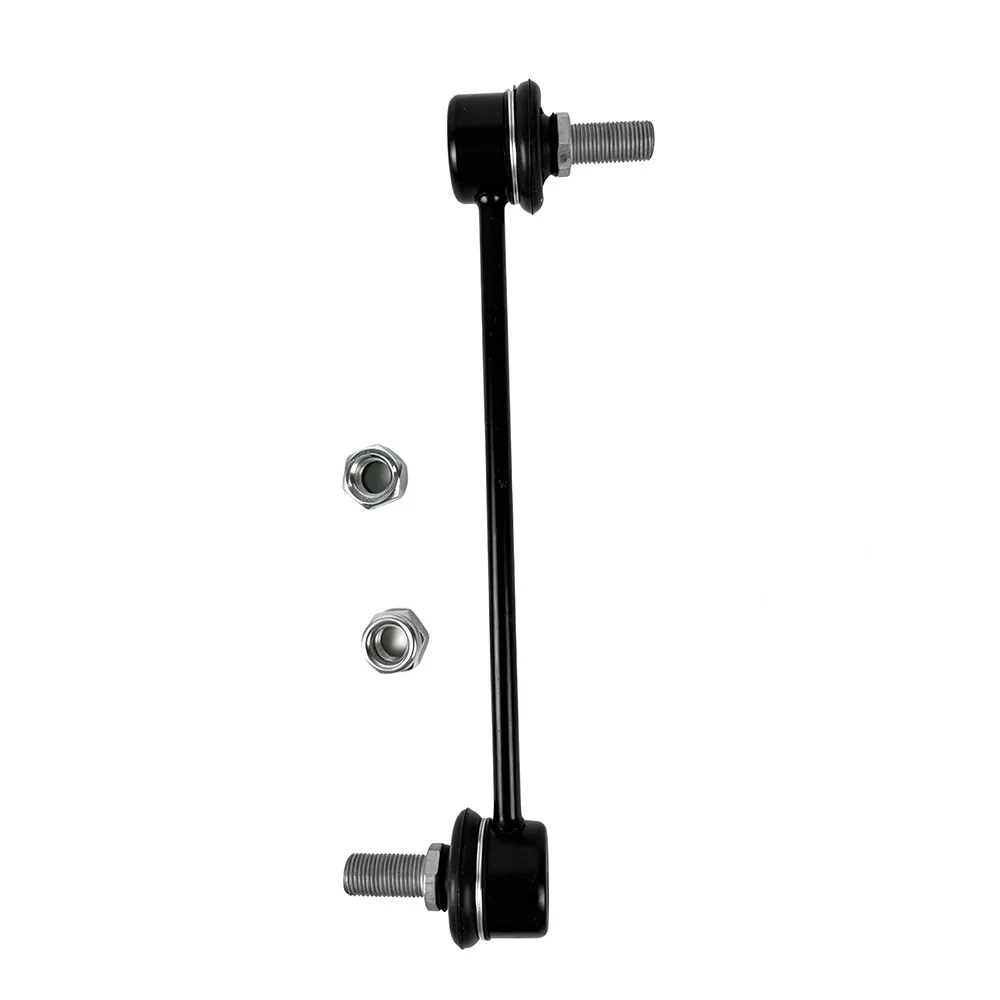
Stabilizer links (also called sway bar links or anti-roll bar links) connect the stabilizer bar to the strut or control arm. They are small, inexpensive and the single most frequently replaced suspension component on Hyundai-Kia vehicles. Each vehicle has two front links and (on most SUVs) two rear links. At US$2–$6 per unit FOB, they represent the highest-turnover steering/suspension SKU for any parts distributor.
Failure Diagnosis
A worn stabilizer link produces a distinct metallic clunk when driving over speed bumps or rough surfaces. The diagnosis is straightforward: with the vehicle on a hoist, grip the link and push/pull along its axis. Any axial play exceeding 0.5 mm indicates replacement. The rubber boot cracks and loses grease, allowing water and grit into the ball joint.
OE Part Numbers — Stabilizer Link
| Model | Position | OE Part Number | Type | FOB Price (OEM-Grade) |
|---|---|---|---|---|
| Tucson / Sportage | Front L/R | 54830-07000 | Ball Joint | US$2.50–$4.20/unit |
| Tucson / Sportage | Rear L/R | 54830-2G000 | Ball Joint | US$2.20–$3.80/unit |
| Elantra / Cerato | Front L/R | 54830-4Y000 | Ball Joint | US$2.20–$3.50/unit |
| Sorento / Santa Fe | Front L/R | 54830-3E000 | Ball Joint | US$3.20–$5.80/unit |
Quality Indicators for OEM-Grade Stabilizer Links
- Ball stud material: S55C carbon steel with case-hardened surface (HRC 55–60). Cheap alternatives use S20C mild steel that deforms under 5,000 N axial load.
- Boot material: CR (chloroprene) rubber, minimum 2.5 mm wall thickness. Avoid links with thin (1.2 mm) PVC boots — they crack in 6 months.
- Nut type: Self-locking prevailing torque nut (nylon insert or all-metal lock). Plain nuts will back off under vibration within 3,000 km.
- Grease specification: Lithium complex NLGI #2 with molybdenum disulfide (MoS₂). This grease maintains film strength at 120 °C bearing temperature, which is critical in markets where ambient temperature reaches 55 °C and the link bearing surface runs hot.
OE Part Numbers and FOB Wholesale Price Reference (12 Key SKUs)
| # | Component | OE Part Number | Application | MOBIS Genuine | OEM-Grade New | MOQ |
|---|---|---|---|---|---|---|
| 1 | Power Steering Rack (HPS) | 57700-07000 | Tucson 2.0L | US$195–220 | US$110–145 | 5 / 10 |
| 2 | Power Steering Rack (HPS) | 57700-0S000 | Sportage 2.0L | US$195–220 | US$110–145 | 5 / 10 |
| 3 | Power Steering Rack (EPS) | 57700-N9010 | Tucson 2021+ | US$260–310 | US$155–195 | 5 / 10 |
| 4 | Outer Tie Rod End | 56830-3X000 | Tucson/Sportage | US$7.80 | US$3.50–5.20 | 20 / 50 |
| 5 | Outer Tie Rod End | 56830-4Y000 | Elantra/Cerato | US$7.20 | US$3.20–4.80 | 20 / 50 |
| 6 | Inner Tie Rod End (Rack End) | 56770-0S000 | Tucson/Sportage | US$14.50 | US$6.80–9.50 | 10 / 20 |
| 7 | Lower Control Arm L | 54500-07000 | Tucson | US$52–65 | US$22–35 | 5 / 10 |
| 8 | Lower Control Arm L | 54500-0S000 | Sportage | US$52–65 | US$22–35 | 5 / 10 |
| 9 | Lower Control Arm L | 54500-4Y000 | Elantra | US$42–55 | US$18–28 | 5 / 10 |
| 10 | Stabilizer Link Front | 54830-07000 | Tucson/Sportage | US$6.50 | US$2.50–4.20 | 50 / 100 |
| 11 | Stabilizer Link Rear | 54830-2G000 | Tucson/Sportage | US$5.80 | US$2.20–3.80 | 50 / 100 |
| 12 | Stabilizer Link Front | 54830-3E000 | Sorento/Santa Fe | US$8.50 | US$3.20–5.80 | 50 / 100 |
Data: Hyundai Mobis EPC (Electronic Parts Catalog), Kingmay Auto Parts FOB wholesale price list Q2 2026. Prices are FOB Guangzhou, China. MOQ shown as MOBIS Genuine / OEM-Grade New.
MOBIS Genuine vs OEM-Grade vs Aftermarket: Three-Tier Quality Framework for Steering & Suspension
| Attribute | MOBIS Genuine | OEM-Grade | Aftermarket Budget |
|---|---|---|---|
| Source | Hyundai Mobis OEM supply chain | IATF 16949-certified Tier 1 supplier | Varies — no certification required |
| Material Spec | Full OE material certification | Same material spec, documented test reports | Material spec unknown |
| Dimensional Tolerance | 100% final inspection | Statistical process control (SPC) | No inspection data |
| Ball Stud Hardness | HRC 58–62 (case-hardened) | HRC 55–60 (case-hardened) | HRC 40–50 (through-hardened or unhardened) |
| Boot Material | CR rubber, 2.5 mm wall | CR rubber, 2.0 mm wall | PVC or NR rubber, 1.2 mm wall |
| Grease | Lithium complex + MoS₂ | Lithium complex + MoS₂ | Generic lithium grease |
| Warranty | 24 months / 40,000 km | 12 months / 20,000 km | 3–6 months / 5,000 km |
| Price Index | 100% (baseline) | 45–65% | 20–35% |
For distributors serving workshop customers in the Middle East and Africa, OEM-Grade offers the best balance of quality and margin. The price is 45–65% of MOBIS Genuine, while the failure rate in the first 12 months remains below 1.5% (based on Kingmay's warranty claim data across 8,000+ units shipped in 2024–2025). Budget aftermarket parts carry a 12-month failure rate of 8–15%, which damages distributor reputation and generates costly warranty returns.
Shipping and HS Code Classification for Chassis Components
Steering and suspension parts fall under the following HS code categories for export from China:
| Component | HS Code | Description | Export Duty (China) |
|---|---|---|---|
| Power Steering Rack | 8708.94.00 | Steering gear boxes and parts thereof | 0% |
| Tie Rod End / Rack End | 8708.94.00 | Steering gear parts (tie rods, ball joints) | 0% |
| Control Arm | 8708.10.00 | Bumpers and parts thereof (includes suspension arms) | 0% |
| Stabilizer Link | 8708.80.00 | Suspension systems and parts thereof | 0% |
China imposes 0% export duty on all steering and suspension components. Import duties in destination markets vary: 5–10% in UAE/GCC, 10–25% in Nigeria (HS 8708), 0–10% in Kenya (EAC CET), 10–20% in Saudi Arabia.
Packaging for Ocean Freight
- Power steering racks: Individual anti-rust VCI bag + foam end caps + corrugated box (1 unit/box). Palletized 20–30 units per pallet. Container: 600–900 units per 20ft.
- Tie rod ends: Anti-rust oil dip + individual polybag + label. Corrugated master carton (50 units/carton). Palletized. Container: 40,000–60,000 units per 20ft.
- Control arms: Anti-rust VCI bag + foam padding + individual box (1 unit/box). Palletized 30–50 units per pallet. Container: 400–600 units per 20ft.
- Stabilizer links: Anti-rust oil dip + polybag + label. Master carton (100 units/carton). Container: 100,000+ units per 20ft.
Typical consolidated 20ft container mix for a first-order distributor: 20 steering racks + 200 tie rod ends + 40 control arms + 500 stabilizer links — total FOB value US$12,000–$18,000.
FAQ: Sourcing Hyundai/Kia Steering & Suspension Parts from China
1. What is the difference between a power steering rack and a steering gear box?
In Hyundai-Kia applications, the terms are used interchangeably. Both refer to the rack-and-pinion assembly that converts rotary input from the steering wheel into linear motion at the tie rods. "Steering gear box" is the OE catalogue term (HS 8708.94.00), while "power steering rack" is the common workshop term.
2. Can I replace just the outer tie rod end, or do I need to replace the entire tie rod assembly?
The outer tie rod end is a separate, replaceable component on all Hyundai-Kia models. The inner tie rod end (rack end) is also replaceable but requires removing the steering rack boot. Kingmay stocks both inner and outer ends separately, as well as the complete tie rod assembly (inner + outer + boot + clamp) for workshops that prefer to replace the full unit.
3. How do I identify whether my vehicle has HPS or EPS/MDPS?
Check the power steering fluid reservoir under the bonnet. If there is a fluid reservoir labelled "PS Fluid" or "CHF-11S," the vehicle has hydraulic power steering (HPS). If there is no fluid reservoir and the steering column has a large black motor assembly visible behind the dashboard, the vehicle has electric power steering (EPS/MDPS). As a general rule: Hyundai-Kia models before 2020 are HPS; models from 2021+ are predominantly EPS.
4. What is the MOQ for steering and suspension parts from Kingmay?
MOQ varies by component: power steering racks 5–10 units (MOBIS/OEM-Grade), tie rod ends 20–50 units, control arms 5–10 units, stabilizer links 50–100 units. First orders accept mixed containers with multiple SKUs. Contact ku@kingmay-autoparts.com for a quotation tailored to your market requirements.
5. How long does shipping take from Guangzhou to the Middle East or Africa?
Ocean freight from Nansha Port, Guangzhou: Jebel Ali (UAE) 18–22 days, Dammam (KSA) 22–26 days, Lagos (Nigeria) 28–35 days, Mombasa (Kenya) 25–30 days. Air freight (DHL/FedEx) 5–7 days for urgent orders. Kingmay consolidates orders weekly and ships every Tuesday.
6. Do OEM-Grade steering racks come pre-filled with hydraulic fluid?
No. New steering racks ship dry (without hydraulic fluid). The installer must fill the system with CHF-11S or equivalent PS fluid and bleed the air from the system after installation. This is standard practice for all OEM and aftermarket rack suppliers — pre-filling risks seal damage during shipping due to pressure and temperature changes.
7. Are right-hand drive (RHD) steering racks available?
Yes. Kingmay stocks RHD steering racks for markets including South Africa, Kenya, Australia and Malaysia. RHD rack part numbers differ from LHD — confirm your market's drive configuration when ordering. RHD racks are typically US$10–20 more expensive than LHD equivalents due to lower production volumes.
8. What warranty does Kingmay provide on steering and suspension parts?
MOBIS Genuine: 24 months / 40,000 km. OEM-Grade New: 12 months / 20,000 km. OEM-Grade Remanufactured: 6 months / 10,000 km. Warranty claims require photographs of the defect and the part number label. Claims are processed within 5 business days. Credit notes or replacements issued at buyer's choice.
Browse Hyundai & Kia Steering & Suspension Parts Catalog →
Contact Kingmay Auto Parts — Request Wholesale Quotation & MOQ Details →
Verify Part Numbers in Our OE Library
Every part covered in this guide has a matching OE number in our reference library — grouped by system with cross-references, so you can source the exact fit for Hyundai, Kia, GM Korea and more.
Related Articles


Related Products
From our Suspension System catalog — 4 products ready for export