Why Hyundai/Kia Brake Pads Are a High-Demand Category
Walk through any spare parts market in Riyadh, Jeddah, Dubai, or Lagos and one brand dominates the shelves more than most people realise: Hyundai and Kia. Over the past decade, Korean vehicles have quietly overtaken Japanese brands in several key Middle Eastern and African markets. In Saudi Arabia alone, Hyundai sold over 68,000 vehicles in 2025 — second only to Toyota — while Kia added another 45,000+ units. In the UAE, the Hyundai Tucson and Kia Sportage are consistently among the top five best-selling SUVs. Across North and West Africa, used Hyundai Elantra and Kia Rio imports from the UAE and Korea have surged, creating a massive — and growing — aftermarket for replacement parts.
And the single most frequently replaced part on any vehicle? Brake pads.
Brake pads are a consumable: every Hyundai and Kia on the road needs a new set every 30,000–50,000 km. In stop-start city traffic — Riyadh's King Fahd Road at 5 PM, Lagos's Third Mainland Bridge at rush hour, Dubai's Sheikh Zayed Road during the morning commute — wear rates are up to 30% higher. A fleet of 50 Hyundai Elantra taxis in Jeddah, each running 80,000 km per year, will go through approximately 80–130 sets of brake pads annually. That is not a one-time order. That is a recurring revenue stream.
Chinese manufacturers are uniquely positioned to serve this demand. A set of genuine Hyundai Mobis front brake pads for a Tucson retails at US $85–120 in Gulf markets and US $60–90 in Africa. A functionally equivalent set from an IATF 16949-certified Chinese supplier ships at US $8–14 FOB Guangzhou. Even after freight, import duty (5% in KSA, 10% in UAE, 10–25% in most African countries), and a retail margin of 50–70%, the Chinese-sourced pad reaches the end customer at 40–55% of the OEM price. For a taxi fleet operator or a neighbourhood repair shop, the annual savings are measured in thousands of dollars.
This guide is built for the importer, wholesaler, and parts dealer who wants to move beyond generic "brake pads for all cars" sourcing and build a focused, profitable Hyundai/Kia brake pad inventory. Every OE number, price benchmark, and quality tip below comes from real-world purchase data across Kingmay Auto Parts' buyer network in the Middle East and Africa.
OEM (Hyundai Mobis) vs Aftermarket: The Real Cost Breakdown
Let us cut through the marketing language. When a Hyundai Tucson owner needs new front brake pads, they face three options at the parts counter:
| Option | Source | Retail Price (KSA/UAE) | Retail Price (Africa) | Margin for Dealer | Customer Perception |
|---|---|---|---|---|---|
| Genuine Hyundai Mobis | Toyota/Hyundai dealership network | US $85–120 | US $60–90 | 15–25% (dealer net price is high) | "Factory quality, peace of mind" |
| IATF 16949 Aftermarket | Chinese factory, quality-grade | US $35–55 | US $28–45 | 50–70% | "Same performance, half the price" |
| Budget Aftermarket | Low-cost factory, no certification | US $15–25 | US $10–20 | 60–80% | "Cheap, but will it stop the car?" |
The sweet spot for importers is the IATF 16949 tier. Here is the unit economics, using a Hyundai Tucson front brake pad set (OE 58101-D7A50) as a real example:
- FOB Guangzhou: US $10.50 per set (MOQ 100 sets)
- Sea freight to Jeddah: approximately US $0.30 per set (consolidated LCL, 1,000 sets per pallet)
- Saudi import duty (5% of CIF): approximately US $0.54 per set
- SASO certification & clearing: approximately US $0.60 per set (amortised across shipment)
- Landed cost Jeddah: approximately US $11.94 per set
- Wholesale price to repair shops: US $24–28 per set
- Retail price to end customer: US $38–48 per set
At 50 sets sold per month — a realistic volume for a mid-sized parts shop in Riyadh or Jeddah — that one SKU alone generates US $600–850 in monthly gross profit. Multiply across Tucson, Sportage, Elantra, and Seltos applications, and brake pads become one of the highest-margin, fastest-turning categories in the shop.
Top-Selling Hyundai/Kia Brake Pad OE Cross-References
Below are the Hyundai and Kia brake pad OE numbers that generate the highest inquiry volume from Kingmay's Middle Eastern and African buyers. These are the SKUs to stock first — they cover the four best-selling Korean vehicle models across all target markets.
| Vehicle | Position | Hyundai/Kia OE Number | Aftermarket Cross-Ref | Pad Material | FOB Guangzhou (Q2 2026) | MOQ |
|---|---|---|---|---|---|---|
| Hyundai Tucson (2015–2024) | Front | 58101-D7A50 | D1074-8512 | Ceramic / Semi-Met | US $8.50–14.00/set | 100 sets |
| Hyundai Tucson (2015–2024) | Rear | 58302-D7A50 | D1075-8513 | Ceramic / Semi-Met | US $6.50–10.00/set | 100 sets |
| Kia Sportage (2016–2024) | Front | 58101-D7A50 | D1074-8512 | Ceramic / Semi-Met | US $8.50–14.00/set | 100 sets |
| Kia Sportage (2016–2024) | Rear | 58302-D7A50 | D1075-8513 | Ceramic / Semi-Met | US $6.50–10.00/set | 100 sets |
| Hyundai Elantra (2016–2023) | Front | 58101-F2A50 | D1462-8749 | Ceramic | US $7.00–11.00/set | 100 sets |
| Hyundai Elantra (2016–2023) | Rear | 58302-F2A10 | D1463-8750 | Ceramic | US $5.50–8.50/set | 100 sets |
| Kia Seltos (2019–2024) | Front | 58101-Q0A00 | D1825-9120 | Ceramic | US $7.50–12.00/set | 100 sets |
| Kia Seltos (2019–2024) | Rear | 58302-Q0A00 | D1826-9121 | Ceramic | US $5.50–9.00/set | 100 sets |
Ceramic vs Semi-Metallic: Which Material Wins for Your Market?

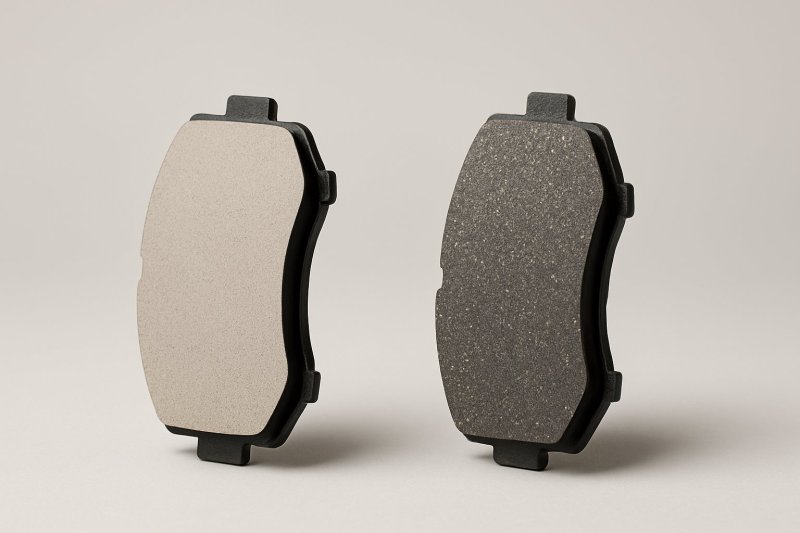
Ceramic brake pads: quiet, low dust, longer rotor life.
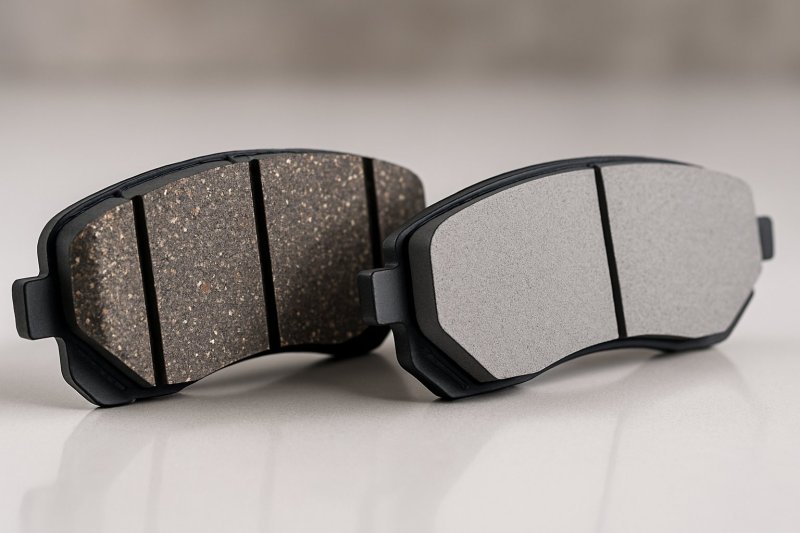
Semi-metallic brake pads: strong bite, heat-tolerant, cost-effective.
The single most common question from brake pad buyers is: "Should I stock ceramic or semi-metallic?" The answer depends entirely on your end customer — and too many importers get it wrong by stocking what their factory recommends rather than what their market demands.
| Factor | Ceramic | Semi-Metallic |
|---|---|---|
| Noise | Quiet — the quietest option available. Almost no squeal under normal conditions. | Moderate — slight squeal possible, especially when cold or wet. Acceptable in markets where noise is not a primary concern. |
| Dust | Very low — wheels stay cleaner longer. Important for premium SUV owners in the UAE. | Higher — visible brake dust on wheels within 2–3 days. Not a concern for fleet and taxi operators who wash vehicles weekly. |
| Heat Performance | Good up to 400°C. Fading can occur above 450°C in sustained heavy braking — rare in normal driving. | Excellent up to 550°C. Maintains friction coefficient in extreme heat — critical for Saudi summer driving when road surface temperatures exceed 65°C. |
| Rotor Wear | Low — ceramic compounds are gentler on brake rotors, extending rotor replacement interval by 20–30%. | Moderate — metallic content accelerates rotor wear slightly. Rotors may need replacement every second pad change rather than every third. |
| Cold Bite | Moderate — requires 1–2 stops to reach optimal friction at low temperatures. | Strong — immediate braking response from the first application. Preferred by drivers who value pedal feel. |
| Price (FOB China) | US $9–14/set (front, passenger car) | US $7–11/set (front, passenger car) |
| Best Market Fit | UAE, Qatar, Kuwait — premium-conscious markets where low dust and quiet operation justify the premium price. | Saudi Arabia, Africa — value-driven markets where heat tolerance and lower unit cost are the dominant purchasing criteria. |
Practical stocking advice: Stock both materials, but weight them by market. A dealer in Dubai should carry 70% ceramic / 30% semi-metallic — their customers own newer vehicles and care about wheel cleanliness. A dealer in Lagos or Nairobi should carry 80% semi-metallic / 20% ceramic — their customers prioritise price, durability, and heat performance on rough roads. A dealer in Riyadh or Jeddah should split approximately 50/50 — the taxi fleets want semi-metallic, but private Tucson and Sportage owners increasingly demand ceramic.
How to Verify Brake Pad Quality Before Ordering from China
The price advantage of Chinese brake pads evaporates the moment a pad fails — and brake failure is not a minor inconvenience. It is a safety event that costs the customer relationship, the replacement order, the return shipping, and the word-of-mouth reputation damage. At Kingmay Auto Parts, brake pad defect rates are maintained below 1.8% through a verification process that any importer can replicate:
- Request the ECE R90 certification: ECE R90 is the UN regulation governing aftermarket brake pads sold in the EU, UAE, and increasingly in Saudi Arabia (SASO now references ECE R90 in its brake component standards). A supplier who holds ECE R90 certification has passed third-party testing for friction coefficient consistency, shear strength, compressibility, and high-temperature performance. Ask for the certificate number — you can verify it on the issuing body's database. Note: ECE R90 is not required for African imports, but it is the strongest available quality signal regardless of destination market.
- Request a friction material composition report: Brake pads contain 10–20 different materials — ceramic fibres, metallic powders, friction modifiers, fillers, and binding resins. The composition determines everything about pad performance. A reputable supplier will share a material data sheet listing the key component percentages (copper content, steel fibre content, ceramic fibre content, resin percentage). If the supplier refuses to share composition data, they are likely using inconsistent raw material sourcing — a red flag for batch-to-batch variability.
- Check the backing plate and shim quality: This is the fastest visual quality check. A quality brake pad has a precision-stamped steel backing plate with clean edges, uniform paint/coating, and a properly fitted rubber-steel multi-layer shim (the anti-noise component attached to the back of the pad). Budget pads skip the shim entirely or use a single-layer adhesive foam that degrades within months. If you can peel the shim off with your fingernail, the pad will squeal within 5,000 km.
- Request a pre-shipment inspection report: For orders over US $3,000, engage a third-party inspector (SGS, Bureau Veritas, or AsiaInspection) to sample 5–10% of units and check: dimensional accuracy against the OE specification (±0.3 mm tolerance), friction material thickness (minimum 8 mm for passenger car front pads), shim adhesion, and packaging integrity. Inspection cost: US $280–350 per man-day — approximately 1–2% of a US $20,000 order.
- Order samples and test them on a vehicle in your market: Before committing to a container, order 5–10 sample sets for the most common application. Install them on a local vehicle — your own car, a friend's car, or a trusted mechanic's test vehicle. Drive 500 km and check for noise, dust level, pedal feel, and rotor wear. The US $150–200 investment in sample testing can prevent a US $15,000 container of pads that squeal or fade.
Shipping Brake Pads: Costs, Packaging & Lead Times
Brake pads are one of the most logistics-friendly auto parts categories — they are compact, stackable, non-fragile, and not subject to hazardous material restrictions. This makes them an ideal category for importers new to Chinese sourcing.
Packaging matters more than most importers realise. Brake pads shipped loose in bulk (wrapped in paper, stacked in a carton) arrive with friction material chipping at the edges — a cosmetic defect that makes the product look cheap even if performance is unaffected. The standard for professional importers is individual boxed sets: each set of four pads in a printed colour box with the OE number, vehicle application, and material type clearly marked on the label. Boxed packaging adds approximately US $0.50–1.00 per set to FOB cost but increases perceived value by far more — a boxed pad set sells for US $8–15 more at retail than a loose-wrapped pad.
| Route | Transit Time | LCL Cost (per CBM) | Pads per CBM | Freight Cost per Set |
|---|---|---|---|---|
| Guangzhou → Jeddah (KSA) | 16–22 days | US $85–120 | ~1,200 boxed sets | approximatel $0.07–0.10 |
| Guangzhou → Dubai (UAE) | 14–18 days | US $75–100 | ~1,200 boxed sets | approximatel $0.06–0.08 |
| Guangzhou → Mombasa (Kenya) | 18–25 days | US $130–180 | ~1,200 boxed sets | approximatel $0.11–0.15 |
| Guangzhou → Lagos (Nigeria) | 30–38 days | US $180–250 | ~1,200 boxed sets | approximatel $0.15–0.21 |
Key shipping insight: Brake pad freight cost per unit is so low (under US $0.25 per set to any destination) that it rarely justifies air freight. The exception is a small sample order of 20–50 sets for market testing, where air freight (3–5 days, approximately US $4–6/kg) is faster and the total freight bill remains under US $200.
FAQ
Q: Are Chinese aftermarket brake pads as safe as genuine Hyundai Mobis pads?
When sourced from ECE R90-certified, IATF 16949 manufacturers, Chinese aftermarket brake pads perform within 90–95% of the OEM friction coefficient across the full temperature range and meet the same regulatory stopping distance requirements. The critical variable is not the country of origin — it is whether the specific supplier holds and maintains these certifications. A Chinese factory with ECE R90 and IATF 16949 produces brake pads that are functionally equivalent to any European or Japanese aftermarket brand. A Chinese factory without these certifications is a gamble — regardless of how attractive the price.
Q: What is the typical lifespan difference between ceramic and semi-metallic pads?
In moderate climates with highway-biased driving, ceramic pads typically last 50,000–70,000 km while semi-metallic pads last 40,000–55,000 km — a 15–25% lifespan advantage for ceramic. However, in hot climates with heavy city traffic (the typical Middle Eastern driving profile), the gap narrows significantly: ceramic pads may last 35,000–45,000 km while semi-metallic pads last 30,000–40,000 km. The heat tolerance advantage of semi-metallic partially offsets the material wear advantage of ceramic in high-temperature environments. For fleet operators running vehicles 80,000+ km per year, the lower per-set cost of semi-metallic usually produces a lower total cost per kilometre despite the slightly shorter replacement interval.
Q: How can I tell if a Chinese brake pad supplier is legitimate versus a trading company with no factory?
Three tests: (1) Ask for a factory video showing the production line with a handwritten sign displaying today's date — a trading company cannot produce this. (2) Ask for the IATF 16949 certificate and verify the scope of certification on the IATF Global Oversight website (iatfglobaloversight.org) — the scope MUST specify "brake friction materials" or "brake pads," not just generic "auto parts." (3) Ask for the mixing room process description — brake pad manufacturing starts with precisely weighing and mixing 10–20 raw materials in an industrial mixer. A supplier who cannot describe their mixing process and quality control steps in detail is likely outsourcing production and acting as a middleman.
Q: What is the minimum order quantity for Hyundai/Kia brake pads from Kingmay?
Our standard MOQ is 100 sets per SKU (one vehicle model, one position). For importers testing a new market, we support consolidated trial orders combining 2–3 vehicle models in a single shipment — for example, 100 sets Tucson front, 100 sets Sportage front, 100 sets Elantra front, total 300 sets. A starter order of approximately US $2,500–3,500 FOB covers a balanced selection of the top six SKUs listed in this guide and fits on a single pallet for LCL shipping.
Q: Do the same brake pads fit both Hyundai and Kia models?
Yes — and this is one of the biggest advantages of specialising in Korean vehicle parts. Hyundai and Kia share platforms, engines, and brake systems extensively. The Tucson and Sportage (2015–2024) use identical front and rear brake pads (same OE numbers). The Elantra and Kia Forte/Cerato (2016–2023) share front pads. The Santa Fe and Sorento share brake systems. Stocking one SKU that covers two vehicle models halves your inventory investment while maintaining full market coverage. Always verify the specific year and engine variant — platform sharing is extensive but not universal.
Q: Can brake pads be shipped together with vehicle orders?
Yes. This is one of the most cost-effective strategies for vehicle importers adding a parts business. A 40-foot container carrying 3–4 Hyundai/Kia vehicles typically has 4–6 cubic metres of remaining space — enough for 4,500–7,000 boxed brake pad sets. The incremental freight cost is zero, because you are filling space that would otherwise ship empty. Kingmay regularly consolidates brake pad inventory with vehicle shipments for clients importing to Jeddah, Dubai, Mombasa, and Lagos. The same customs broker who clears your vehicles can handle the parts documentation — no additional brokerage relationship is needed.
Start Your Hyundai/Kia Brake Pad Inventory with Kingmay Auto Parts
Kingmay Auto Parts has supplied Hyundai and Kia brake components to wholesalers, fleet operators, and repair shops across Saudi Arabia, the UAE, Kenya, Nigeria, and Ghana since 2013. Our brake pad catalogue covers the full Hyundai/Kia passenger vehicle range — Tucson, Sportage, Elantra, Seltos, Santa Fe, Sorento, Accent, Rio, and K5/Optima — with both ceramic and semi-metallic formulations from ECE R90-certified, IATF 16949 manufacturing partners in Guangzhou and Shandong. Every shipment includes OE cross-reference documentation for customs classification and a pre-shipment quality report. FOB Guangzhou pricing. Flexible MOQ from 100 sets per SKU. Consolidated shipments with vehicle orders available.
WhatsApp Miss UU — Get a brake pad quotation →
Send us your vehicle list — we will build a custom brake pad stocking plan →
Browse our complete Hyundai/Kia parts catalogue by vehicle and system →
Verify Part Numbers in Our OE Library
Every part covered in this guide has a matching OE number in our reference library — grouped by system with cross-references, so you can source the exact fit for Hyundai, Kia, GM Korea and more.
Related Articles


Related Products
From our Auto Parts catalog — 4 export-ready products