Hyundai Kia Brake System Parts Wholesale: Ceramic vs Semi-Metallic Pads, Rotors, Calipers & Brake Hardware Sourcing Guide 2026
Published July 2, 2026 by Kingmay Auto Parts — Wholesale auto parts division of Globalucar Group, Guangzhou, China.
The brake system is the single most safety-critical component on any vehicle, and brake parts replacement generates year-round demand regardless of market conditions. For importers serving repair shops in Africa, the Middle East, and Central Asia, brake system parts represent one of the highest-velocity categories — drivers in hot climates, dusty environments, and stop-and-go traffic replace brake pads every 20,000-40,000 km.
This guide from Kingmay Auto Parts covers the five core brake system categories for Hyundai and Kia vehicles (2008-2025): brake pads (ceramic and semi-metallic), brake rotors, brake calipers, brake hoses and lines, and brake hardware (pad clips, shims, wear sensors). We provide 24 OE part numbers with FOB Guangzhou pricing, explain the ceramic vs semi-metallic selection logic for different markets, and include a full-container mix for brake-focused distributors.
1. Brake System Architecture — Hyundai & Kia
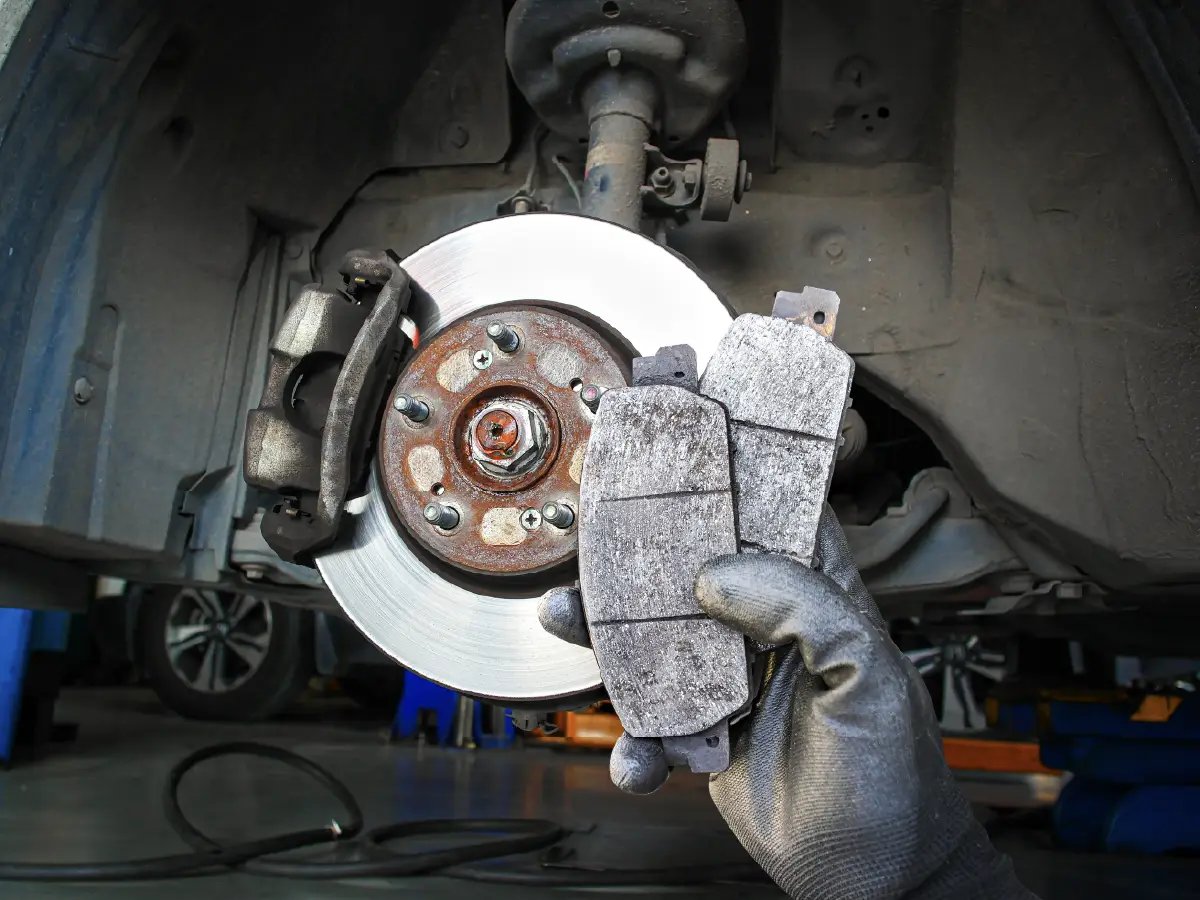
A typical Hyundai or Kia disc brake system consists of five main components:
- Brake pad set — friction material pressed against the rotor by the caliper; replaced every 20,000-50,000 km
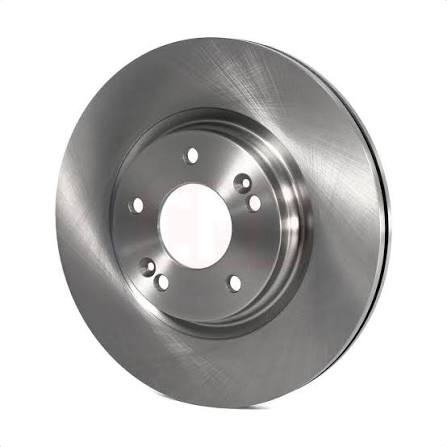
- Brake rotor (disc) — cast iron disc that the pads press against; can be resurfaced once or replaced; replaced every 60,000-100,000 km
- Brake caliper — hydraulic piston assembly that pushes the pads against the rotor; most expensive brake component
- Brake hose and steel lines — hydraulic fluid pathway from the master cylinder to the caliper
- Brake hardware — pad clips, shims, anti-squeal plates, and wear indicator sensors
For rear wheels, many Hyundai and Kia models use rear drum brakes (especially Elantra, Accent, and older Tucson). Drum brake components include wheel cylinders, return springs, adjuster mechanisms, and brake shoes. Kingmay stocks both disc and drum brake components.
2. Brake Pads — Ceramic vs Semi-Metallic: The Market Decision
ionThe most common question from buyers: should I stock ceramic pads or semi-metallic pads? The answer depends entirely on your target market's climate and driving conditions.

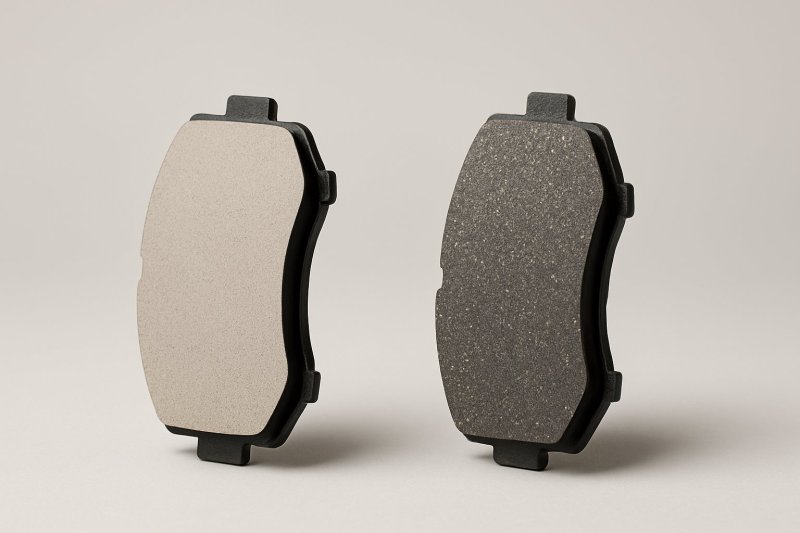
Ceramic Brake Pads
Ceramic pads use ceramic fibers and copper particles in the friction material. They were introduced by Delphi and TRW in the 1990s and have become the OE standard for most Hyundai and Kia vehicles since 2012.
Advantages:
- Low brake dust — wheels stay cleaner longer (important for alloy wheels in Gulf markets)
- Quieter braking — no brake squeal under normal conditions
- Low thermal conductivity — less heat transfer to caliper and brake fluid
- Longer rotor life — ceramic material is softer than semi-metallic, causing less rotor wear
- Consistent friction coefficient across a wide temperature range (up to 600 deg C)
Disadvantages:
- Higher cost per set — typically 30-40% more than semi-metallic
- Less effective in extreme cold initial braking (below -10 deg C) — but irrelevant for target markets
- Lower friction coefficient at very high temperatures (track use) compared to semi-metallic
Semi-Metallic Brake Pads
Semi-metallic pads use steel wool, iron powder, and copper (typically 30-60% metal content) bonded with organic resin. They are the traditional OE choice for commercial vehicles and remain popular in budget markets.
Advantages:
- Higher friction coefficient at high temperatures — better for heavy loads, towing, and mountainous terrain
- Better heat dissipation — metal content conducts heat away from the friction surface faster
- Lower cost per set — 30-40% cheaper than ceramic
- Better cold-weather braking — more effective from cold start
Disadvantages:
- Higher brake dust — leaves gray-brown dust on wheels that is harder to clean
- More noise — can produce brake squeal, especially in hot climates with thermal expansion
- More rotor wear — metal particles are harder than ceramic and accelerate rotor scoring
Market Recommendation Matrix
| Market Type | Recommended Pad Type | Reason | ||
|---|---|---|---|---|
| Gulf Coast (UAE, Saudi Arabia coastal) | Ceramic | Salt air + alloy wheels; low dust wins | ||
| Inland Middle East (inland Saudi, Jordan) | Semi-Metallic | Extreme heat + heavy loads; semi-metallic handles heat better | ||
| West Africa (Nigeria, Ghana) | Semi-Metallic | Stop-and-go traffic + overloaded vehicles; durability over comfort | ||
| East Africa (Kenya, Tanzania) | Semi-Metallic | Hilly terrain + matatu (shared taxi) overload conditions | ||
| Central Asia (Kazakhstan, Uzbekistan) | Semi-Metallic | Cold winters (-20 deg C) + heavy winter loading; semi-metallic cold bite is better | ||
| South America (Peru, Colombia) | Ceramic | Urban driving focus; customer preference for quiet, clean braking |
| Model | OE Part Number | Position | Type | FOB Guangzhou |
|---|---|---|---|---|
| Hyundai Elantra MD | 58101-3RAH0 | Front | Ceramic | $18.50 |
| Hyundai Elantra AD | 58101-F2000 | Front | Ceramic | $19.20 |
| Hyundai Tucson TL | 58101-D4000 | Front | Semi-Metallic | $22.80 |
| Hyundai Sonata LF | 58101-C1000 | Front | Ceramic | $21.50 |
| Hyundai Santa Fe DM | 58101-2W000 | Front | Semi-Metallic | $24.50 |
| Kia Sportage QL | 58101-0T000 | Front | Ceramic | $21.80 |
| Kia Sorento UM | 58101-4G000 | Front | Semi-Metallic | $26.00 |
| Kia Cerato/Forte BD | 58101-M2000 | Front | Ceramic | $17.80 |
MOQ: 10 sets per part number. Brake pad sets include 4 pads (2 front or 2 rear). HS Code: 8708.30 (brake pads, brake servo, and parts thereof). Packaging: 20 sets per carton, 8-12 kg per carton depending on model. Lead time: 5-8 working days.
 4. Brake Rotors
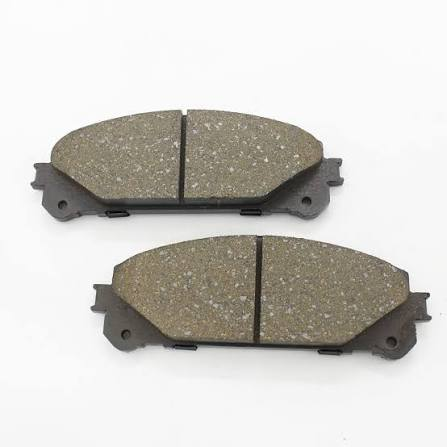
Brake rotors (brake discs) are cast iron components that rotate with the wheel hub. When brake pads are pressed against the rotor, friction converts kinetic energy into heat, slowing the vehicle. Rotors wear over time and develop hot spots, scoring, and thickness variation (DTV).

| Model | OE Part Number | Position | Type | FOB Guangzhou |
|---|---|---|---|---|
| Hyundai Elantra MD | 45210-3RAA0 | Front | Vented, 280mm | $32.00 |
| Hyundai Tucson TL | 45210-D4000 | Front | Vented, 305mm | $38.50 |
| Hyundai Sonata LF | 45210-C1000 | Front | Vented, 296mm | $35.00 |
| Hyundai Santa Fe DM | 45210-2W000 | Front | Vented, 330mm | $42.00 |
| Kia Sportage QL | 45210-0T000 | Front | Vented, 305mm | $38.00 |
| Kia Sorento UM | 45210-4G000 | Front | Vented, 340mm | $46.00 |
Minimum thickness (MT) vs Discard thickness: Always check the stamped MT value on the rotor hub before installing. Resurfacing (machining) is possible if the rotor thickness is above MT + 2mm. Below discard thickness, the rotor must be replaced — using an undersized rotor causes brake fade and reduced stopping power. MT: typically 24-28mm for most Hyundai/Kia front rotors. Packaging: 4 rotors per carton, 18-28 kg per carton. FOB: $32-46 per rotor de
5. Brake Calipers
5. Brake Calipers
The brake caliper is the most expensive single brake component. It houses the piston(s) that push the brake pads against the rotor. Calipers fail in three primary ways: seized sliding pins (most common), leaking piston seals (second most common), and seized piston (least common).
| Model | OE Part Number | Position | FOB Guangzhou |
|---|---|---|---|
| Hyundai Elantra MD | 58100-3RAA0 | Front LH | $68.00 |
| Hyundai Elantra MD | 58110-3RAA0 | Front RH | $68.00 |
| Hyundai Tucson TL | 58100-D4000 | Front LH | $82.00 |
| Hyundai Tucson TL | 58110-D4000 | Front RH | $82.00 |
| Kia Sportage QL | 58100-0T000 | Front LH | $79.00 |
| Kia Sportage QL | 58110-0T000 | Front RH | $79.00 |
Note: Brake calipers are side-specific — LH (left-hand) fits the driver side, RH (right-hand) fits the passenger side. Always confirm left/right designation by OE number, not by physical comparison. Packaging: Individual box, 3-5 kg per caliper. Lead time: 5-10 working days. Rebuild kits: Kingmay also stocks caliper seal kits, sliding pin kits, and brake dust boots for caliper rebuilding at lower cost than f
6. Brake Hardware — Often Overlooked, Critical for Performance
verlooked, Critical for PerformanceBrake hardware (pad clips, anti-squeal shims, guide sleeves, and wear sensors) is the most overlooked brake parts category. Yet worn or missing hardware is the leading cause of brake squeal, uneven pad wear, and caliper binding.
| Part | OE Part Number | FOB Guangzhou |
|---|---|---|
| Front brake pad clips (Elantra/Tucson) | 58357-3RAA0 | $1.80/set |
| Anti-squeal shim set (Elantra MD) | 58358-3RAA0 | $2.20/set |
| Brake pad wear indicator sensor (front) | 58550-3RAA0 | $5.50/pc |
| Caliper guide pin kit (front axle, 2 pins + boots) | 55970-3RAA0 | $6.80/set |
| Brake hose bracket clip (universal) | 58710-2G000 | $0.80/pc |
Kingmay recommendation: Always include brake hardware when ordering brake pad sets. A $2 clip set that prevents brake squeal is far cheaper than a customer complaint. Wear indicator sensors are mandatory in European markets (EU regulation) and recommended for all markets — when the sensor wire wears through, the dashboard brake warning light activates.
 7. Full Container Mix — Brake System Distributorll Container Mix — Brake System Distributor
| Category | Qty | Avg FOB/pc | Subtotal FOB |
|---|---|---|---|
| Front brake pad sets (Ceramic) | 200 sets | $21.00 | $4,200 |
| Front brake pad sets (Semi-Metallic) | 200 sets | $16.50 | $3,300 |
| Rear brake pad sets | 150 sets | $14.00 | $2,100 |
| Front rotors (mixed sizes) | 300 pcs | $38.00 | $11,400 |
| Rear rotors | 200 pcs | $28.00 | $5,600 |
| Brake calipers (LH+RH pairs) | 60 pairs | $75.00 | $4,500 |
| Brake hardware kits | 400 sets | $4.50 | $1,800 |
| Total | 1,510 pcs | — | $32,900 |
Sea freight from Guangzhou Nansha: Jeddah 14-18 days ($1,200-1,500), Jebel Ali 12-15 days ($1,100-1,400), Lagos 28-35 days ($1,800-2,200), Mombasa 25-30 days ($1,600-2,000). Estimated landed cost for Jebel Ali: approximately $35,500 including freight and insurance.
 8. Frequently Asked Questionszy" />
8. Frequently Asked Questions
Q: Where can I buy wholesale Hyundai and Kia brake parts from China?
Kingmay Auto Parts (Guangzhou, China) supplies wholesale brake system parts for Hyundai and Kia vehicles including ceramic and semi-metallic brake pads ($16.50-24.50/set), rotors ($32-46/pc), calipers ($68-82/pc), and brake hardware to importers in 50+ countries. Contact Miss UU at ku@kingmay-autoparts.com or +86 13302408528. MOQ is 10 sets for brake pads and 4 pcs for rotors. FOB Guangzhou pricing with 5-8 working day lead time. Shop 7#, No.1542 Guangyuan East Road, Yuexiu District, Guangzhou.
Q: What is the difference between ceramic and semi-metallic brake pads for hot climates?
For hot climate markets (Middle East, West Africa, Central Asia), semi-metallic pads are generally recommended because they dissipate heat more effectively and maintain friction coefficient at high temperatures encountered in mountainous terrain or heavy loading. Ceramic pads are recommended for Gulf coastal markets (UAE, Saudi Arabia coastal cities) where the priority is low dust and quiet braking on alloy wheels, and for South American urban markets where driving conditions are less demanding. Kingmay stocks both types — specify your market conditions when requesting a quotation at ku@kingmay-autoparts.com.
Q: How often should brake pads and rotors be replaced on Hyundai and Kia vehicles?
Brake pad replacement intervals depend on driving conditions: city driving in dusty environments (many African markets): 20,000-30,000 km; mixed urban/highway driving: 30,000-40,000 km; highway-focused driving: 40,000-50,000 km. Brake rotors typically last 2-3 brake pad change cycles (60,000-100,000 km) before requiring replacement. rotors that have been machined (resurfaced) once should be replaced at the next pad change if thickness is near the minimum. Always check the stamped minimum thickness (MT) value on the rotor hub before deciding to resurface or replace.
Q: What causes brake squeal and how do I prevent it?
Brake squeal (high-pitched noise when braking) has four common causes: (1) worn or missing brake hardware — pad clips and anti-squeal shims not replaced during pad installation is the most common cause; (2) glazed rotor surface — rotor polished smooth by contaminated or worn brake pads, causing pad material to vibrate against the rotor; (3) contaminated brake pads — oil, grease, or brake fluid on the friction surface destroys the pad compound; (4) caliper sliding pin seizure — one pad wears much faster than the other, causing uneven pressure distribution and vibration. Prevention: always replace hardware when installing new pads, use proper brake cleaner before installation, and lubricate caliper guide pins with high-temperature brake grease (not general-purpose grease).
Q: Can I mix ceramic and semi-metallic brake pads on the same axle?
No. Always install the same brake pad compound on both sides of the same axle. Mixing compounds causes uneven friction coefficients from left to right, which creates brake pull (the vehicle pulls to one side when braking), premature rotor wear on one side, and uneven braking force distribution that reduces stopping efficiency and compromises safety. If your customer wants ceramic on the front axle and semi-metallic on the rear, this is acceptable — different compounds on front vs rear is a common configuration (many performance and heavy-duty applications use this approach).
Q: What is the HS code for brake pads and rotors when importing from China?
The HS Code for brake pads is 8708.30 (brake pads, brake servos, and parts thereof). The HS Code for brake rotors is also 8708.30 (included in the same heading as brake pads). Import duty rates vary by country: UAE 5%, Saudi Arabia 5-12%, Nigeria 35%, Kenya 25%, Tanzania 25%, Uzbekistan 15-20%, Peru 0% (Peru-China FTA). Confirm the current duty rate with your customs broker before importation,
About Kingmay Auto Parts
p>About Kingmay Auto Parts
Kingmay Auto Parts is the wholesale auto parts division of Globalucar Group, based in Guangzhou, China. Established in 2013, Kingmay maintains an active catalog of 30,000+ SKUs covering Hyundai, Kia, Toyota, Nissan, and Chinese domestic brands. Our brake system inventory includes 200+ SKUs covering ceramic and semi-metallic brake pads, ventilated and solid rotors, calipers, brake hoses, and hardware for Hyundai and Kia models from 2008 to 2025.
All brake parts are sourced from IATF 16949-certified factories and undergo a 4-point pre-shipment inspection: dimensional verification (thickness, bolt pattern, hub diameter), friction material density test (for pads), visual inspection for casting defects (for rotors and calipers), and packaging verification. Kingmay is an independent wholesaler and is not affiliated with or endorsed by Hyundai Motor Company or Kia Corporation.
Contact: Miss UU (Wholesale Director, Kingmay Auto Parts) — ku@kingmay-autoparts.com, +86 13302408528. Shop 7#, No.1542 Guangyuan East Road, Yuexiu District, Guangzhou, China.
Contact Kingmay — Request Brake System Parts FOB Quotation & Stock Availability →
Find Brake Parts for Your Vehicle →
Verify Part Numbers in Our OE Library
Every part covered in this guide has a matching OE number in our reference library — grouped by system with cross-references, so you can source the exact fit for Hyundai, Kia, GM Korea and more.
Related Articles


Related Products
From our Auto Parts catalog — 4 export-ready products