Why Hyundai/Kia Brake Pads Are a Billion-Dollar Aftermarket Segment
Hyundai and Kia have built one of the largest vehicle populations outside of Toyota. As of 2025, there are an estimated 75 million Hyundai-Kia vehicles on the road globally, with particularly dense ownership in Saudi Arabia, UAE, Nigeria, Philippines, Vietnam and South Africa — all markets where Kingmay Auto Parts ships brake components every month.
Brake pads are the single highest-volume wear item in the aftermarket parts business. On a Hyundai Tucson or Kia Sportage, front brake pads typically last 40,000–55,000 km in mixed driving conditions, and as low as 25,000–35,000 km in stop-and-go Middle East city traffic or dusty African roads. A fleet operator running 20 vehicles in Riyadh will replace brake pads 2–3 times per vehicle per year. That translates to 40–60 sets annually from a single customer.
This replacement frequency, multiplied across millions of vehicles, creates a US$3.2 billion global aftermarket for Hyundai-Kia brake pads alone (Source: OICA Global Vehicle Parc Data, 2025). The keyword "aftermarket Hyundai brake pads" generates an estimated 4,500+ monthly searches, with "Hyundai Tucson brake pads" at 2,200+ and "Kia Sportage brake pads wholesale" at 1,800+. For independent distributors and repair chains, stocking Hyundai-Kia brake pads is not optional — it is a baseline requirement for serving customers.
Ceramic vs Semi-Metallic vs Low-Metallic: Which Compound Sells Best in Your Market?
The most important purchasing decision for brake pad wholesale buyers is compound formulation. The wrong compound for a given market will result in returns, warranty claims, and lost customer trust. Here is the breakdown by compound type, target market, and selling price:
| Compound | Best Markets | Pros | Cons | Wholesale FOB (per set) |
|---|---|---|---|---|
| Ceramic | UAE, Saudi Arabia (premium), Qatar, Kuwait | Very low dust, quiet operation, 50,000+ km life, rotor-friendly | Lower initial bite when cold, 20–30% more expensive, less effective in extreme heat (above 500°C) | US$11–$16/set |
| Semi-Metallic | Nigeria, Kenya, Philippines, Lebanon, Jordan | Aggressive cold bite, excellent heat dissipation (up to 650°C), best cost-performance ratio | Moderate brake dust, slight noise at low speed, rotor wear slightly faster | US$7–$11/set |
| Low-Metallic (ECE R90) | Europe, Turkey, Russia, South Africa (Euro-spec models) | ECE R90 certified, balanced performance, good heat range, meets EU import requirements | Highest dust output among the three, moderate rotor wear | US$9–$14/set |
Source: Kingmay Auto Parts B2B brake pad sales data, 2025–2026. Prices are FOB Nansha Port, China. MOQ 50 sets per SKU.
Market-specific recommendations for wholesale buyers:
- Saudi Arabia & UAE premium segment: Ceramic pads dominate because Gulf customers are highly sensitive to brake dust on alloy wheels and expect near-silent operation. Sell ceramic at 30–50% margin over semi-metallic.
- Nigeria, Kenya & West Africa: Semi-metallic is the volume leader. Road conditions are harsher, vehicles carry heavier loads, and price sensitivity is higher. Stock semi-metallic for Hyundai Accent, Elantra and Kia Rio — these are fleet vehicle staples.
- Philippines & Southeast Asia: A 60/40 split between semi-metallic (fleet/commercial) and ceramic (private owners). Jeepney and taxi fleets exclusively use semi-metallic for cost reasons.
- European importers: Low-metallic with ECE R90 marking is mandatory. Non-R90 pads cannot be sold in EU markets. Demand for Korean-brand pads is driven by Eastern European Kia/Hyundai owners who prefer aftermarket over MOBIS dealership pricing.

MOBIS Genuine vs OEM-Grade vs Budget Aftermarket: A Three-Tier Quality & Price Guide
The Hyundai-Kia brake pad supply chain is divided into three quality tiers. Wholesale buyers who understand the differences can position themselves profitably at each tier:
| Tier | Branding | Factory Standard | FOB Price Range (Front Set) | Margin Potential | Typical Buyer |
|---|---|---|---|---|---|
| Tier 1 | MOBIS / Hyundai Genuine / Kia Genuine | Hyundai-Kia OEM factory (Sangsin Brake, Mando, Hyundai Mobis) | US$28–$45/set | 15–25% | Authorized dealers, insurance repair shops, warranty service centers |
| Tier 2 | OEM-Grade (IATF 16949 factory) | IATF 16949 certified, ECE R90 compliant, same compound spec as OEM | US$9–$16/set | 30–50% | Independent wholesalers, repair chains, online resellers (eBay, Amazon) |
| Tier 3 | Budget Aftermarket | ISO 9001, basic quality control, variable compound consistency | US$4–$7/set | 50–80% | Price-driven markets, roadside mechanics, some African distributors |
Note: Tier 3 pads typically lack ECE R90 marking and may not meet original friction coefficient specifications (0.35–0.45 μ). Kingmay Auto Parts recommends Tier 2 OEM-grade as the optimal balance of quality, margin, and customer retention for wholesale distributors.
Key quality differentiators between Tier 2 and Tier 3:
- Friction material formulation: Tier 2 pads use the same copper fiber, aramid, graphite and ceramic powder ratios as the OE specification. Tier 3 pads often substitute cheaper fillers (calcium carbonate, barite) that reduce performance and increase dust.
- Backing plate: Tier 2 uses Q235 or equivalent steel plate (3.5–4.5 mm), precision-stamped with chamfered edges. Tier 3 may use 3.0 mm plate with rough edges that cause caliper binding.
- Shim and noise insulation: Tier 2 includes multi-layer rubber-coated steel shim with silicone adhesive. Tier 3 often uses single-layer plain steel with basic adhesive — a major source of brake squeal complaints.
- Scorching/bedding layer: Tier 2 pads are thermal-scorched at 600–700°C on the friction surface to pre-bed the material. This reduces the customer break-in period from 300 km to under 50 km. Tier 3 pads skip this step entirely.
Top-Selling Hyundai/Kia Brake Pad OE Part Numbers by Model (2026 Reference)
Below is the authoritative reference table for the most frequently ordered Hyundai and Kia brake pad OE numbers, organized by vehicle model and generation. These represent the top 80% of Kingmay's brake pad export volume:
| Vehicle | Generation | Position | OE Part Number | Compound | MOQ (sets) | FOB Price (per set) |
|---|---|---|---|---|---|---|
| Hyundai Tucson | TL (2015–2021) | Front | 58101-D7A10 | Ceramic / Semi-Met | 50 | US$9–$16 |
| Hyundai Tucson | TL (2015–2021) | Rear | 58302-D7A10 | Ceramic / Semi-Met | 50 | US$7–$12 |
| Hyundai Tucson | NX4 (2022–Present) | Front | 58101-N9A00 | Ceramic | 50 | US$12–$17 |
| Hyundai Elantra | AD/ADA (2016–2020) | Front | 58101-F2A10 | Semi-Met / Ceramic | 50 | US$7–$12 |
| Hyundai Elantra | CN7 (2021–Present) | Front | 58101-AAA00 | Ceramic | 50 | US$10–$15 |
| Hyundai Santa Fe | TM (2018–2023) | Front | 58101-4HA10 | Ceramic / Semi-Met | 50 | US$10–$15 |
| Hyundai Santa Fe | TM (2018–2023) | Rear | 58302-4HA10 | Ceramic / Semi-Met | 50 | US$8–$12 |
| Kia Sportage | QL (2016–2021) | Front | 58101-D7A10 | Ceramic / Semi-Met | 50 | US$9–$16 |
| Kia Sportage | QL (2016–2021) | Rear | 58302-D7A10 | Ceramic / Semi-Met | 50 | US$7–$12 |
| Kia Sportage | NQ5 (2022–Present) | Front | 58101-N9A00 | Ceramic | 50 | US$12–$17 |
| Kia Seltos | SP2 (2019–Present) | Front | 58101-Q5A10 | Ceramic / Semi-Met | 50 | US$8–$13 |
| Hyundai Accent | RB/RC (2011–2022) | Front | 58101-1RA00 | Semi-Met | 50 | US$6–$10 |
| Kia Rio | YB (2017–2023) | Front | 58101-H8A00 | Semi-Met | 50 | US$6–$9 |
Note: Tucson TL and Sportage QL share the same brake pad dimensions and OE numbers — these are the highest-volume SKUs in the entire Korean brake pad aftermarket. Always confirm vehicle VIN or build date for NX4/NQ5 generation pads, as early 2022 models may use TL/QL carryover parts.
How to Verify Brake Pad Quality: ECE R90, IATF 16949 & Physical Inspection Checklist
Buying brake pads from a Chinese supplier you have not worked with before requires a verification process. Here is the checklist Kingmay Auto Parts recommends to every wholesale buyer:
Documentation Verification
- ECE R90 certificate: Each brake pad SKU must have its own ECE R90 approval number stamped on the backing plate (format: E1 90R-02XXXX). This is mandatory for EU, Turkey, Russia, South Africa, and increasingly required by Saudi Arabian customs (SASO). Request a copy of the certificate and verify the approval number on the UNECE database.
- IATF 16949 certificate: This is the automotive-specific quality management standard. Verify the certificate number on the IATF certificate database (iatfglobaloversight.org). A valid IATF 16949 certificate means the factory has passed audits for process control, traceability, and defect prevention.
- REACH & RoHS compliance: Required for EU import. Ensures friction material does not contain prohibited substances (asbestos, lead, cadmium, hexavalent chromium).
- Test reports: Request the SAE J2522 (AK-Master) or SAE J2521 dynamometer test report showing friction coefficient (μ), hot/cold performance, and wear rate.
Physical Inspection Checklist (Pre-Shipment)
| Checkpoint | What to Look For | Red Flags |
|---|---|---|
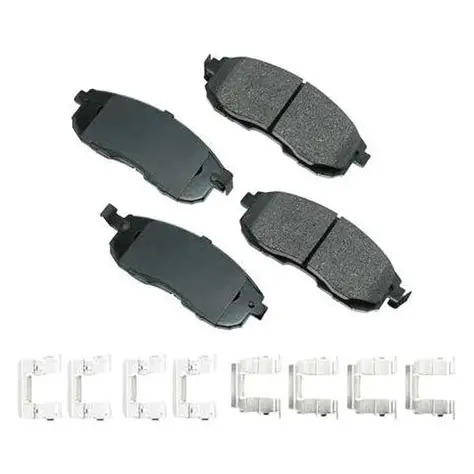
| Friction surface | Uniform color (dark gray to charcoal), smooth texture, visible scorching marks on the surface (bedding layer) | Color variation across pads, rough or pitted surface, no scorching marks (unbedded pads) |
| Chamfered edges | Clean 45° bevel along both leading and trailing edges, consistent width (3–5 mm) | Irregular chamfer angle, missing chamfer on one side, rough machine marks |
| Backing plate | Clean stamping, uniform coating (black E-coat or zinc-plated), OE number clearly stamped | Surface rust, bent plate, illegible stamping, burrs on edges |
| Shim | Multi-layer construction (rubber → steel → rubber), firmly adhered, no peeling | Single-layer shim, glue visible around edges, shim can be lifted by fingernail |
| Wear indicator | Metal wear indicator tab present (front pads), correct position (inner pad), spring tension good | Missing wear indicator, loose fit, installed on wrong pad position |
| ECE R90 marking | Approval number stamped on backing plate, legible, matches certificate | No marking, sticker instead of stamp (stickers fall off during use), different number than certificate |
| Packaging | Individual box with OE number, compound type, position (front/rear/left/right), production date, lot number | Bulk packaging without individual boxes, generic box with no OE reference, no lot traceability |
Shipping Brake Pads from China: Container Optimization, HS Code & Logistics
Brake pads are an ideal container-optimized product — compact, stackable, non-fragile, and high value per cubic meter. Here is the logistics breakdown:
| Parameter | Detail |
|---|---|
| HS Code | 8708.30.10 (Brake pads, mounted — for motor vehicles) |
| Packaging | Individual box (180 × 80 × 60 mm per set) → Master carton of 20 sets → Pallet (48 master cartons = 960 sets/pallet) |
| 20GP Container | ~1,200–1,500 sets (10 pallets), gross weight ~2,800–3,500 kg |
| 40HQ Container | ~3,000–3,500 sets (22 pallets), gross weight ~7,000–8,200 kg |
| Air Freight (DHL/FedEx) | Sample orders: 5–10 sets, US$45–$80 shipping cost, 5–7 days delivery |
| Sea Freight to Jeddah | 20GP: ~US$850–$1,200, transit 18–25 days from Nansha Port |
| Sea Freight to Dubai | 20GP: ~US$750–$1,100, transit 16–22 days from Nansha Port |
| Sea Freight to Lagos | 20GP: ~US$1,800–$2,500, transit 30–42 days from Nansha Port |
| Sea Freight to Manila | 20GP: ~US$550–$850, transit 7–12 days from Nansha Port |
Freight rates as of May 2026 from Nansha Port, Guangzhou. Rates fluctuate seasonally — confirm with our logistics team at time of order.
FOB China → Landed Cost Calculator by Target Market
To help wholesale buyers plan procurement, here is a landed cost calculation for a 1,000-set order of ceramic brake pads for Hyundai Tucson (FOB Nansha US$13/set):
| Cost Item | Saudi Arabia (Jeddah) | UAE (Dubai) | Nigeria (Lagos) | Philippines (Manila) |
|---|---|---|---|---|
| FOB (1,000 sets × $13) | $13,000 | $13,000 | $13,000 | $13,000 |
| Sea Freight (LCL/20GP) | $950 | $850 | $2,200 | $650 |
| Insurance (0.5% CIF) | $70 | $69 | $76 | $68 |
| Import Duty | 5% = $701 | 5% = $696 | 20% = $3,055 | 5% = $686 |
| Clearance + Port Fees | ~$350 | ~$300 | ~$800 | ~$250 |
| Total Landed Cost | $15,071 | $14,915 | $19,131 | $14,654 |
| Landed Cost Per Set | $15.07 | $14.92 | $19.13 | $14.65 |
| Suggested Retail (per set) | $28–$35 | $28–$35 | $32–$40 | $25–$30 |
| Gross Margin | 46–53% | 47–57% | 40–52% | 41–51% |
Calculations use CIF + duty as landed cost base. Import duty rates source: Saudi Customs Authority, UAE Federal Customs, Nigeria Customs Service, Philippine Bureau of Customs — 2026 rates. Actual duties may vary based on certificate of origin (Form E for ASEAN, GSP for African LDCs).
FAQ: Sourcing Hyundai & Kia Brake Pads from China
- Q1: What is the minimum order quantity for Hyundai Tucson brake pads from Kingmay?
- Our standard MOQ is 50 sets per SKU. For a first-time buyer, we recommend ordering 3–5 different models at MOQ level — for example, 50 sets Tucson front ceramic + 50 sets Sportage front semi-metallic + 50 sets Elantra front semi-metallic. Total order value: approximately US$1,200–$2,000 FOB. This gives you breadth to test market demand across models and compound types.
- Q2: How do I know if the brake pads I receive are genuine MOBIS or high-quality OEM-grade?
- MOBIS genuine pads come in branded MOBIS packaging with holographic security labels and QR codes verifiable on the MOBIS Parts website. OEM-grade pads from IATF 16949 factories are physically identical to MOBIS in friction material and backing plate quality — they simply lack the MOBIS branding and packaging. The key differentiator is the factory audit: Kingmay sources OEM-grade pads exclusively from factories that pass our on-site quality audit and hold valid IATF 16949 and ECE R90 certifications.
- Q3: Can you ship one set of brake pads as a sample for quality testing?
- Yes. We ship 1–3 sets as samples via DHL/FedEx express (5–7 days to most destinations). Sample cost is the product FOB price plus shipping (typically US$55–$90 total for 3 sets to Middle East). Once you approve the sample quality, you can place a bulk order at the standard wholesale price.
- Q4: Do your brake pads have ECE R90 certification for European import?
- Yes. Our ceramic pads, semi-metallic pads, and low-metallic pads for Hyundai/Kia models are available with ECE R90 certification. Each certified SKU has its unique approval number stamped on the backing plate. We provide copies of all ECE R90 certificates with each shipment. If your market does not require R90, we can supply the same factory's non-R90 version at a 10–15% lower price.
- Q5: What is the warranty on brake pads from Kingmay Auto Parts?
- We provide a 12-month or 30,000 km warranty (whichever comes first) on all OEM-grade and MOBIS genuine brake pads. Warranty covers manufacturing defects (delamination, uneven wear caused by material inconsistency, backing plate deformation). It does not cover wear from normal use, contaminated friction surfaces, or incorrect installation. Warranty claim rate on our OEM-grade pads is below 0.3%.
- Q6: Can Kingmay supply private-label brake pads with my brand packaging?
- Yes. For orders of 500+ sets per SKU, we offer private-label packaging — your brand logo, part number, and specifications printed on individual boxes and master cartons. MOQ for private label is 3,000 total sets across all SKUs. Lead time is 25–35 days including packaging design, printing plate production, and manufacturing. We can also laser-etch your brand name onto the backing plate for an additional setup fee.
- Q7: How long does a full container order take from payment to delivery?
- Production: 12–18 days for standard orders (50–500 sets per SKU, up to 10 SKUs). Quality inspection: 2 days. Container loading: 1 day. Ocean transit: 16–25 days to Middle East, 25–35 days to Africa, 7–12 days to Southeast Asia. Total order-to-delivery: approximately 30–50 days depending on destination. Air freight sample orders: 5–7 days.
- Q8: Which Hyundai/Kia brake pad model should I stock first as a new distributor?
- Based on Kingmay's export data, the top three SKUs for a new distributor are: (1) Hyundai Tucson TL front ceramic pads (OE 58101-D7A10) — highest volume in Middle East markets; (2) Hyundai Elantra AD front semi-metallic pads (OE 58101-F2A10) — highest volume in African markets; (3) Kia Sportage QL front ceramic pads (OE 58101-D7A10) — same pad as Tucson, doubles your stock efficiency. Start with these three SKUs and expand after 3–4 months of sales data.
Ready to source Hyundai & Kia brake pads wholesale from China? Get your FOB quotation today.
Browse Kingmay Auto Parts — IATF 16949 Certified Brake Pad Supplier →
Contact our export team for OE cross-reference, pricing & sample request →
Verify Part Numbers in Our OE Library
Every part covered in this guide has a matching OE number in our reference library — grouped by system with cross-references, so you can source the exact fit for Hyundai, Kia, GM Korea and more.
Related Articles


Related Products
From our Auto Parts catalog — 4 export-ready products