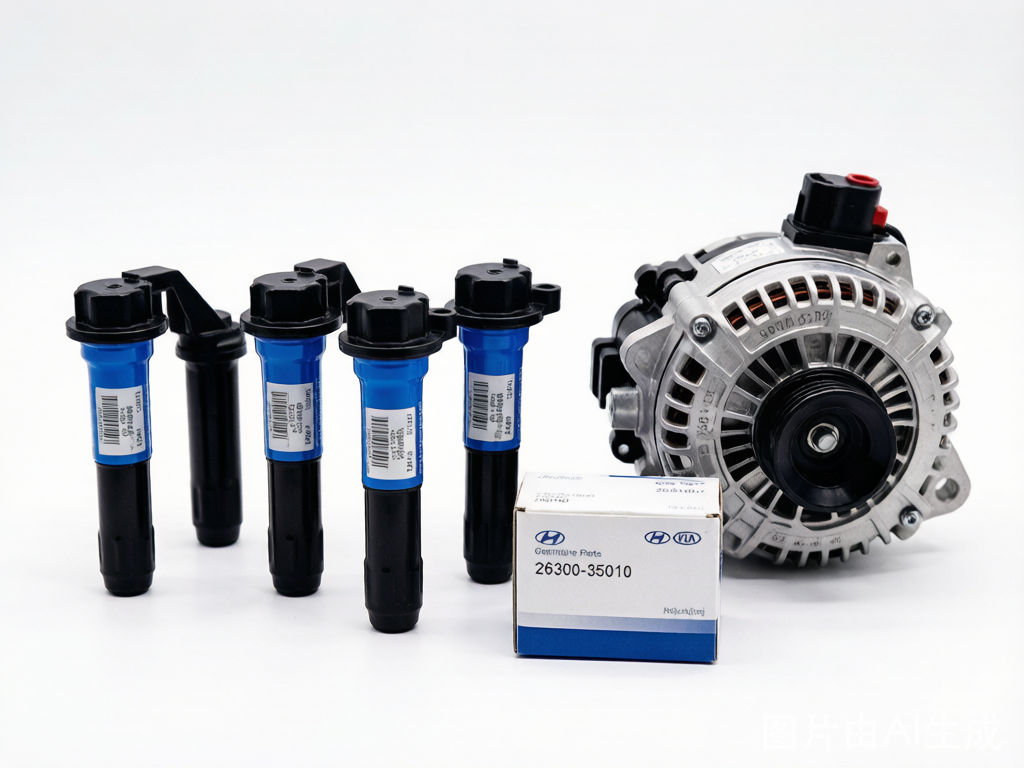
Straight answer: Engine management sensors and electrical components are the fastest-growing segment of the aftermarket auto parts trade. Why? Because modern vehicles pack 15-30 electronic sensors — and every one of them will fail at some point, leaving the car undriveable until it's replaced. A failed crankshaft position sensor means no start, period. A dead MAF sensor triggers limp mode. An alternator that gives out at 120,000 km strands a customer on the highway. This guide covers all major engine management sensors and electrical components available from Kingmay Auto Parts — 22 SKUs covering crankshaft/camshaft position sensors, oxygen (O2) sensors, MAF/MAP sensors, knock sensors, throttle position sensors, alternators, starter motors and window switches — with FOB Guangzhou prices from $8 to $260 per unit.
Why Sensors Are the High-Margin Electrical Category
Three economic factors make sensors the most profitable electrical parts category for importers:
- Non-negotiable replacement. When a crankshaft position sensor fails, the ECU cannot determine engine timing — the vehicle will not start. There is no "limp home" mode for a dead CKP sensor. The customer must buy, and the price sensitivity is lower than for brake pads or filters.
- High unit value, small package. A crankshaft sensor retails for $40-120 in local markets while weighing 50 grams and occupying 5 cm of shelf space. The FOB-to-retail markup on sensors is 60-100%, higher than any other auto parts category except ECUs and ABS modules.
- Diagnostic-driven demand. Most sensor replacements are triggered by an OBD-II fault code (P0335 for CKP sensor, P0130-P0135 for O2 sensor, P0101 for MAF sensor). The workshop plugs in a scanner, reads the code, and orders the part. There is no guesswork or customer indecision — the DTC (diagnostic trouble code) makes the sale.
Crankshaft & Camshaft Position Sensors (CKP / CMP)
The crankshaft position sensor and camshaft position sensor are the two most critical engine timing sensors. CKP sensor failure (code P0335) is the #1 cause of "crank but no start" for Hyundai, Kia and Toyota four-cylinder engines in the 100,000-180,000 km range. Both sensors are Hall-effect or magneto-resistive types in modern vehicles; Hall-effect sensors are more durable but cost 30-50% more than inductive (VR) types at FOB level.
| Sensor | Common DTC Codes | Typical Failure Mileage | FOB Price (USD) | MOQ |
|---|---|---|---|---|
| Crankshaft Position Sensor (CKP) | P0335, P0336, P0339 | 100,000-180,000 km | $15 - $55 | 10 pcs |
| Camshaft Position Sensor (CMP) | P0340, P0341, P0344 | 120,000-200,000 km | $15 - $55 | 10 pcs |
Hot-Climate Failure Note — Middle East Importers
CKP and CMP sensor failure rates in the GCC (Saudi Arabia, UAE, Qatar) are approximately 25-30% higher than in temperate climates. Engine bay temperatures in summer (55-65 deg C, measured near the exhaust manifold where CKP sensors are typically mounted) degrade the Hall-effect semiconductor junction faster. Stock at least 30% extra CKP/CMP sensors for GCC-bound shipments, particularly for Hyundai Tucson, Kia Sportage and Toyota Camry applications where engine bay heat soak is most severe.
Oxygen (O2) Sensors & Lambda Probes
Oxygen sensors are the single highest-unit-volume sensor category globally. Every vehicle since 1996 (OBD-II mandate) has at least two O2 sensors (upstream/pre-cat and downstream/post-cat). V6 and V8 engines have four. O2 sensor replacement is triggered by P0130-P0167 codes and is one of the most common Check Engine Light (CEL) causes worldwide.
Kingmay O2 sensor inventory:
| Type | Wire Count | Application | FOB Price (USD) | MOQ |
|---|---|---|---|---|
| Zirconia (narrowband) O2 Sensor | 1-4 wire | Universal — most pre-2015 Hyundai/Kia/Toyota | $15 - $45 | 10 pcs |
| Wideband / AFR (Air-Fuel Ratio) Sensor | 5-6 wire | Post-2018 Hyundai/Kia GDi, Toyota D-4S | $35 - $95 | 5 pcs |
Caution on universal vs. model-specific O2 sensors: Universal O2 sensors (requiring the installer to splice the original connector) are approximately 40% cheaper at FOB level but carry a higher return rate (5-8% vs. 1-2% for plug-and-play model-specific sensors). For importers targeting professional workshops, stock model-specific plug-and-play sensors. For DIY/retail channels, universal sensors at the lower price point sell well but require clear installation instructions in the package.
MAF & MAP Sensors: The Air-Fuel Management Pair
Mass Air Flow (MAF) and Manifold Absolute Pressure (MAP) sensors measure the air entering the engine. A faulty MAF sensor (code P0101) is the third most common CEL cause globally. The symptoms are unmistakable: rough idle, hesitation on acceleration, 15-25% fuel economy loss, and occasionally black smoke from the exhaust (rich condition).
| Sensor | DTC Codes | Technology | FOB Price (USD) | High-Failure Climate |
|---|---|---|---|---|
| MAF Sensor (Mass Air Flow) | P0101, P0102, P0103 | Hot-wire or hot-film anemometer | $25 - $95 | Dusty environments (Africa), oiled air filters accelerate contamination |
| MAP Sensor (Manifold Absolute Pressure) | P0105, P0106, P0107 | Piezoresistive silicon diaphragm | $18 - $70 | High altitude + turbocharged engines |
Buying tip: MAF sensors for Hyundai/Kia GDi engines (Theta II, Gamma, Nu platforms) are the highest-volume sensors by value. A single MAF sensor for a 2016-2024 Tucson/Sportage 2.0L MPI retails at $120-180 in most African and Middle Eastern markets from a $35 FOB base. Importers who stock 5-8 Hyundai/Kia MAF sensor variants capture the bulk of this demand.
Knock Sensor, TPS & Oil Pressure: The Auxiliary Trio
Three additional sensors round out the engine management category. While each individually generates lower volume than CKP or O2 sensors, collectively they represent 15-20% of sensor revenue for a balanced distributor.
| Sensor | Function | Failure Symptom | DTC | FOB Price (USD) |
|---|---|---|---|---|
| Knock Sensor | Detects engine knock/pre-ignition; ECU retards timing | Power loss, hesitation under load, no audible knock | P0325, P0330 | $15 - $55 |
| Throttle Position Sensor (TPS) | Measures throttle plate angle; signals ECU for fuel mapping | Hesitation, erratic idle, sudden acceleration surge | P0120, P0121 | $12 - $48 |
| Oil Pressure Sensor / Switch | Monitors engine oil pressure; triggers warning light | Oil warning light on dash, false low-pressure readings | P0520, P0521 | $8 - $38 |
Alternator & Starter Motor: The Two Big Electrical Components
Alternators and starter motors are the heavyweight champions of the electrical category — literally (5-8 kg each) and commercially. These two components account for 40-50% of a typical electrical parts importer's revenue by value, despite representing fewer than 10% of units sold. An alternator retails for $180-400 versus $35 for a CKP sensor; the gross profit per unit is 5x-8x higher.
| Component | Amp Rating / kW | Common Fitment | FOB Price (USD) | MOQ |
|---|---|---|---|---|
| Alternator Assembly | 90A / 110A / 130A | Hyundai Elantra/Tucson, Kia Sportage/Cerato | $65 - $260 | 5 pcs |
| Starter Motor Assembly | 1.2 kW / 1.4 kW / 1.7 kW | Universal — Hyundai/Kia/Toyota common fitments | $55 - $220 | 5 pcs |
Warranty Policy — Alternators & Starters
Kingmay provides a 12-month / 30,000 km replacement warranty on all alternators and starter motors from the date of shipment, provided the unit was installed by a qualified workshop and the vehicle's electrical system (battery, voltage regulator, wiring harness) is confirmed functional. Warranty claims on alternators and starters average 2.1% — Kingmay replaces the defective unit and ships with the next order. Photographic documentation of the installation and the workshop's diagnostic report (showing battery voltage, charging circuit test, and starter draw test) is required to process a claim.
Power Window Switch & Comfort Electronics
While not engine management, power window switches and comfort electronics represent a reliable "bread and butter" category. Window switches fail from mechanical wear (contact degradation over 100,000+ operations), coffee spills, and voltage spikes. They are the single most requested electrical comfort part in tropical markets (windows are opened and closed constantly throughout the day).
Kingmay stocks power window master switches (driver-side, 4-switch panel) and individual window switches for Hyundai Accent, Elantra, Tucson, Kia Rio, Cerato and Sportage from 2015-2024. FOB price range: $12-48 per switch, MOQ 10 pieces. For importers, window switches are a natural add-on to sensor and alternator orders — light, compact, no special handling, and consistent demand.
Container Loading: Packing Sensors and Electrical Parts Efficiently
Sensors and small electrical components are among the most space-efficient auto parts to ship — a single 40HQ container can hold tens of thousands of units. The challenge is not space but weight for alternators and starters.
| Product | Weight per Unit | Units per 20GP | Estimated FOB Value per 20GP |
|---|---|---|---|
| CKP/CMP Sensors (mixed) | 0.05 kg | 15,000+ (volume-limited) | $225,000 - $825,000 |
| O2 Sensors (mixed) | 0.08 kg | 10,000+ (volume-limited) | $150,000 - $450,000 |
| Alternators | 5.5 - 7.5 kg | 2,000 - 3,000 (weight-limited at 21,500 kg total) | $130,000 - $520,000 |
| Starter Motors | 3.5 - 5.0 kg | 3,500 - 5,000 (weight-limited) | $192,500 - $770,000 |
| Mixed Container (sensors + alternators + starters + switches) | Varies | Typical: 5,000 sensors + 300 alternators + 200 starters + 1,000 switches | $60,000 - $120,000 |
Practical packing note: Sensors are packed in anti-static bags inside individual branded boxes. For importers who want to private-label, Kingmay can supply sensors in bulk (25-50 pcs per master carton, unbranded white box) at a 5-8% discount from the branded unit price. Branded retail boxes (with your logo, part number and application chart) are available with a minimum order of 500 pcs per SKU and a one-time artwork charge of $120 per design.
Regional Demand Analysis for Sensors & Electrical Parts
| Market | Top Sensor Demand | Vehicle Age Range | Market Value (Estimated Annual) |
|---|---|---|---|
| Saudi Arabia / GCC | CKP sensors, O2 sensors, alternators | 2014-2022 vehicles, 100K-200K km | $80M - $120M (sensors + alternators + starters) |
| Nigeria / West Africa | CKP sensors, O2 sensors (universal), MAF sensors | 2008-2018 used imports, 120K-250K km | $40M - $70M |
| East Africa | MAF sensors, O2 sensors, alternators | 2010-2020 Toyota/Nissan used imports | $25M - $45M |
| Egypt / North Africa | TPS, O2 sensors, MAP sensors | 2013-2022 Hyundai/Kia (locally assembled) | $35M - $55M |
Market value estimates are based on 2025 import data from China Customs (HS codes 9032.89 and 8511.50 for sensors and alternators/starters respectively) and Kingmay's internal shipment data.
Quality: OEM-Grade vs Economy Sensor Grades
Not all sensors are created equal. The difference between a $15 CKP sensor and a $45 CKP sensor is the semiconductor chip inside and the connector quality:
| Attribute | OEM-Grade | Economy |
|---|---|---|
| Hall-effect IC supplier | Infineon / Allegro / Melexis (same as OE) | Domestic Chinese IC (Honeywell-licensed or cloned) |
| Connector | Amphenol / TE / Yazaki equivalent, gold-plated pins | Generic connector, tin-plated pins |
| Operating temp range | -40 to +150 deg C | -20 to +120 deg C |
| Return rate | 0.8 - 1.5% | 3.5 - 7% |
| Recommended market | GCC, South Africa, professional workshops | Price-sensitive street markets, DIY retail |
For alternators and starters: Kingmay's OEM-grade units use Denso / Valeo / Mando core designs with new copper windings, new voltage regulators (with thermal protection), and new bearings (NSK / NTN equivalent). Economy units are re-manufactured cores with new brushes, new bearings, and tested output — they carry a 6-month warranty vs 12 months for OEM-grade.
Frequently Asked Questions (FAQ)
Q: How can I be sure the CKP/O2 sensor I order will fit the exact vehicle model?
Sensor fitment depends on three factors: vehicle model year, engine code (e.g., G4FG, G4NA, G4KH for Hyundai/Kia), and transmission type (the CKP sensor mounting position differs between manual and automatic versions of the same engine). Provide the VIN, engine code, and a clear photo of the existing sensor (showing the connector shape and wire count) to Kingmay before ordering. Our cross-reference system covers 98%+ of Hyundai/Kia/Toyota engine sensors from 2008-2025.
Q: What is the minimum order quantity (MOQ) for sensors and electrical parts?
MOQ varies by product type: 10 pieces for CKP/CMP sensors, 10 pieces for O2 sensors, 5 pieces for alternators, 5 pieces for starter motors, 10 pieces for window switches. For mixed orders (e.g., 3 CKP + 5 O2 + 2 alternators + 3 starters), the combined value must reach a minimum of $500 FOB. There is no minimum per individual sensor type within a mixed carton — you can order 1-3 pieces of diverse sensor part numbers in a single shipment.
Q: How long do sensors typically last, and what is your warranty?
OEM-grade sensors from Kingmay carry a 12-month / 30,000 km warranty from the date of shipment. Economy sensors carry a 6-month warranty. Actual service life of OEM-grade CKP and CMP sensors is 100,000-180,000 km under normal driving conditions, but hot-climate operation or frequent engine washing can shorten this. O2 sensors typically last 100,000-160,000 km for upstream (pre-catalyst), and 120,000-200,000 km for downstream (post-catalyst) units. Contaminated fuel (high sulfur content, leaded fuel) dramatically shortens O2 sensor life — this is the single largest cause of premature O2 sensor failure in West African markets.
Q: Do you provide the OBD-II fault codes for each sensor so I can help my workshops diagnose correctly?
Yes. Every sensor shipment from Kingmay includes a printed diagnostic reference card listing the DTC codes, typical symptoms, and a basic wiring pinout for the sensor. The card is formatted as a quick-reference tri-fold that workshops can pin on the wall. A PDF version is also available for email distribution to your dealer network. For large orders (500+ sensors), we can custom-print the diagnostic card with your company logo and contact information.
Q: What is the typical lead time for sensor orders, and can you air-freight small quantities?
Standard lead time for sensor orders is 3-7 working days from order confirmation (if all SKUs are in stock). For sea freight, total transit time from Guangzhou Nansha to your port is 14-25 days depending on destination (see container loading section above for port-specific times). For urgent small orders (up to 50 kg, approximately 300-500 sensors), Kingmay offers DHL/UPS/FedEx air freight with 4-7 working day delivery to most African and Middle Eastern cities. Air freight cost is calculated per kg (approximately $6-9/kg) and is quoted before shipment. Air-freighted sensor orders carry the same warranty as sea-freighted orders.
Order Engine Sensors & Electrical Parts from Kingmay
Kingmay Auto Parts stocks 22 electrical SKUs — from $8 oil pressure sensors to $260 alternator assemblies — covering Hyundai, Kia, Toyota and Nissan vehicle platforms from 2008 to 2025. All sensors and electrical components are sourced from IATF 16949-certified factories and undergo a 6-point pre-shipment inspection including Hall-effect output waveform testing, connector contact resistance measurement, and thermal cycling (3 cycles from -20 to +120 deg C).
Contact: Miss UU (Wholesale Director, Kingmay Auto Parts) — ku@kingmay-autoparts.com, +86 13302408528. Shop 7#, No.1542 Guangyuan East Road, Yuexiu District, Guangzhou, China.
Request Electrical Parts Quotation →
Verify Part Numbers in Our OE Library
Every part covered in this guide has a matching OE number in our reference library — grouped by system with cross-references, so you can source the exact fit for Hyundai, Kia, GM Korea and more.
Related Articles
Related Products
From our Engine System catalog — 4 products ready for export