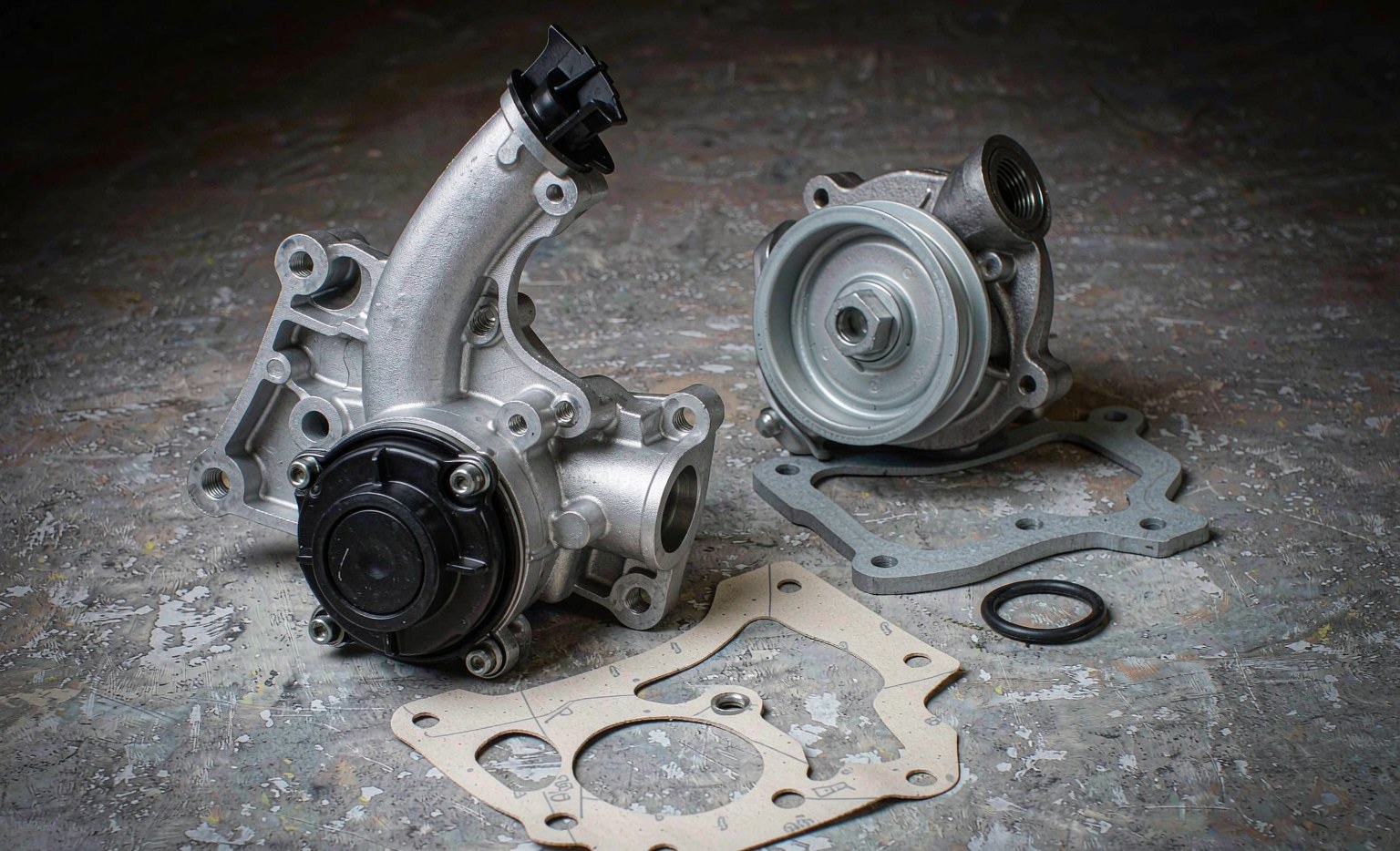
A thermostat costs less than a brake pad and a water pump costs less than a headlight, yet between them they account for most of the overheating jobs that reach a workshop. Both fail in ways that look identical from the driver's seat, and the usual shortcut — replace both and hope — hides a third possibility that is far more expensive. This guide separates the two failures by what each part actually does, gives the three checks that settle the question without dismantling anything, and lists thirty OE references we hold for BMW, Mercedes-Benz, Volkswagen, Audi and Toyota applications.
Two Parts, Two Different Jobs
The cooling system is a loop, and the two components sit at opposite ends of it. The thermostat is a valve. It decides where coolant goes: through the engine only while the engine is cold, through the radiator once the coolant reaches its rated opening temperature. The water pump is the mover. It has no opinion about temperature; it simply pushes volume, and its output rises and falls with engine speed on a belt-driven design.
That split explains almost every diagnostic difference in this article. A thermostat failure changes when the engine reaches temperature. A pump failure changes whether heat leaves the engine at all.
The temperature at which the valve opens is stamped on the part, and it matters commercially. European petrol engines commonly run thermostats rated around 88–90 °C, with the whole range across passenger cars sitting roughly between 82 °C and 93 °C — about 180–200 °F. Normal operating temperature once warm sits higher, generally 90–105 °C. Fit a thermostat rated ten degrees low and the engine will run cold enough to set a fault code and raise fuel consumption, which is why a cheap substitution is never actually cheap.
Design has also moved. On older engines both parts are mechanical and belt-driven. On BMW’s N52, N54 and N55 six-cylinders the pump is electrically driven and controlled by the engine management, so there is no belt to watch and no pulley to wobble — the failure shows up as a stored fault code and a command test that produces no flow. Any diagnostic routine written before about 2005 will mislead a technician working on those engines.
Why the Symptoms Overlap So Badly
Three mechanisms blur the picture, and each one has fooled someone into replacing the wrong part.
No flow looks like no radiator. If the pump is not circulating, the radiator stays cool too — so a cold lower hose, the classic “thermostat is stuck shut” clue, can also mean a dead pump. The hose test is supporting evidence, not proof.
Air behaves like a broken component. A low coolant level or an incomplete bleed leaves a pocket at the temperature sensor or in the heater circuit. The gauge swings, the heater goes hot and cold, and the engine overheats under load — the same signature as a failing pump. Air is far more common than a failed pump on a car that has just had cooling work done.
The engine has more than two parts. A restricted radiator, a collapsed hose, a fan that never runs, a pressure cap that will not hold, or combustion gas entering the coolant will all produce overheating that no amount of pump and thermostat replacement will fix. Those are the cases that end up as a comeback, and they are the reason a pressure test belongs in the first ten minutes rather than the last.
The Symptom Matrix
Sorted by what the driver reports, with the component each pattern favours. Read the “more likely” column as a starting hypothesis, not a verdict.
| Reported symptom | More likely part | Why | Confirmation test |
|---|---|---|---|
| Warms up very slowly; gauge never reaches the middle | Thermostat stuck open | Coolant circulates through the radiator from cold, so the engine never reaches rating | Scan-tool warm-up curve plateaus below rating; upper hose warms early |
| Heats normally, then spikes several minutes after start | Thermostat stuck closed | Flow to the radiator never opens; the bypass circuit keeps the heater working, which is why heat still feels fine | Upper hose stays cold while the gauge climbs |
| Fine around town, overheats on the highway or under load | Water pump (impeller or flow) | Heat rejection demand rises with load; a weak impeller cannot keep up | Temperature rises with engine speed; heater output drops as revs rise |
| Overheats at idle, cools once moving | Neither — usually fan or airflow | Road speed substitutes for the fan; the loop itself is sound | Command the fan on with a scan tool and watch the temperature fall |
| Coolant level drops, no puddle on the ground | Water pump seal or weep hole | Small loss evaporates on a hot engine; dried residue rather than a pool | Cold pressure test; inspect the weep hole and the pump-to-block seam |
| Grinding or whining from the front of the engine | Water pump bearing | Bearing wear is audible before it becomes a leak; pulley play follows | Isolate the noise with the belt off; check for shaft play |
| Heater weak at idle, stronger with revs | Water pump (low-speed flow) | Heater core is the highest point in the loop and the first to notice reduced flow | Compare heater outlet temperature at idle and at 2,000 rpm |
| Gauge swings repeatedly on one drive | Thermostat sticking intermittently | A valve that hangs part-open produces temperature cycling rather than a single failure | Log coolant temperature over a full drive; look for repeated sawtooth |
The first two rows are the ones that get confused most often, and the confusion is expensive in the wrong direction: a stuck-closed thermostat still delivers cabin heat, so owners conclude the cooling system is working. By the time the gauge reaches the red, the head has already been heat-soaked.
Three Checks That Separate Them
None of these requires draining the system, and together they resolve most cases. Do all of them with the engine completely cold to start, and never open a pressurised cap.
One: watch the warm-up curve, not the dash gauge. Connect a scan tool and log engine coolant temperature from a cold start through fifteen minutes of driving. A healthy engine climbs steadily and levels off near the thermostat rating, then stabilises a little above it. A curve that plateaus well below rating — say 60 °C when the part is rated 90 °C — is a thermostat that is not closing. A curve that climbs normally and then keeps climbing is a flow problem or a stuck-closed valve.
Two: compare three temperatures with an infrared thermometer. Measure at the engine outlet (upper hose, near the thermostat housing), at the radiator inlet, and at the radiator outlet. On a working system the drop across the radiator is real and repeatable. If the engine outlet is hot and the radiator inlet is cold, coolant is not being let through. If both are hot but the radiator outlet is barely cooler than the inlet, the radiator is not shedding heat — which is a radiator problem, not a pump or thermostat problem, and this is the check that catches it before a part gets replaced.
Three: listen and look at the pump itself. With the engine off, check the pump pulley for play and the housing for seepage. Run the engine and listen for bearing noise that tracks engine speed. On a belt-driven pump, a trace of dried coolant at the weep hole is a seal on its way out — the bearing usually follows, because the same coolant that escapes past the seal washes the bearing grease out.
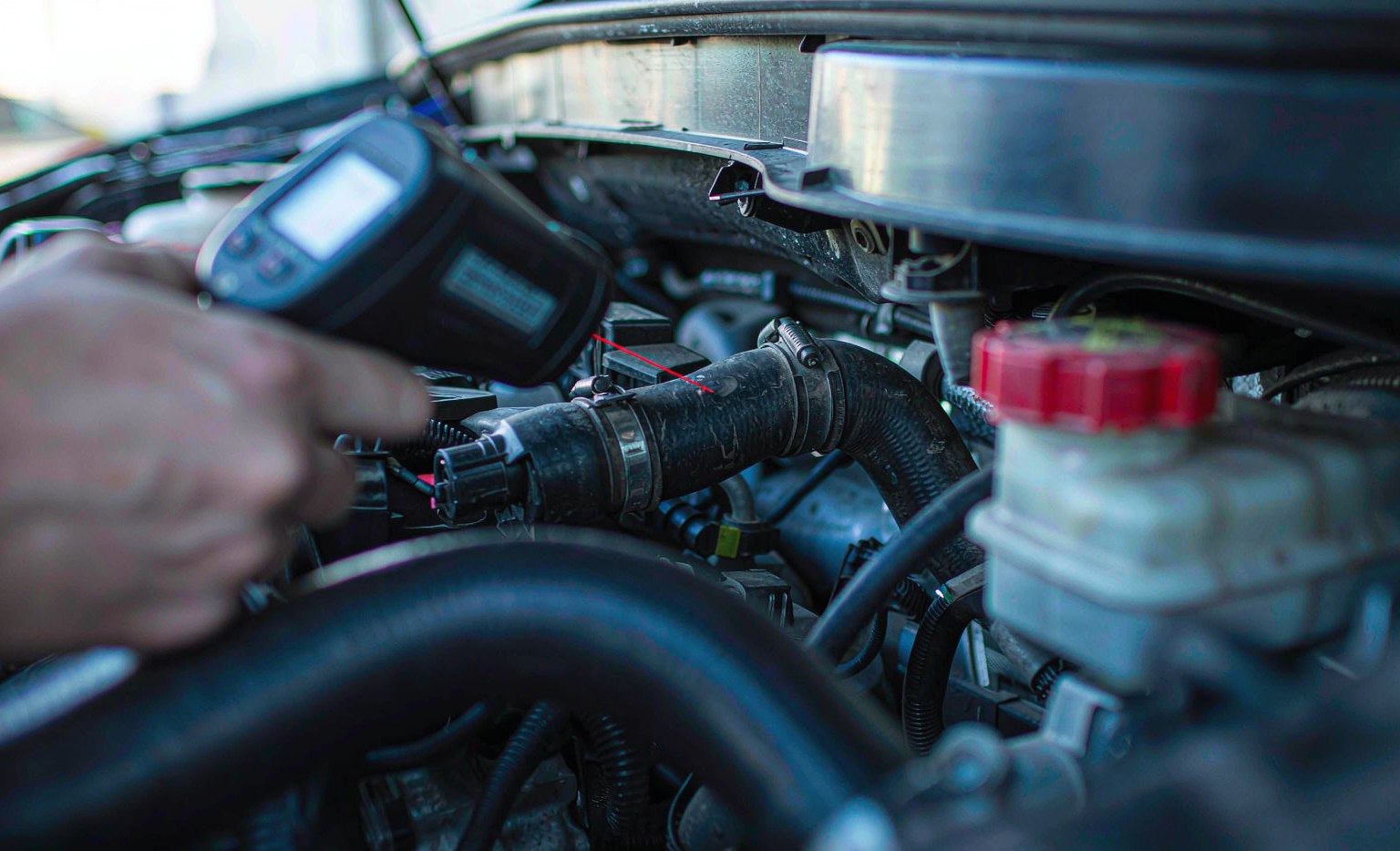
If all three checks point at nothing, stop and pressure-test the system cold. A slow external leak, a failed cap or combustion gas in the coolant will mimic both parts, and no parts cannon will fix any of them.
Thermostat: Open, Closed and Everything Between
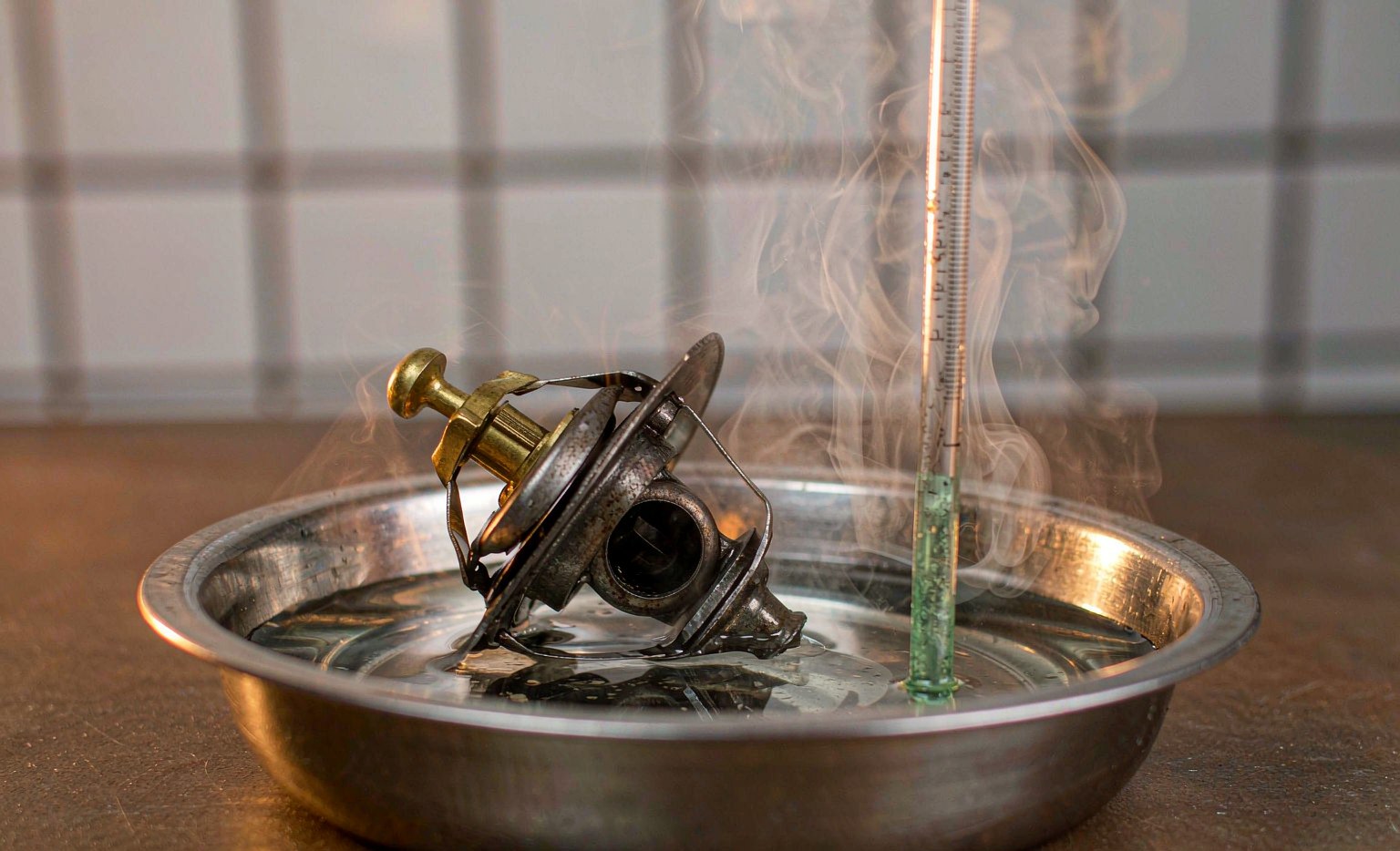
The valve has three failure modes, and they are not interchangeable. A wax-element thermostat fails progressively: the element weakens, the opening temperature drifts down, and the valve starts to hang part-open before it sticks outright.
| Failure mode | Temperature behaviour | Cabin heat | Typical code | Commercial consequence |
|---|---|---|---|---|
| Stuck open | Runs cold; slow warm-up; cools further at highway speed | Weak but present | P0128 | Fuel consumption and emissions rise; drivable for weeks, so the customer postpones |
| Stuck closed | Warms normally, then climbs fast once the valve should open | Often still strong, via the bypass circuit | Usually none | Head gasket and warped head risk; this is the failure that turns a cheap part into an engine job |
| Sticking / part-open | Repeats a sawtooth: hot, cool, hot on one drive | Fluctuates with the gauge | Sometimes P0128, sometimes nothing | Hardest to sell because the fault is intermittent; scan logs are the evidence |
| Wrong rating fitted | Stable but offset from specification | Depends on the offset | P0128 or none | Repeat comeback after a “successful” repair; check the stamp on the old part |
Two details decide whether the repair holds. The first is the rating: fit the number the engine was calibrated for, not the one that happens to be on the shelf. The second is the housing. On a growing share of modern engines — VW and Audi EA111 and EA888 families, several Mercedes-Benz four-cylinders — the thermostat is moulded into a plastic housing with the sensor and seal integrated. Replacing only the insert on those engines means reusing a housing that has already been heat-cycled for a decade, and the leak returns at the seam rather than the valve. Sell the complete housing for those applications.
Water Pump: Seal, Bearing, Impeller
Three failure paths, and only two of them leave evidence outside the pump.
The seal goes first, almost always. The weep hole under the pump snout is a deliberate drain: when the shaft seal starts to pass, coolant escapes there instead of into the bearing or the sump. What a technician finds is not usually a puddle but a chalky trail — the dye and mineral residue left after the water evaporates. On a hot engine that trail is the whole diagnosis.
The bearing follows the seal. Once coolant has washed the grease out, the bearing howls, whines or grinds, and the pulley develops play. A pulley with visible wobble is a stopped-engine situation: a shaft that lets go can throw the belt, take the fan with it and destroy the radiator.
The impeller fails silently. This is the one that produces no leak and no noise. A plastic or pressed-metal impeller can crack, corrode, spin on the shaft or separate from it entirely, and the pump looks perfect from outside while moving almost nothing. The signature is overheating under load with a full system, a heater that weakens as revs rise, and a radiator that never gets properly hot. A pump that has run on the wrong coolant, or on plain water, is the usual candidate.
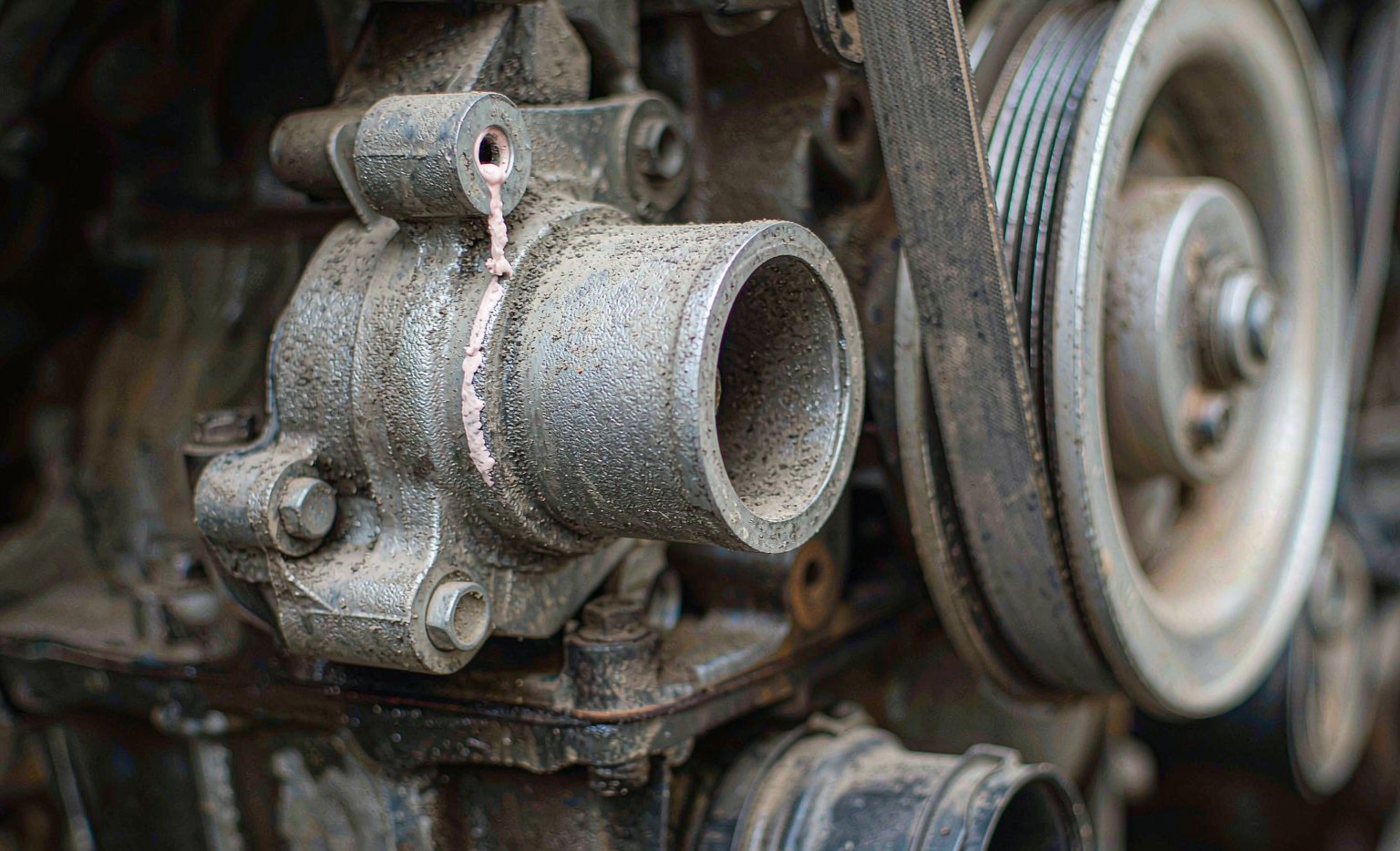
On an electrically driven pump the whole diagnostic changes. There is no belt, no pulley and no weep hole worth watching. The pump is commanded by the engine management, so the test is a scan-tool activation with the coolant temperature watched live, plus a check of supply voltage and the associated fault memory. Replacing an electric pump because of a corroded connector is an expensive way to learn that lesson.
P0128 Is Not an Overheating Code
P0128 means “coolant temperature below thermostat regulating temperature”: the engine did not warm up as fast as the calibration expects. It is the opposite of an overheating complaint, and reading it as one sends people down the wrong path.
The most common cause by a wide margin is a thermostat stuck open, followed by a coolant temperature sensor reporting low, a low coolant level leaving air at the sensor, and a cooling fan that runs continuously. Note what is absent from that list: the water pump. A pump that is not circulating usually causes overheating, not under-temperature, because the engine keeps its heat instead of losing it.
So P0128 plus a cold-running engine is a thermostat sale. P0128 plus a normal gauge and a sensor reading that disagrees with an infrared thermometer at the hose is a sensor sale. P0128 plus overheating is neither, and the two faults need to be diagnosed separately rather than assumed to share a cause.
Still Overheating After the Thermostat Was Changed
This is the most common comeback in the category, and it has a short list of causes worth working through in order.
Air in the system. The single most frequent cause. Modern cooling systems have bleed points at the heater hose, the thermostat housing or an expansion tank cap, and some require a vacuum fill or a specific warm-up and cool-down cycle. An engine with an air pocket behaves exactly like one with a failing pump: the gauge climbs, the heater goes cold at idle, and the radiator stays cool.
The housing was reused. A new insert in a warped plastic housing leaks at the seam, behind the sensor, or past an O-ring that has gone flat. It looks like the repair failed when in fact only half the part was replaced.
The pump was the fault all along. A stuck-closed thermostat and a dead impeller produce the same symptom, and the thermostat is the cheaper guess. If the temperature still climbs after a correct thermostat and a correct bleed, measure flow before buying another valve.
The radiator, fan or cap. A radiator restricted internally will pass enough coolant to idle happily and fail under load. A fan that never runs turns every traffic jam into an overheat. A cap that will not hold pressure lowers the boiling point and produces steam at normal temperatures.
Combustion gas. A failing head gasket pressurises the system, pushes coolant out of the expansion tank and leaves the loop unable to transfer heat. A chemical block test on the coolant takes ten minutes and settles it.
Replace One, or Both?
The honest answer is that it depends on labour access, not on parts philosophy. Where both components sit behind the same covers — common on transverse four-cylinders and on several V6 layouts — the second part costs a fraction of the first in labour, and replacing it pre-emptively is sound economics. Where the pump is driven off the accessory belt and the thermostat sits in an accessible housing, replacing a healthy part adds cost and a new failure point for no benefit.
| Platform family | Pump drive | Thermostat arrangement | What to replace together |
|---|---|---|---|
| BMW N52 / N54 / N55 | Electric, ECU-controlled | Separate housing, map-controlled | Pump, thermostat, coolant; bleed via scan tool |
| BMW M52 / M54 | Mechanical, belt-driven | Housing with gasket | Pump, thermostat, housing gasket, belt if contaminated |
| Mercedes-Benz M112 / M113 | Mechanical, belt-driven | Separate housing, O-ring sealed | Pump, thermostat, housing O-ring |
| Mercedes-Benz M270 / M274 | Mechanical, belt-driven | Integrated plastic housing | Complete housing assembly; pump if mileage is high |
| VW / Audi EA111, EA888 | Mechanical, belt or chain driven | Integrated plastic housing with sensor | Complete housing, pump, coolant |
| Toyota 1GR / 2TR | Mechanical, belt-driven | Separate housing with rubber gasket | Thermostat and gasket; pump on condition |
One rule survives every platform: replace the coolant. Old coolant that has lost its inhibitor package is what kills the next pump, and mixing two chemistries — typically an OAT with an older silicate formula — produces the gel that blocks heater cores. Flush, fill with the specified type, and bleed properly. The labour is charged either way.
Buying: References, Housings and What Actually Sells
Three decisions shape a cooling-system order, and each one has a failure mode worth knowing before the container is booked.
Insert or assembly. European applications increasingly want the complete housing because the insert alone is not what fails. Stock the assembly for VW/Audi EA111 and EA888, Mercedes-Benz M270 and M274, and the plastic-housing BMW engines; stock the plain insert for older cast-housing applications where price drives the sale.
Pump construction. Metal impellers outlast plastic ones and cost cents more to make, not dollars. Ask for the impeller material and the seal type on the datasheet — a supplier who cannot name either is buying on price from someone else. For hot-climate markets, specify the higher-temperature seal compound.
Kit completeness. A pump sold with its gasket and O-ring sells to a workshop; a bare pump sells to whoever is prepared to chase a seal separately. The same applies to thermostats: housing, seal and sensor in one box removes a phone call from the job.
The references below are the ones we hold for these two families, with the primary application for each. Every number links to its product page with the full fitment list.
| OE reference | Primary applications | Family | Supply |
|---|---|---|---|
| 0130261800 | MERCEDES-BENZ 190 (W201), S-CLASS (W126), SL (R107) | Water pump | In stock · MOQ 50 pcs |
| 1022000120 | MERCEDES-BENZ 190 (W201), 123 Saloon (W123) | Water pump | In stock · MOQ 50 pcs |
| 1022000401 | MERCEDES-BENZ G-CLASS (W460), T1/TN Platform/Chassis, T1 Platform/ | Water pump | In stock · MOQ 50 pcs |
| 1022006201 | MERCEDES-BENZ 124 Saloon (W124), 190 (W201) | Water pump | In stock · MOQ 50 pcs |
| 1032000401 | MERCEDES-BENZ G-CLASS Cabrio (W463), 124 Saloon (W124), 190 (W201), S-CLASS (W | Water pump | In stock · MOQ 50 pcs |
| 1042000301 | MERCEDES-BENZ 124 Saloon (W124), SL (R129) | Water pump | In stock · MOQ 50 pcs |
| 1042002701 | MERCEDES-BENZ G-CLASS Cabrio (W463), S-CLASS (W140) | Water pump | In stock · MOQ 50 pcs |
| 1042003301 | MERCEDES-BENZ E-CLASS Coupe (C124), C-CLASS (W202), SL (R129), 124 Break (S124 | Water pump | In stock · MOQ 50 pcs |
| 11517508535 | BMW N62-3.6/4.0 | Water pump | In stock · MOQ 50 pcs |
| 11517563659 | BMW N54/N55 | Water pump | In stock · MOQ 50 pcs |
| 11517586924 | BMW N52 | Water pump | In stock · MOQ 50 pcs |
| 11517588885 | BMW N54/N55 | Water pump | In stock · MOQ 50 pcs |
| 11517643067 | BMW B58 3.0T | Water pump | In stock · MOQ 50 pcs |
| 11517805190 | BMW N47/N57 | Water pump | In stock · MOQ 50 pcs |
| 11517807311 | BMW N47 | Water pump | In stock · MOQ 50 pcs |
| 11517500597 | BMW 1 (E87), 3 Convertible (E46) | Thermostat | In stock · MOQ 50 pcs |
| 11517789014 | BMW 5 (E60), X3 (E83), X6 (E71, E72), X5 (E53), 6 Convertible (E64), 3 (E46), | Thermostat | In stock · MOQ 50 pcs |
| 11518512234 | BMW 2 Coupe (F22, F87), 4 Coupe (F32, F82), 3 (E90), 1 (F20) | Thermostat | In stock · MOQ 50 pcs |
| 11531247122 | BMW 3 Coupe (E36), 5 Touring (E34) | Thermostat | In stock · MOQ 50 pcs |
| 11531436386 | BMW X5 (E53), 5 (E39), 7 (E38) | Thermostat | In stock · MOQ 50 pcs |
| 11531437040 | BMW X3 (E83), 3 (E46), 5 (E39), Z4 Roadster (E85), 7 (E38), Z3 Roadster (E36), | Thermostat | In stock · MOQ 50 pcs |
| 11531437085 | BMW 3 (E46), Z3 Roadster (E36) | Thermostat | In stock · MOQ 50 pcs |
| 11531466174 | BMW 3 (E30), 5 (E12), Z1 Roadster, 6 (E24), 7 (E23) | Thermostat | In stock · MOQ 50 pcs |
| 0022037675 | MERCEDES-BENZ E-CLASS Coupe (C124), G-CLASS (W460), C-CLASS (W202), SL (R129), | Thermostat | In stock · MOQ 50 pcs |
| 1022000417 | MERCEDES-BENZ G-CLASS (W463), 190 (W201), 124 Saloon (W124) | Thermostat | In stock · MOQ 50 pcs |
| 1112000915 | MERCEDES-BENZ SPRINTER, VW LT | Thermostat | In stock · MOQ 50 pcs |
| 1112030375 | MERCEDES-BENZ CLK, DAEWOO, GM KOREA KORANDO Cabrio (KJ), SSANGYONG KYRON | Thermostat | In stock · MOQ 50 pcs |
| 1114600302 | Audi A4 Avant Cabriolet Quattro 06B121111K | Thermostat | In stock · MOQ 50 pcs |
| 1603131011 | TOYOTA HILUX REVO VIII Pickup (_N1_), LAND CRUISER PRADO (_J15_), HILUX VIGO V | Thermostat | In stock · MOQ 50 pcs |
| 11531708808 | BMW 3 (E46), Z3 Roadster (E36) | Thermostat | In stock · MOQ 50 pcs |
Applications shown are the first model lines on each reference, not the complete fitment list — the product page carries the full application set and any cross-reference to other brands. If a number is missing, send it with a photo of the original part and our team will check the wider reference library, which holds more than 13,500 numbers, and answer within 24 hours.
Frequently Asked Questions
How do I know if it is the thermostat or the water pump?
Start with behaviour rather than parts. An engine that never reaches temperature, or warms up very slowly, points to a thermostat stuck open. An engine that warms normally and then overheats under load, especially with a heater that weakens as revs rise, points to circulation — the pump. A pump that leaks or growls is confirmed by inspection; a thermostat is confirmed by the warm-up curve on a scan tool.
Can I drive with a stuck-open thermostat?
Yes, for a while. It will not overheat the engine; it will run cold, use more fuel, produce more emissions and give weak cabin heat, and it will usually set P0128. Weeks are acceptable, months are not, because an engine running rich for a long period dilutes the oil and loads the catalyst.
Can I drive with a failing water pump?
Only until the temperature gauge moves. Once a pump stops circulating, the head reaches damaging temperatures in minutes, and the difference between a pump replacement and a head gasket job is measured in how long the driver kept going. A noisy or leaking pump with normal temperatures is a repair to schedule immediately, not a reason to stop at the roadside.
Why does my heater blow cold when the engine is hot?
The heater core is the highest point in the loop and the first place to lose flow. Air in the system, a pump with a failing impeller or a partially blocked core all produce the same symptom. If the heater recovers when you raise the revs, suspect flow; if it never recovers, suspect air or a blockage.
Does a water pump failure always leak?
No. Impeller separation happens entirely inside the pump and leaves no external trace. A pump can be dry, quiet and completely ineffective. That is the case where the infrared comparison across the radiator earns its place in the diagnostic routine.
What is the minimum order for wholesale supply?
Fifty pieces per reference. Pumps, thermostats and housings can be mixed within one order, and both families combine well with brake, gasket or suspension lines in a mixed container. Quotations are issued FOB Guangzhou, usually within 48 hours of receiving the OE list.
Send us your OE list. Photograph the number stamped on the old thermostat or the pump housing, send it over WeChat or through the enquiry form, and we will match it against our cooling range, confirm whether that application needs the complete housing, and quote FOB Guangzhou within 48 hours. Mixed containers are welcome.
Related Articles


Related Products
From our export catalog — parts and vehicles ready for international delivery

Full-Size EREV SUV
2026 Rox Adamas EREV 215km 6-Seat Executive Edition
USD 53,000 FOB Guangzhou
View Details
Full-Size EREV SUV
2026 Rox Adamas EREV 215km 7-Seat All-Terrain Edition
USD 51,500 FOB Guangzhou
View Details
