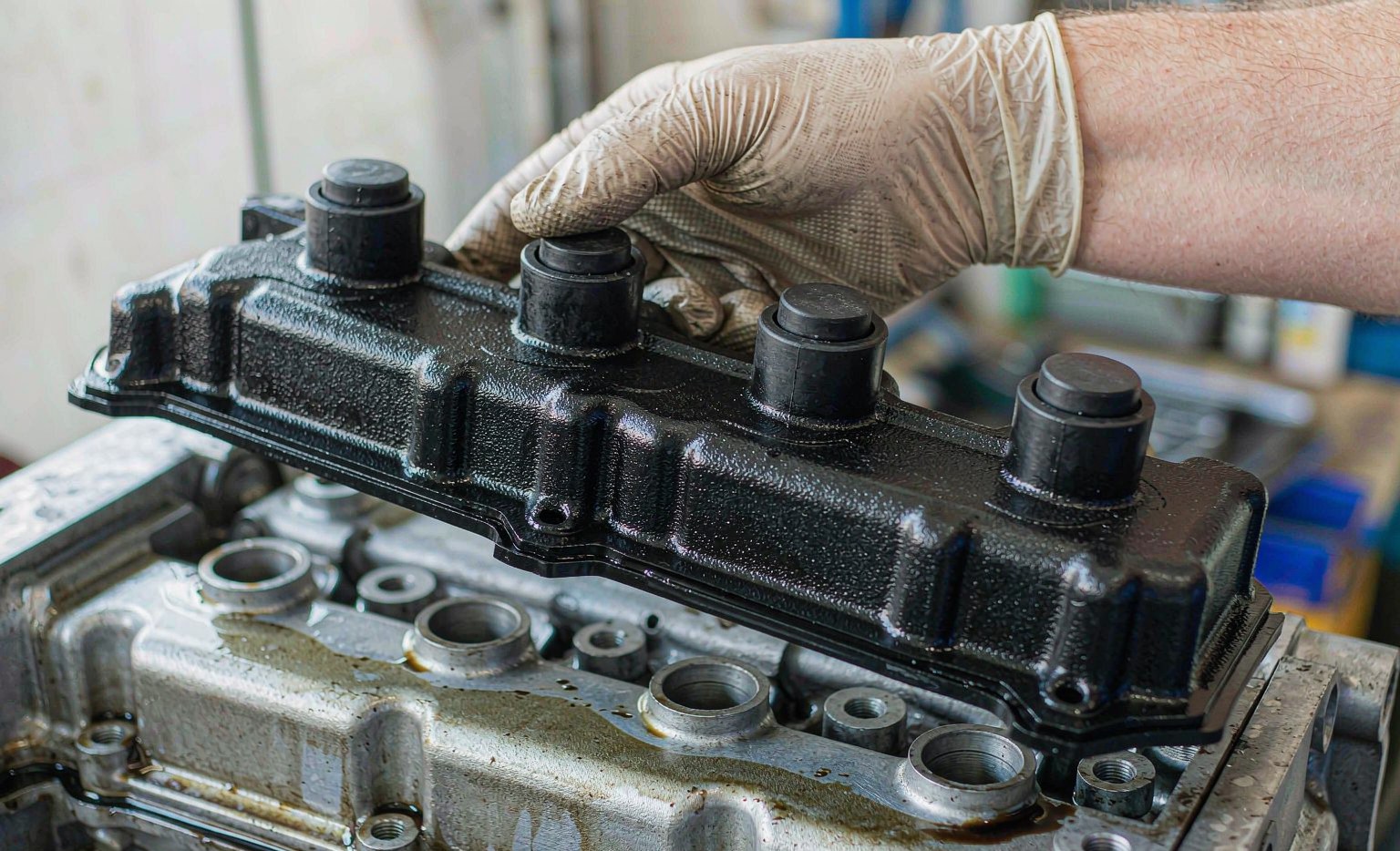
A valve cover gasket is a rubber ring that costs less than a tank of fuel, and a failed one can still take a coil pack, a catalytic converter and a weekend with it. The part is simple; the diagnosis is not. Oil that appears at the top of an engine can come from the cover gasket, the spark plug tube seals, a cracked plastic cover, a clogged PCV system or a head gasket that is about to cost ten times more to fix. This guide separates those cases, gives the torque numbers that actually prevent repeat failures, and lists the OE references we hold for BMW, Mercedes-Benz, Toyota and Lexus applications.
What the Valve Cover Gasket Actually Seals
The valve cover sits on top of the cylinder head and closes the chamber where the camshafts, valves, springs and lifters live. The gasket between cover and head keeps splash-fed oil inside that chamber and keeps dust out. That is the whole job — and the limits of the job explain most of the confusion around it.
It does not seal combustion pressure. It does not separate coolant from oil. It is not exposed to the several hundred degrees and dozens of bar that a head gasket survives every cycle. A valve cover gasket works at low pressure and moderate temperature, which is why the material is usually rubber — EPDM, HNBR or silicone — rather than the multi-layer steel used lower down the engine. On older engines the gasket is a flat cork or rubber sheet; on anything built in the last twenty years it is a moulded rubber profile that clips into a groove around the cover, often with separate tube seals pressed into the cover for each spark plug well.
That design detail matters commercially. The gasket is a consumable that gets replaced whenever the top end is opened — during a timing chain job, a camshaft sensor replacement, a valve clearance service or a spark plug change on an engine with oil in the wells. Shops that keep a small range on the shelf sell them steadily; importers who stock only complete gasket sets miss the single-line demand from workshops that already have the rest of the kit.
Seven Symptoms, Ranked by What They Actually Mean
Owners describe the same failure in different words, and the words point at different stages of it. The table below sorts the common reports by what each one tells a technician.
| What the driver reports | What you find on inspection | What it usually means | How urgent |
|---|---|---|---|
| "There is oil on the engine" | Wet sheen or dark crust along the cover-to-head seam, heaviest at the rear or near the cam sensor | Early external leak; gasket hardening, cover still flat | Plan within weeks |
| "It smells like burning oil after I park" | Oil dripped onto the exhaust manifold or downpipe; light smoke from the engine bay | Leak has reached a hot surface — the smell is the leak rate talking | Plan within days |
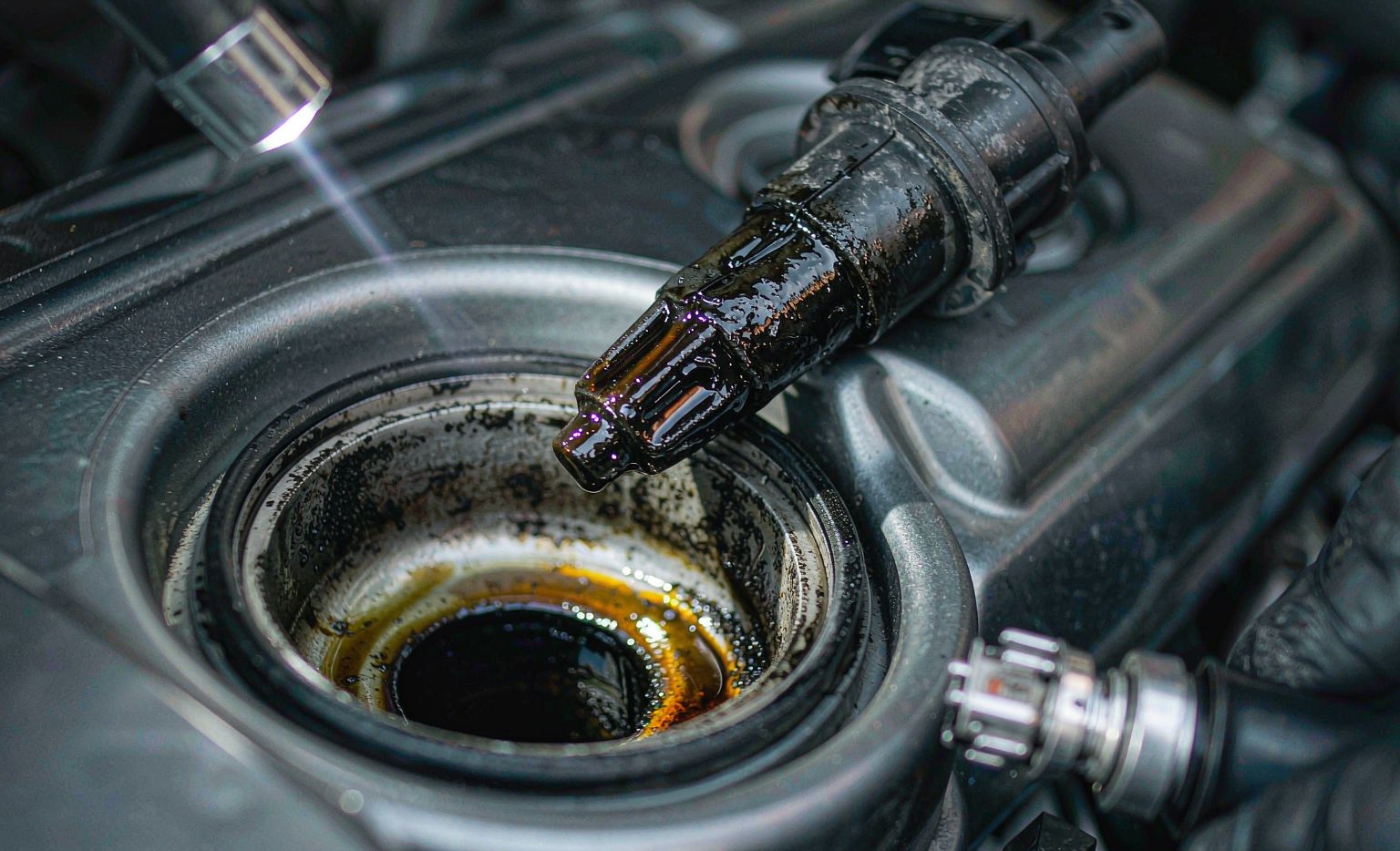
| "It misfires when cold" | Oil pooled in one or more spark plug wells; coil boot swollen and soft | Tube seals have failed, not just the perimeter gasket | Repair now |
| Check engine light with P0300–P0304 | Oil-fouled plug, tracking marks on the boot, misfire counter climbing on one bank | Oil is shorting the ignition circuit; the gasket is the root cause | Repair now, before the converter suffers |
| "It uses oil but never drips" | No puddle, but consumption above roughly one quart per 1,000 miles and a wet rear seam | Leak is burning off on the manifold instead of reaching the ground | Diagnose within a week |
| "The belt squeals" | Oil mist on the accessory belt, tensioner or alternator | Long-running leak contaminating rubber and electrics | Repair now; belt may need replacing too |
| "It smells hot and there is smoke" | Heavy baked-on oil, sometimes smoke from the turbo or manifold area after shutdown | Advanced leak close to an exhaust component | Stop driving; assess fire risk |
Two of these symptoms are routinely misread. A misfire on a car with a known oil leak is usually blamed on the coil, and the coil does get replaced — then fails again, because the oil in the well was never addressed. And low oil consumption with no puddle gets filed under "old engine" when the leak is simply landing somewhere hot. Both misreads cost more than the gasket.
Valve Cover Gasket or Head Gasket? The Test That Settles It
This is the question that decides whether a customer faces a two-hour job or a cylinder-head removal, and the two failures share almost no symptoms once you look at the fluids rather than the oil.
| Signal | Valve cover gasket | Head gasket |
|---|---|---|
| Where the leak starts | Top of the engine, at the cover-to-head seam | Lower down, at the block-to-head joint; often invisible from above |
| Fluid involved | Engine oil only | Coolant, oil, or combustion gas — rarely just one |
| Coolant level | Unchanged | Drops without an external leak; bubbles in the expansion tank |
| Exhaust | Normal, or light blue smoke from the engine bay | Persistent white, sweet-smelling steam from the tailpipe |
| Oil condition | Clean or normally dirty | Milky, coffee-coloured emulsion on the dipstick or filler cap |
| Temperature | Normal | Overheats, or the heater runs cold then hot |
| Typical repair | Gasket kit and 1.5–6 hours of labour | Cylinder head removal, surfacing, new bolts — days in the shop |
If coolant is disappearing, the oil looks like milkshake, or the temperature gauge climbs, stop diagnosing the cover gasket and pressure-test the cooling system. If none of those three is present and the oil is at the top of the engine, the cover gasket is the right suspect. A combustion-gas test on the coolant bottle takes ten minutes and settles the question before anyone orders parts.
Why They Fail: Heat, Pressure and the Wrong Wrench
Four causes account for most failures we see in warranty returns, and only one of them is the gasket's own fault.
Heat cycling. Rubber that is squeezed between an aluminium head and a hot cover takes a permanent set over thousands of cycles. It hardens, loses elasticity, and stops following the small movements of a cover that expands at a different rate from the head. This is normal ageing, and it is why the part fails on time rather than on mileage.
Crankcase pressure. A blocked PCV valve, a collapsed breather hose or a turbo engine with worn rings pushes pressure into the cover. The gasket is not designed to hold positive pressure, so it lifts at the weakest point — usually the rear of the cover, where nobody looks. Replacing the gasket without checking the PCV system is the most common cause of a leak that returns within a month.
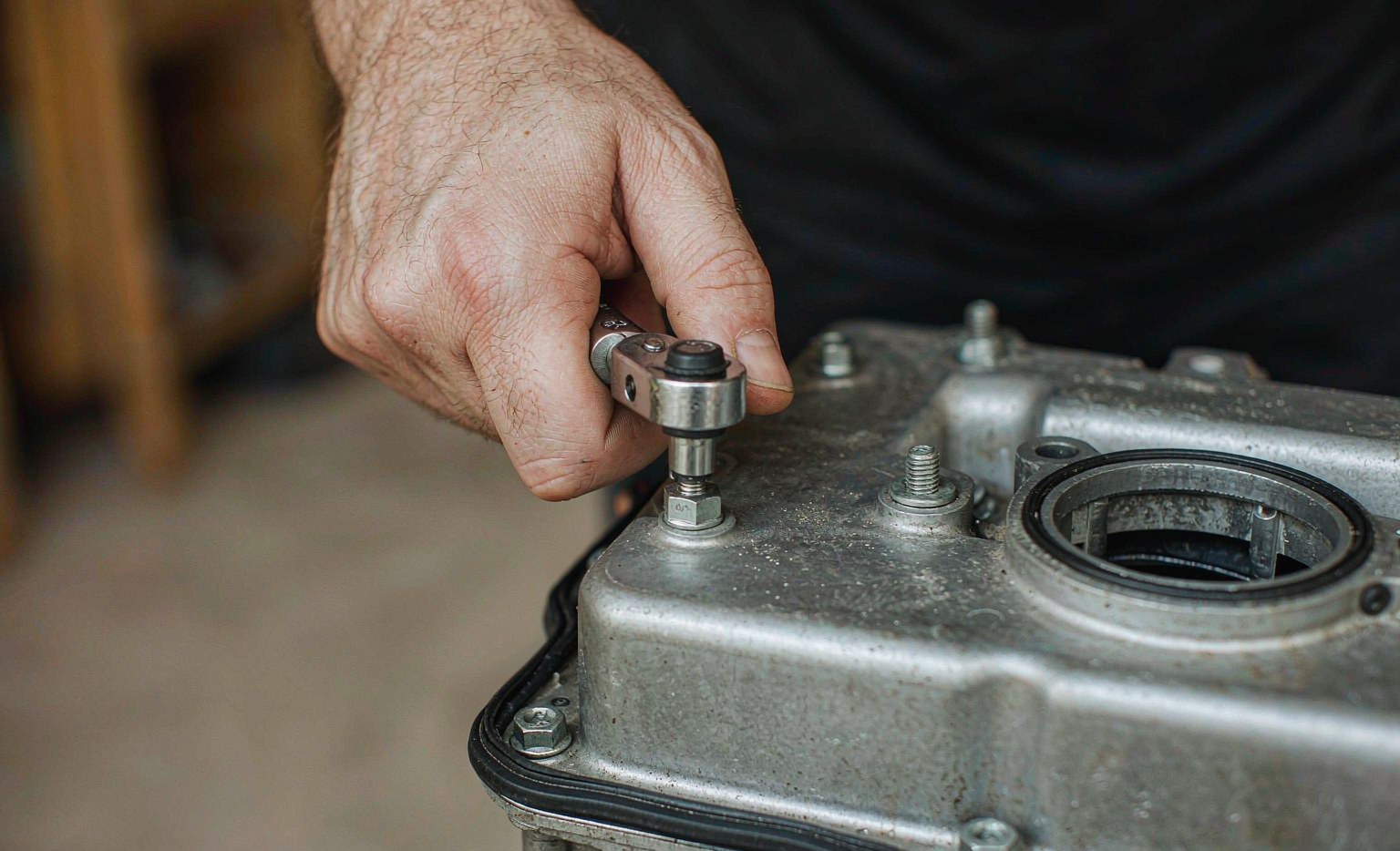
Over-torque. Valve cover bolts are small, usually M6, and the specification is 8–12 Nm on most engines — about the force of a firm wrist, not a ratchet handle. Tightening beyond that crushes the gasket profile and distorts a plastic cover. The leak that appears three months after a "quick" gasket job is almost always an over-torqued one.
Warped or cracked covers. Plastic covers on modern turbo engines move and crack with age; aluminium covers warp if they have been overheated. A straightedge and feeler gauge across the sealing face takes a minute and prevents a repeat repair. If the cover is out of flat, no gasket will seal it, and the correct part to sell is the complete cover with gasket fitted.
How Long Should One Last?
Published service life clusters between 60,000 and 120,000 miles, with most workshops quoting 60,000 to 100,000 miles as the realistic window. Treat those figures as a planning horizon, not a service interval — no manufacturer schedules valve cover gasket replacement, because the part is replaced when it leaks, and the spread between a 60,000-mile failure and a 150,000-mile one is driven by conditions rather than design.
Three conditions shorten the window predictably. Sustained high ambient temperature hardens rubber faster, so fleets in the Gulf, North Africa and South Asia see earlier failures than the same engine in a temperate market. Engines that already burn oil coat the gasket in hot vapour and degrade it from both sides. And any engine with a marginal PCV system pressurises the cover continuously. In those three cases, inspection at every oil change is worth more than any mileage rule.
For a workshop, the practical instruction to give a customer is simple: check the seam and the plug wells at every service, and replace when you find fresh oil — not when a number on a chart says so.
The Tube Seals Nobody Quotes
Most modern covers carry four separate tube seals — one per spark plug well — pressed into the cover, and they fail at roughly the same age as the perimeter gasket. When they do, oil fills the well from below, the coil boot sits in it, and the spark shorts down the insulator instead of jumping the gap.
The commercial consequence is a second repair. A shop that orders only the perimeter gasket discovers the wells are full during reassembly, and either reuses the old seals or pulls the cover again a month later. Complete kits include the tube seals and the cover grommets for the bolt holes, and they cost a few dollars more. Any engine with oil in the wells should also have the affected coil boots inspected; a swollen, soft boot will keep misfiring even with a dry well.
Torque, Sequence and Sealant: The Install Rules That Matter
Installation errors cause more comebacks than material defects. The procedure below is the one that holds across BMW, Mercedes-Benz, Toyota and Lexus four-cylinder and six-cylinder engines; confirm the exact figure in the workshop manual for the engine in front of you, because the pattern and the spec do vary.
1. Clean the mating surfaces completely. Old gasket residue, cured sealant and oil film all prevent the new profile from seating. Solvent and a plastic scraper, then a lint-free cloth — no abrasive disc on an aluminium head.
2. Check the cover for flatness. Straightedge and feeler gauge across the sealing face; a plastic cover that rocks or shows a gap needs replacing, not resealing.
3. Fit the gasket dry. Modern moulded gaskets seat in the cover groove without sealant. The only exception is a small dab of RTV at the corners where the cover meets a separate cam cap or timing cover, where the manual calls for it. Sealant anywhere else, especially in an oil drain-back passage, can block an oil feed.
4. Hand-thread every bolt first. Threading by hand prevents cross-threading and stops the cover being pulled off-centre as the first bolt tightens.
5. Torque in three passes, centre outward, in a cross pattern. Roughly 30 percent, 70 percent, then full value — typically 8–12 Nm for M6 bolts, with some engines specifying 7–10 Nm. A torque wrench is not optional here; the difference between sealed and crushed is a few newton-metres.
6. Reassemble and verify. Refit coils to their original wells, reconnect the PCV and breather hoses, run the engine for five minutes, then inspect the seam with a torch. Recheck after 50 miles, when the gasket has taken its first heat cycle.
Two things not to do: never reuse a gasket that has been compressed, and never pour in a stop-leak product to buy time. Stop-leak swells rubber briefly and then deposits in oil passages and the heater matrix, which turns a cheap repair into an expensive one.
What the Repair Costs, by Engine Layout
Cost is driven almost entirely by how much has to come off to reach the cover. The ranges below reflect parts plus labour in a typical independent workshop; dealer pricing runs higher, and markets with expensive labour skew toward the top of each band.
| Engine layout | Labour | Gasket kit | Typical total |
|---|---|---|---|
| Inline four, cover accessible | 1.5–2 hours | USD 20–40 | USD 150–250 |
| V6, front cover only | 2–3 hours | USD 30–60 | USD 250–400 |
| V6 or V8, intake removal needed | 4–6 hours | USD 50–100 | USD 500–800 |
| Any layout needing a new plastic cover | as above | plus USD 80–250 | add to the band |
The contrast worth putting in front of a customer is the downstream cost of delay: an oil-fouled catalytic converter runs USD 500–1,500, and oil on a hot manifold is a genuine, if uncommon, fire risk. A gasket job at the low end of these bands is the cheaper decision every time.
OE Numbers We Hold for BMW, Mercedes-Benz, Toyota and Lexus
Match the number stamped or moulded on the original part before ordering — covers and gaskets changed within the same engine family, and a number that fits an E46 does not necessarily fit an E90. The references below are held in our Guangzhou warehouse and ship as complete kits with the tube seals where the application uses them. Every number links to its own page with fitment detail and cross-reference data.
| OE number | Application | Availability |
|---|---|---|
| 11120030496 | BMW 5 Touring (E39), X3 (E83) | In stock · MOQ 50 pcs |
| 11120031987 | BMW 1 (E87), 3 Coupe (E46) | In stock · MOQ 50 pcs |
| 11120032224 | BMW X3 (E83), 3 Compact (E46) | In stock · MOQ 50 pcs |
| 11120034105 | BMW M62 4.4 / 4.6 V8 | In stock · MOQ 50 pcs |
| 11120034106 | BMW M50 2.0 / 2.5 | In stock · MOQ 50 pcs |
| 11120034108 | BMW M50 2.0 / 2.5 | In stock · MOQ 50 pcs |
| 11121271414 | BMW 5 (E28), 6 (E24) | In stock · MOQ 50 pcs |
| 11121432885 | BMW 3 (E36), Z3 Roadster (E36) | In stock · MOQ 50 pcs |
| 11121721876 | BMW 3 (E30), Z3 Roadster (E36) | In stock · MOQ 50 pcs |
| 11121730230 | BMW Z1, Bertone Freeclimber | In stock · MOQ 50 pcs |
| 11127513194 | BMW 5 (E60), X5 (E53) | In stock · MOQ 50 pcs |
| 11127513195 | BMW 5 (E60), X5 (E53) | In stock · MOQ 50 pcs |
| 11127566289 | BMW S63 / N63 4.4 turbo V8 | In stock · MOQ 50 pcs |
| 11127581215 | BMW 3 (E90), Z4 Roadster (E85) | In stock · MOQ 50 pcs |
| 0140010001 | Mercedes-Benz Sprinter, Auto Union Munga | In stock · MOQ 50 pcs |
| 0140010008 | Mercedes-Benz E-Class, Jaguar Mk X | In stock · MOQ 50 pcs |
| 1020161221 | Mercedes-Benz 190 (W201), 124 Saloon (W124) | In stock · MOQ 50 pcs |
| 1040100630 | Mercedes-Benz S-Class (W140), 124 Saloon (W124) | In stock · MOQ 50 pcs |
| 1040102130 | Mercedes-Benz E-Class Coupe (C124), G-Class (W463) | In stock · MOQ 50 pcs |
| 1110100430 | Mercedes-Benz Sprinter, SsangYong Musso (FJ) | In stock · MOQ 50 pcs |
| 1110160221 | Mercedes-Benz Sprinter, VW LT | In stock · MOQ 50 pcs |
| 1120160221 | Mercedes-Benz Vito, Chrysler Crossfire Roadster | In stock · MOQ 50 pcs |
| 1120160321 | Mercedes-Benz Vito, Chrysler Crossfire Roadster | In stock · MOQ 50 pcs |
| 1130160221 | Mercedes-Benz SLK (R171), G-Class (W463) | In stock · MOQ 50 pcs |
| 1121315050 | Toyota Corolla Caribe, Holden Nova (LF) | In stock · MOQ 50 pcs |
| 1121320030 | Toyota Camry, Lexus ES (MCV / VZV) | In stock · MOQ 50 pcs |
| 1121321011 | Toyota Corolla Axio (E16), Scion xA | In stock · MOQ 50 pcs |
| 1121328021 | Toyota Camry (V5), Avensis (T27) | In stock · MOQ 50 pcs |
| 1121331050 | Lexus ES (V6), Bolwell Nagari | In stock · MOQ 50 pcs |
| 1121350031 | Lexus GS (S19), Hongqi Shengshi | In stock · MOQ 50 pcs |
Applications above are the first two model lines on each reference, not the full fitment list — the product page for each number carries the complete application set and any cross-reference to other brands. If a number is not listed, send it with a photo of the original part; our team checks the wider OE reference library, which currently holds more than 13,500 numbers, and answers within 24 hours.
Buying Valve Cover Gaskets Wholesale from Guangzhou
Three decisions shape the order, and each one has a failure mode worth knowing before the container is booked.
Gasket only, or complete kit. The kit — perimeter gasket, tube seals, bolt grommets — is the version that sells to workshops, because it matches the labour already being charged. Single gaskets sell to price-driven retail and to shops that already hold seals. Stock roughly 70 percent kits and 30 percent single gaskets unless your customers tell you otherwise.
Material and hardness. HNBR and silicone handle heat better than basic EPDM, and the price difference is cents per piece, not dollars. Ask for the compound and the hardness on the datasheet; a supplier who cannot name the compound is buying on price from someone else. For Gulf and African markets, specify the higher-temperature compound and say so on the label.
Packing and mixed loads. Gaskets are light and bulky, so they combine well with heavier parts in a mixed container — a natural fit for a buyer already shipping brake or suspension lines. Flat-packing in labelled poly bags with the OE number printed on each bag saves hours at the receiving end, and it is the kind of detail that separates a warehouse-ready supplier from one that ships loose pieces.
Our minimum is 50 pieces per reference, which is low enough to test a new application before committing a full run, and we ship from Nansha with the same documentation we use for complete vehicles — commercial invoice, packing list and certificate of origin. Send the OE numbers you need and we will come back with availability, the compound specification and a quotation.
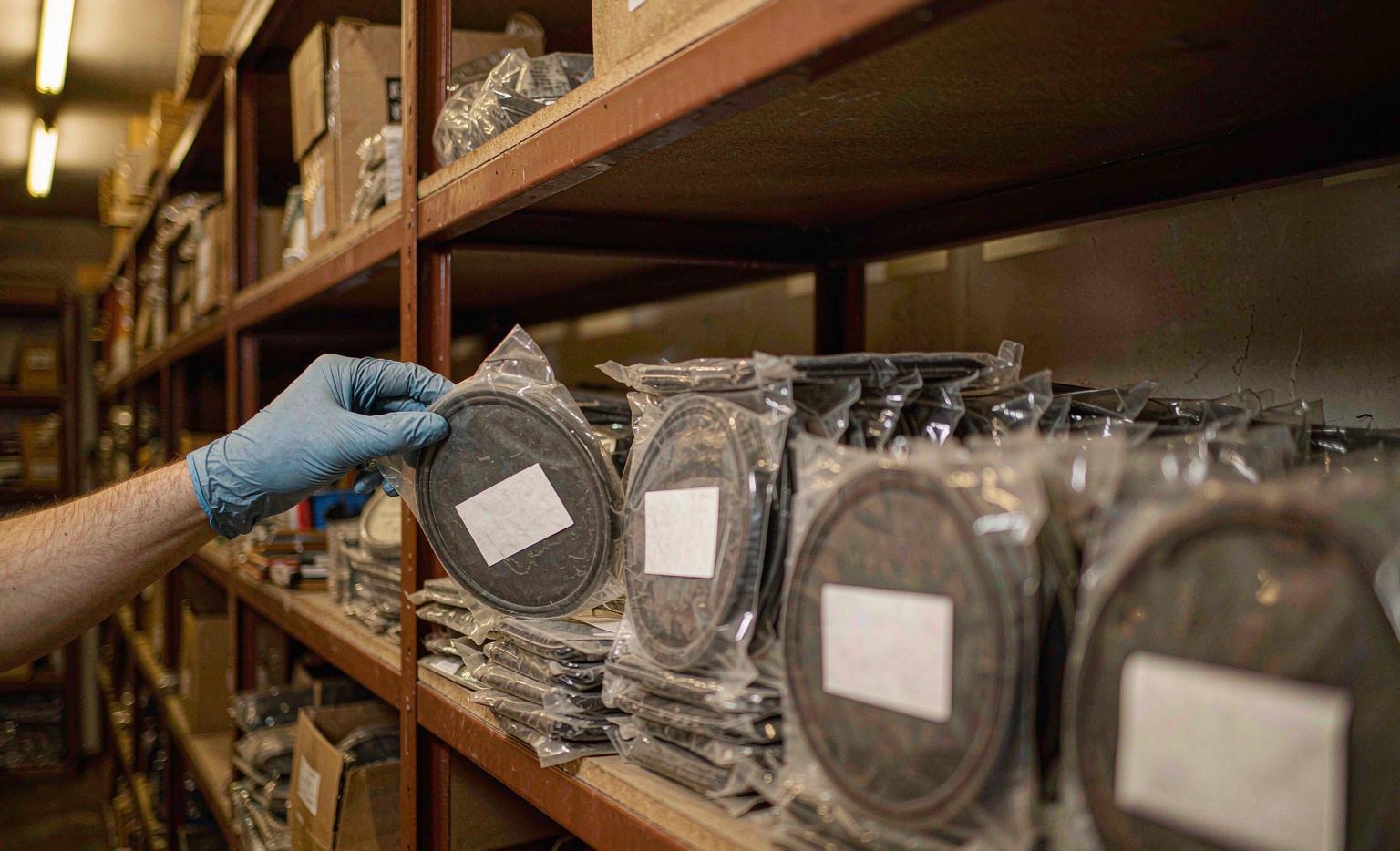
Send us your OE list. Photograph the number on the old gasket or the cover, send it over WeChat or through the enquiry form, and we will match it against our engine gasket range, confirm the tube seals for that application and quote FOB Guangzhou within 48 hours. Mixed containers with brake, cooling or suspension lines are welcome.
Frequently Asked Questions
Can I drive with a leaking valve cover gasket?
Short term, yes — but the clock is not free. Oil dripping onto the exhaust manifold burns and smokes, oil in the spark plug wells causes misfires that can destroy a catalytic converter, and a leak near the turbo or manifold carries a fire risk. Treat a slow external seep as a repair to schedule within weeks, and a leak that has reached a hot surface or the plug wells as a repair to do now.
How do I know it is the cover gasket and not the head gasket?
Check three things: coolant level, oil colour and exhaust. A valve cover gasket leaks oil only, leaves the coolant level alone and does not overheat the engine. A head gasket typically loses coolant with no visible drip, turns the oil milky, sends white sweet smoke out of the tailpipe and pushes the temperature gauge up. A combustion-gas test on the coolant settles it in ten minutes.
Do I need to replace the whole valve cover?
Only if the cover is warped, cracked or its sealing face is out of flat — common on plastic covers fitted to modern turbo engines. On an aluminium cover that passes a straightedge check, the gasket and tube seals are enough. Replacing a gasket on a warped cover guarantees a repeat leak.
How long does the job take?
An inline four with the cover accessible runs 1.5–2 hours. A V6 where the intake has to come off runs 4–6 hours. Add time for cleaning, and add the cost of a new cover if flatness fails.
Can I reuse the old gasket or seal it with RTV?
No on both counts. A compressed gasket has taken a permanent set and will not seal again, and sealant on a moulded rubber profile prevents it seating in its groove. RTV belongs only at the corners where the manual specifies it. Stop-leak additives are worse — they swell the rubber briefly, then clog oil passages.
What is the minimum order for wholesale supply?
Fifty pieces per reference. Kits and single gaskets can be mixed within one order, and gaskets combine well with brake, cooling or suspension parts in a mixed container. Quotations are issued FOB Guangzhou, usually within 48 hours of receiving the OE list.
Related Articles


Related Products
From our export catalog — parts and vehicles ready for international delivery

Full-Size EREV SUV
2026 Rox Adamas EREV 215km 6-Seat Executive Edition
USD 53,000 FOB Guangzhou
View Details
Full-Size EREV SUV
2026 Rox Adamas EREV 215km 7-Seat All-Terrain Edition
USD 51,500 FOB Guangzhou
View Details
