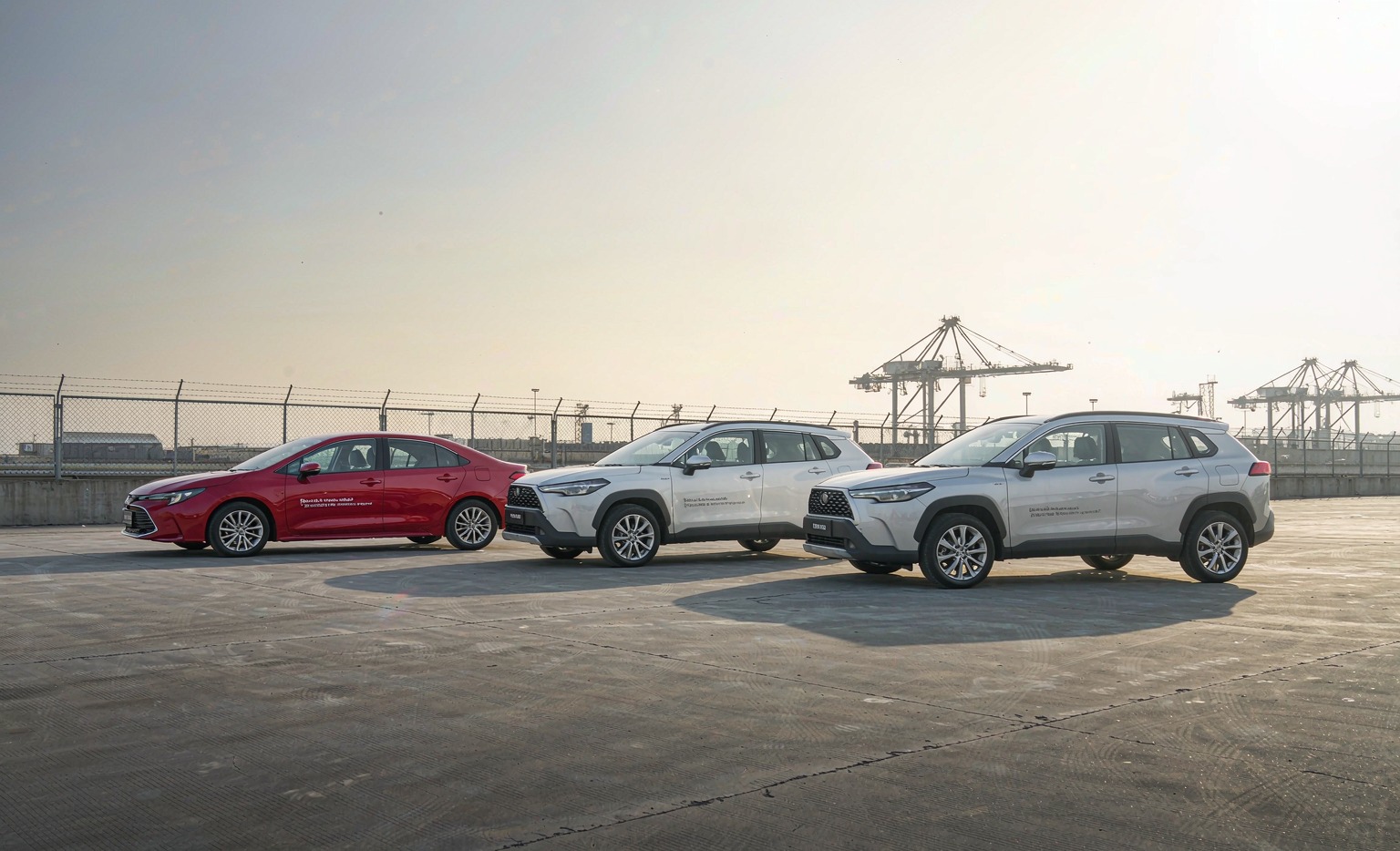
Walk into any taxi rank from Lagos to Lima and you will find one car doing most of the work: the Toyota Corolla. Twelve generations, more than 50 million units sold, and a nameplate that has outlived every prediction of its decline. In 2026 Toyota's export programme from China is built around a small family that wears the Corolla badge — the sedan that started it all, plus two crossovers that use the same hybrid drivetrain and ride on the same Toyota New Global Architecture (TNGA) platform.
This guide is written for vehicle distributors, fleet operators and dealer principals who need a single reference for the 2026 Corolla family. We cover the three vehicles we quote most often from Guangzhou, the 1.8L and 2.0L hybrid powertrains, the Khorgos FOB price ladder, the destination markets that move Corolla family stock at volume, and the most common nameplate confusion we see between the three. All prices are FOB tier for LHD units; RHD is available on order for select trims.
01 The Corolla Family in the 2026 Wholesale Trade
The Corolla nameplate entered its 12th generation in 2019 and has carried the E210 platform since. In the 2026 export catalogue Toyota splits the nameplate across three distinct vehicles that share the same THS-II hybrid system and the same TNGA-C architecture, but address different buyers: the sedan for traditional fleet and taxi duty, the Corolla Cross for the compact-crossover segment, and the Frontlander for the slightly larger and more SUV-styled crossover market. For a wholesale buyer this is the year to think of "Corolla" as a family rather than a single car — three vehicles with related but distinct parts programmes and price points.
The unifying thread is the hybrid powertrain. The sedan runs the 1.8L 2ZR-FXE Atkinson-cycle engine paired with THS-II, the Corolla Cross runs the 2.0L M20A-FXS engine on the same THS-II hardware, and the Frontlander is essentially the Corolla Cross with a different body style and equipment list. That shared platform means the parts programme is largely portable across the three — a fact that has made the Corolla family a favourite for distributors building out a Toyota parts book on a single OE map.
The other thing to keep in mind is port routing. The Corolla sedan 1.8L Hybrid Pioneer is the price-entry unit and ships primarily from Nansha for the Gulf, Africa and Latin America. The Cross 2.0L Hybrid Elite and the Frontlander 2.0L Hybrid Luxury are heavier, more equipment-loaded, and ship primarily from Khorgos via the China-Kazakhstan rail corridor to Russia and Central Asia. Understanding that routing logic is what makes the Corolla family economical to stock — one sourcing decision per car, not three.
02 Three Corolla Family Configurations and Their FOB Prices
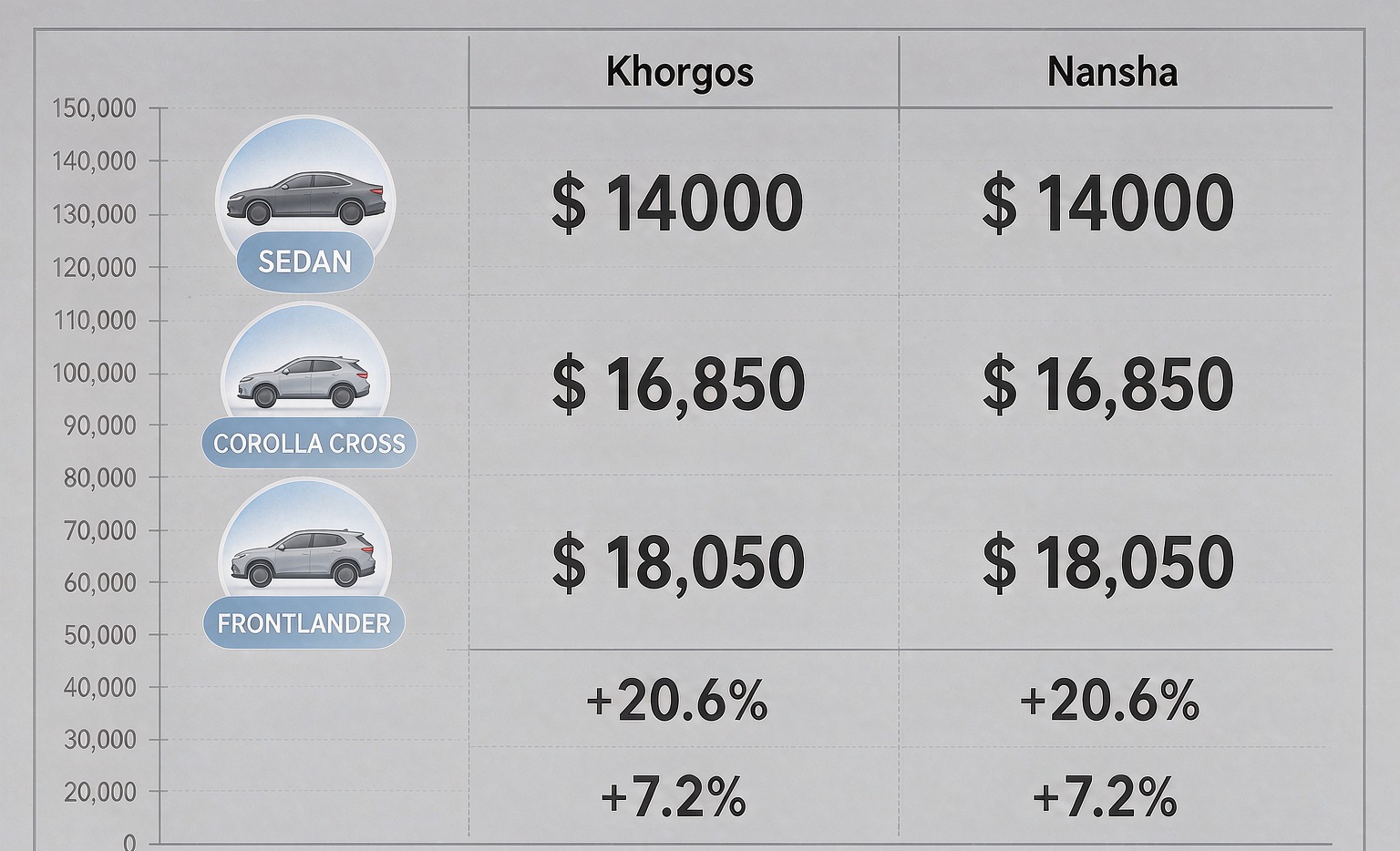
The 2026 Corolla family export range runs three configurations we quote from Guangzhou in October 2026. The table below sets out indicative FOB pricing, the port of loading, and the wholesale role each vehicle plays.
| Vehicle | Engine | Indicative FOB | Port | Wholesale Role |
|---|---|---|---|---|
| Corolla 2026 Sedan 1.8L Hybrid Pioneer | 1.8L 2ZR-FXE hybrid, 90 kW system | USD 14,000 | Nansha | Fleet, taxi, ride-hailing, price-entry retail |
| Corolla Cross 2026 2.0L Hybrid Elite | 2.0L M20A-FXS hybrid, 144 kW system | USD 16,850 | Khorgos | Mid-trim compact crossover for retail and corporate fleets |
| Frontlander 2026 2.0L Hybrid Luxury | 2.0L M20A-FXS hybrid, 144 kW system | USD 18,050 | Khorgos | Top-trim crossover, SUV styling, larger boot |
Three observations. First, the price spread across the family is roughly USD 4,050 — between the entry sedan and the top-trim Frontlander — which is narrower than the RAV4 family spread and reflects the shared TNGA-C platform economics. Second, the Corolla Cross and Frontlander sit on the same powertrain and the same FOB-plus-margin pricing logic; what differentiates them at retail is body style, equipment content and the slightly larger boot on the Frontlander. Third, the sedan at USD 14,000 is the price reference that every used-Japanese compacts are benchmarked against — and where a new-vehicle warranty plus hybrid fuel economy wins the comparison shopping.
03 The THS-II Hybrid System: 1.8L and 2.0L Architecture
Both engines in the 2026 Corolla family run Toyota's THS-II (Toyota Hybrid System II) architecture — the planetary gear-set arrangement that has been refined since the Prius launched in 1997. There is no clutch, no torque converter, no multi-speed gearbox; the engine, motor-generators (MG1, MG2) and the planetary gear set manage torque flow through the hybrid control unit. For wholesale buyers this is a stable architecture: the same control logic, the same battery thermal management approach, and the same kind of high-voltage cabling that any Toyota-certified technician can service.
The 1.8L 2ZR-FXE in the sedan produces 90 kW of system output, with combined fuel consumption around 4.2 L/100 km on the NEDC-equivalent cycle. It is the price-entry engine, sized for taxi and ride-hailing duty cycles where fuel cost dominates the operating math. The 2.0L M20A-FXS in the Cross and Frontlander produces 144 kW of system output, with combined fuel consumption around 4.5 L/100 km. Both engines are tuned for 92 RON petrol, both carry a lithium-ion battery pack (rather than the older nickel-metal-hydride), and both share the same cooling and inverter architecture, which is why the parts programme on the hybrid-specific items is essentially one programme across the three vehicles.
04 Khorgos Versus Nansha: Same Hybrid, Different Routes
The Corolla family splits cleanly by destination. The 1.8L Hybrid Pioneer sedan clears at FOB Nansha and ships predominantly by RORO to the Gulf (Jebel Ali, 18-22 days), Africa (Durban, 25-30 days) and Latin America (Santos, 35-42 days). The 2.0L Hybrid Elite Cross and the 2.0L Hybrid Luxury Frontlander clear at FOB Khorgos and move primarily by the China-Kazakhstan rail block train (15-22 days to Almaty, with onward transload to Moscow and other EAEU destinations).
| Corolla Family Variant | Loading Port | Typical Buyer | Volume Tier |
|---|---|---|---|
| 1.8L Hybrid Pioneer sedan | Nansha port | Gulf fleets, African taxi, Latin American retail | Highest unit volume |
| 2.0L Hybrid Elite Cross | Khorgos dry port | Russia retail, Kazakhstan / Uzbekistan corporate | Mid-volume, rising |
| 2.0L Hybrid Luxury Frontlander | Khorgos dry port | Russia retail premium, Central Asia top trim | Lower volume, higher per-unit margin |
The pricing logic is straightforward: Nansha is the port for the sedan because the sedan is the higher-volume unit and Gulf/Africa buyers want fast RORO economics. Khorgos is the port for the Cross and Frontlander because Russian and Central Asian buyers pay for the equipment content and the rail economics favour heavier, higher-trim vehicles. Container loading runs four units per 40HC for the sedan (the lightest of the three) and three to four units per 40HC for the Cross and Frontlander; RORO from Nansha wins on per-unit cost above eight sedans per sailing, and above six Cross/Frontlander units per sailing.
05 Sixty Years of the Corolla Nameplate
The Corolla nameplate has been in continuous production since 1966 — eleven generations in Japan, the 12th in production for export markets since 2019. In export markets the Corolla family has been Toyota's volume anchor in three distinct phases: the E110/E120 sedans that dominated the taxi trade from the late 1990s to early 2010s, the E140/E170 sedans that carried the fleet and ride-hailing boom of the 2010s, and now the E210 platform that anchors both the sedan and the Cross/Frontlander crossover twins.
For wholesale buyers the generational continuity matters because of one specific commercial fact: the parts channel is exceptionally deep. A distributor stocking filters, brake pads, suspension bushings, lighting and sensors for the current-generation Corolla can cover roughly 80% of the previous-generation aftermarket demand with the same OE references or near-equivalents. That is the depth no other nameplate in the export trade matches, and it is the depth that makes a Corolla family stocking programme economically attractive from the first container.
The crossover expansion is a newer story. The Corolla Cross launched in 2020 and the Frontlander in 2021, both built on TNGA-C with the 2.0L hybrid system; both have moved into the global distribution chain alongside the sedan. For a distributor entering the Corolla family in 2026, the practical mix is two sedans, one Cross, one Frontlander in the trial container — covering fleet duty, retail crossover, and top-trim retail in one shipment.
06 Destination Markets for the Corolla Family 2026
The destination map for the 2026 Corolla family clusters around four corridors. Russia and the EAEU is the largest single market for the Cross and Frontlander, where the 2.0L hybrid's fuel economy and Toyota's dealer network give it a service-network advantage over Chinese compact crossovers priced similarly. Central Asia (Kazakhstan, Uzbekistan, Kyrgyzstan) takes mid-trim Corolla Cross units through the Khorgos rail route, with Almaty acting as the regional hub. The Gulf (UAE, Saudi Arabia, Kuwait) takes the 1.8L sedan in volume for fleet, taxi and ride-hailing, mostly through Nansha RORO. Latin America (Chile, Peru, Colombia) takes both the sedan and the Corolla Cross, with Chile's zero-duty FTA framework making Santiago the cleanest regional price benchmark.
Three market notes. First, the 1.8L sedan's price point at USD 14,000 FOB Nansha makes it the lowest-priced new-Toyota hybrid in the global export trade — a positioning that wins fleet contracts where operating cost per kilometre is the deciding metric. Second, Russia's 2025-2026 utilization fee has pushed buyers toward higher-trim hybrid units where the fixed fee amortises better against equipment value, which is why the Corolla Cross and Frontlander order book out of Khorgos is growing faster than the sedan order book out of Nansha for Russia specifically. Third, Africa's used-Japanese Corolla replacement cycle continues to feed the new-Corolla pipeline — a Corolla E170 sold in Cairo in 2014 is now at the end of its service life, and the replacement unit is overwhelmingly another Corolla, just newer and with a hybrid drivetrain.
07 Parts Commonality Across the Corolla Family
The single biggest operational advantage of stocking the Corolla family is parts commonality. The table below summarises the systems that share OE references across the sedan, Cross and Frontlander.
| System | Common Across Family? | Notes for Wholesale Buyers |
|---|---|---|
| Hybrid powertrain (THS-II) | Yes — 1.8L and 2.0L variants | MG1/MG2 motor-generators share service parts; battery cooling common |
| TNGA-C platform suspension | Yes | Front MacPherson + rear torsion beam on sedan; multi-link on Cross/Frontlander |
| Brake system (front) | Partial — vented rotors common; pad sets split by chassis | Confirm by VIN at quote stage |
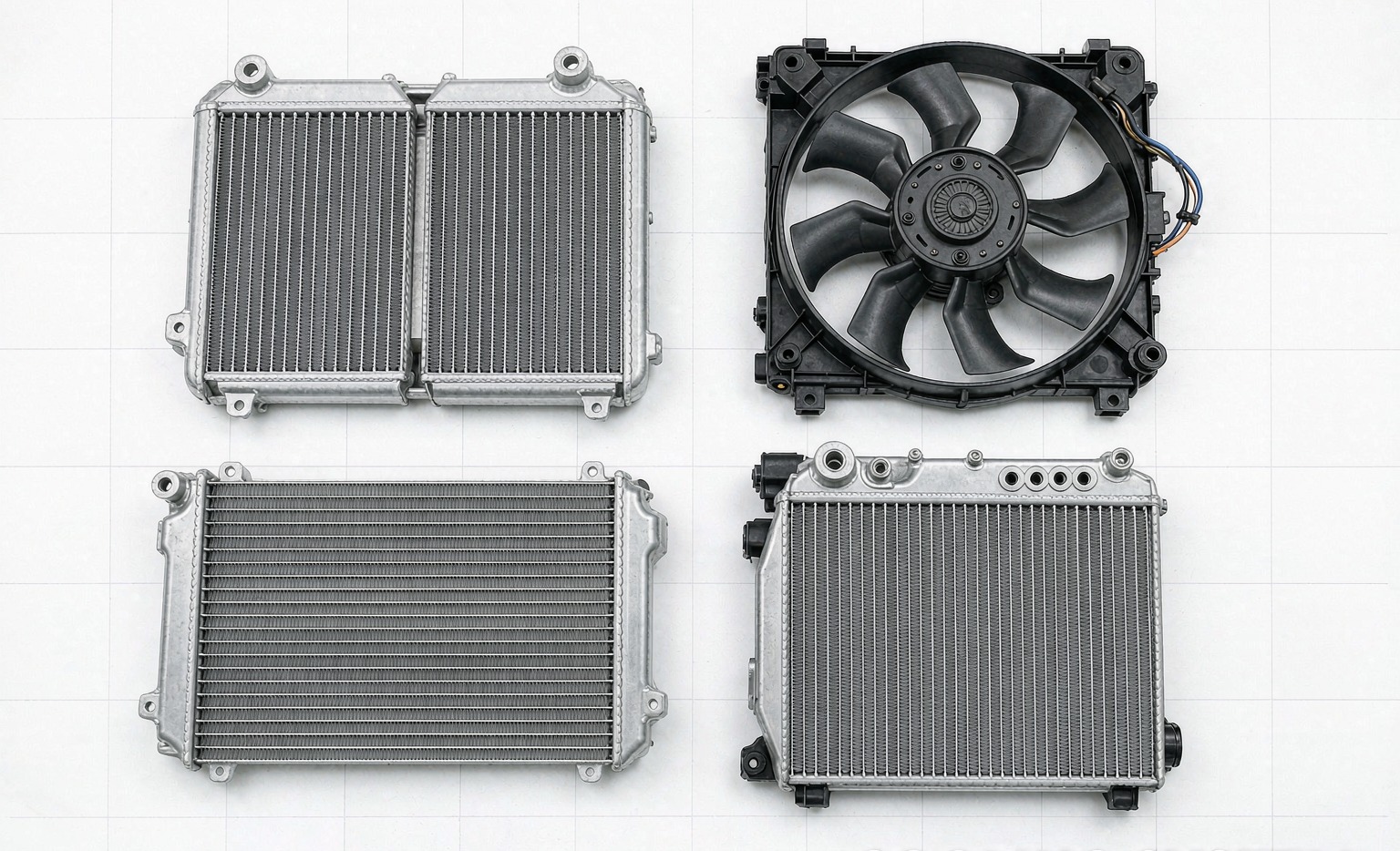
| Cooling system | Yes | Radiator, condenser, cooling fan share common architecture |
| Lighting | Partial | Headlamp cluster and tail lamp body-specific; bulbs common |
| Body panels | No — body-specific | Bumpers, fenders, bonnets and doors are body-specific |
Two operational implications. First, a distributor building a Corolla family parts programme can lean on a small set of common OE references for the high-turnover service items — radiator, condenser, MG1/MG2 motor-generator service parts, cabin filter, oil filter — and only needs to maintain body-specific SKUs for the trim and accident-repair items. Second, the hybrid-specific parts (inverter, converter, battery pack, battery cooling plate) carry the same part numbers across the family in most cases, with the 1.8L and 2.0L variants differing only in capacity calibration. Our dedicated Hyundai/Kia parts wholesale guide covers the comparable programme for the Korean competition.
08 The Same-Name Confusion: Corolla, Corolla Cross and Frontlander
The single most common wholesale mistake in the Corolla family trade is treating "Corolla" as a single vehicle. In 2026 the Corolla nameplate is three distinct cars with three distinct parts books at the body level. The table below summarises the differences that matter at wholesale.
| Item | Corolla Sedan | Corolla Cross | Frontlander |
|---|---|---|---|
| Body style | Four-door sedan | Compact crossover SUV | Larger-styled crossover SUV |
| Wheelbase | 2,700 mm | 2,640 mm | 2,645 mm |
| Boot space | 471 L | 440 L (rear seats up) | 458 L |
| Powertrain | 1.8L hybrid | 2.0L hybrid | 2.0L hybrid |
| Drive | FWD | FWD (AWD select markets) | FWD |
| Target buyer | Fleet, taxi, retail sedan | Compact crossover retail | Premium crossover retail |
| Typical market | Gulf, Africa, Latin America | Russia, Central Asia, Latin America | Russia, Central Asia |
The confusion that matters most: a buyer who orders "a Corolla" expecting the sedan and receives the Cross (or vice versa) creates a return-and-refund problem that no one in the trade wants. The fix is to specify by full model code at quote stage — the sedan's E210 chassis code differs from the Cross's E210G and the Frontlander's slightly different body — and to confirm against the buyer's market homologation rules. For a first-time importer, building a small trial container that pairs the three vehicles is the safest way to gauge which configuration wins the local retail book.
09 Ordering Process, Lead Time and Mixed Loading
A first Corolla family order through our desk follows six steps: vehicle-by-vehicle configuration confirmation, market-spec calibration against your country's homologation rules (Russia EAC, GCC, Latin American type-approval), proforma invoice with FOB Khorgos or FOB Nansha terms, 30% deposit, production slot booking (3-4 weeks for non-stock trims, faster for in-port units), pre-shipment inspection with photo report, and balance against shipping documents. In-port units at Nansha ship within 10 days of deposit; Khorgos rail bookings move on the China-Kazakhstan block-train schedule with 5-7 days from deposit to rail load.
Mixed loading across the family is the standard first-order pattern: two sedans plus one Cross and one Frontlander in the trial container gives a dealer a fleet unit, a compact-crossover retail demonstrator, and a top-trim retail demonstrator in one clearance. For Russia and Central Asia, the mix leans toward the Cross and Frontlander; for the Gulf and Africa, it leans toward the sedan. Add a parts package — filters, brake pads, the high-turnover lighting and sensor items — sized to six months of service demand, and the dealer opens with both sales stock and workshop stock from the first container.
10 Frequently Asked Questions
What is the Toyota Corolla family 2026 wholesale export price from China?
The 2026 Corolla family clears FOB Nansha from USD 14,000 (1.8L Hybrid Pioneer sedan), FOB Khorgos at USD 16,850 (Corolla Cross 2.0L Hybrid Elite), and FOB Khorgos at USD 18,050 (Frontlander 2.0L Hybrid Luxury) — all at container tier for LHD units in mid-October 2026 quotations. Volume discounts of 2-4% apply above ten units per configuration.
What is the difference between the Corolla sedan, Corolla Cross and Frontlander?
Three vehicles on the same TNGA-C platform: the sedan (1.8L hybrid, 2,700 mm wheelbase, 471 L boot, fleet duty); the Corolla Cross (2.0L hybrid, 2,640 mm wheelbase, 440 L boot, compact-crossover retail); the Frontlander (2.0L hybrid, 2,645 mm wheelbase, 458 L boot, premium-crossover retail). The powertrains and most hybrid parts are shared; the body panels, headlamp clusters and trim-specific items are body-specific.
Which Corolla family variant is the volume leader?
The 1.8L Hybrid Pioneer sedan at USD 14,000 FOB Nansha is the single largest volume vehicle in the family, because the price point captures fleet, taxi and ride-hailing buyers across the Gulf, Africa and Latin America. The Corolla Cross at USD 16,850 FOB Khorgos is the fastest-growing variant — driven by Russian and Central Asian retail demand for a compact crossover with hybrid fuel economy.
Do the Corolla family variants share parts?
Yes, partially. The hybrid powertrain (THS-II), TNGA-C platform suspension, cooling system and cabin filter are common across the family. Brake pad sets, body panels, headlamp clusters and tail lamps are body-specific and must be cross-referenced by VIN. A distributor building a Corolla family parts programme can lean on a small common-OE set for the high-turnover items and only needs body-specific SKUs for trim and accident-repair work.
Where do Corolla family cars ship from — Khorgos or Nansha?
The 1.8L Hybrid Pioneer sedan ships primarily from Nansha port for the Gulf, Africa and Latin America. The Corolla Cross 2.0L Hybrid Elite and Frontlander 2.0L Hybrid Luxury ship primarily from Khorgos dry port for Russia and Central Asia via the China-Kazakhstan rail corridor. The split reflects destination logistics, not vehicle quality or specification differences.
Is the Toyota Corolla 2026 family available in RHD?
RHD units are available on order for select trims in the 2026 export programme, primarily for distributor markets in Africa, Southeast Asia, and the Gulf where RHD is required. Lead times run 6-10 weeks beyond the LHD timeline because RHD production slots are scheduled separately. Confirm RHD availability and surcharges at quote stage.
Data sources: Toyota 2026 Corolla family export specifications and quotation guidance; Khorgos dry port rail block-train schedule (October 2026); Nansha port RORO and container rate assessments, Q3 2026; EAEU Common Customs Tariff and 2025-2026 utilization fee schedule; GCC national vehicle type-approval frameworks; Toyota EPC parts catalogue (latest revision); Toyota Corolla global production history (1966-present). Pricing is indicative and varies with sailing date, trim selection and volume tier.
Source 2026 Toyota Corolla family stock from Globalucar Vehicle, Guangzhou. FOB Nansha from USD 14,000 (1.8L sedan), FOB Khorgos from USD 16,850 (Corolla Cross) and USD 18,050 (Frontlander) at container tier, with RORO bookings to Jebel Ali, Durban and Santos and rail routing to Russia and Central Asia via Khorgos. Contact Mr Didi: ucars@global-ucars.com, WhatsApp +86 133 0240 8528, or send your market and quantity through the contact page for a same-week quotation. 28F Guangzhou Jianhua Center, Baiyun District, Guangzhou.
Related Articles

Related Products
From our export catalog — parts and vehicles ready for international delivery

Full-Size EREV SUV
2026 Rox Adamas EREV 215km 6-Seat Executive Edition
USD 53,000 FOB Guangzhou
View Details
Full-Size EREV SUV
2026 Rox Adamas EREV 215km 7-Seat All-Terrain Edition
USD 51,500 FOB Guangzhou
View Details
