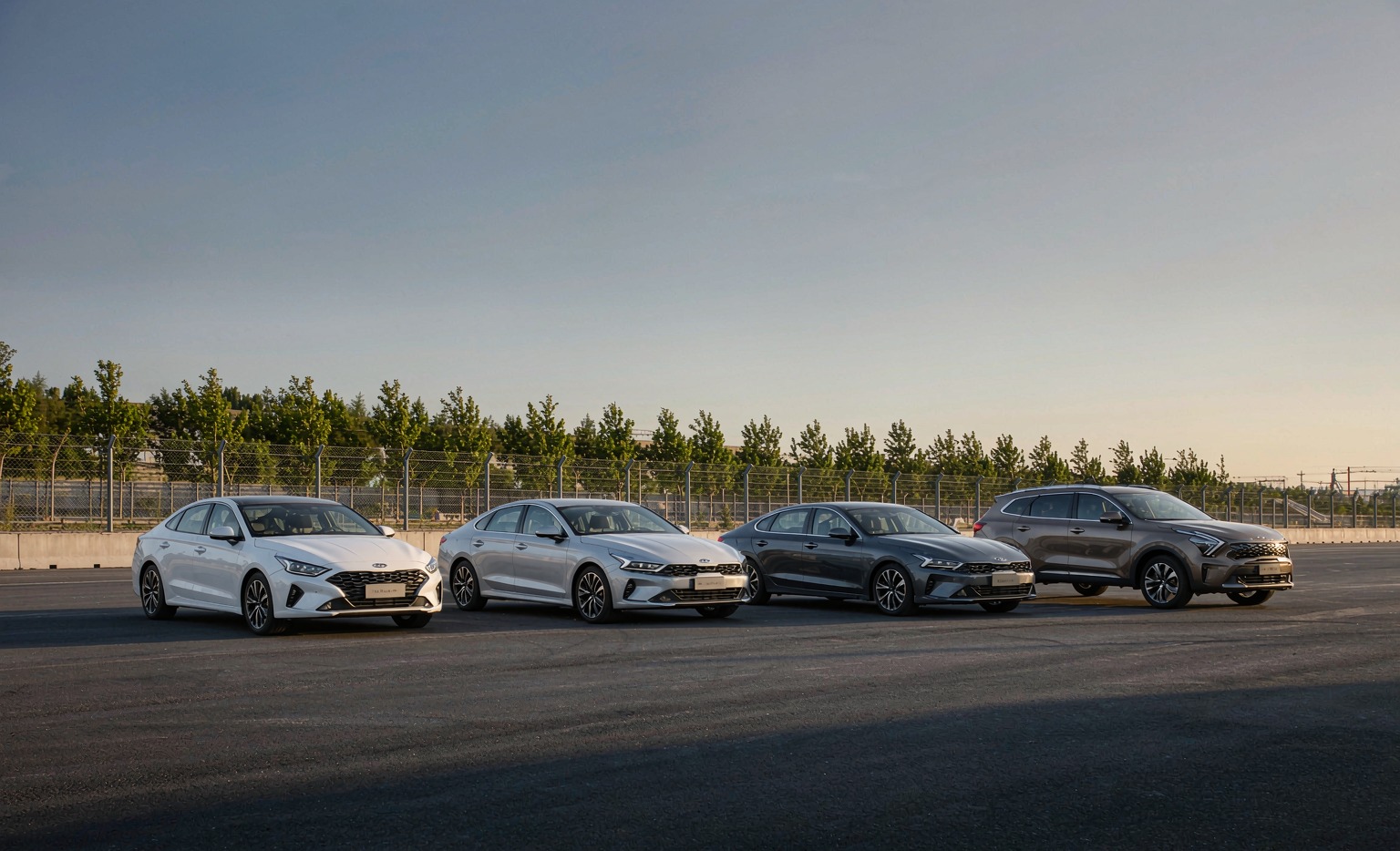
The 2026 Hyundai and Kia export programme from China and Korea moves four passenger cars that share more under the skin than the showroom placards suggest: the Hyundai Elantra (1.5L MPI naturally-aspirated), the Hyundai Sonata (1.5T Turbo), the Kia K5 (1.5T Turbo) and the Kia Sportage (1.5L Turbo). All four carry variants of the Smartstream 1.5T / 1.5L / Nu 2.0L powertrain family, all four share Hyundai-Kia's Theta II / Nu engine architecture, and all four share the same generation of cooling, ignition and engine accessory parts with only body-specific changes.
This guide is written for parts distributors, fleet suppliers and workshop chains sourcing Hyundai and Kia parts from China. It covers the shared powertrain map, the six high-turnover parts systems (cooling, ignition, engine accessories, sensors, filters, suspension top mounts), the OE number map across the family, FOB Guangzhou pricing by tier, IATF 16949 certification, and container loading arithmetic. For the vehicle-side export programme, see our Elantra 2026 export guide.
01 Why the Hyundai/Kia Family Anchors a Parts Wholesale Programme
The Hyundai-Kia passenger car family is the second-largest in the global aftermarket behind Toyota, and within the export trade it has three structural advantages that keep it anchored in a wholesale parts programme. First, parts commonality: a single OE reference often covers two or three of the four vehicles in this guide, which means a distributor can build a small stock keeping unit (SKU) list and cover a disproportionate share of the channel. Second, the parts are physically accessible: cooling, ignition and engine accessory parts sit in the category band where independent workshops and even owner-mechanics can perform the replacement. Third, the price point: Hyundai and Kia parts typically retail at 60-80% of the equivalent Toyota or Honda reference, which keeps the volume flowing through independent channels.
The 2026 programme specifically strengthens the commonality argument. Hyundai-Kia has converged its 1.5L naturally-aspirated, 1.5L turbo and 2.0L Nu engine architecture onto shared subsystems — cooling hose routing, ignition coil architecture, sensor connector types, filter housing dimensions — across the Elantra, Sonata, K5 and Sportage platforms. A distributor quoting the family can lean on a small common-OE set for the high-turnover items and only needs to maintain body-specific SKUs for trim and accident-repair work.
The other reason this family anchors a programme is the destination market map. Hyundai and Kia stock moves at volume into Russia and Central Asia, the Middle East, Africa, Southeast Asia, and Latin America — a corridor wide enough that no single market downturn disturbs the order book. For a Guangzhou-based parts wholesaler, that breadth of demand is what makes a Hyundai/Kia family programme a permanent fixture rather than a market-dependent trade.
02 The 2026 Hyundai/Kia Family Powertrain Map
The four vehicles covered in this guide share more of their powertrain than the model names suggest. The Elantra carries the 1.5L Smartstream naturally-aspirated MPI engine (roughly 115 hp) paired with a CVT. The Sonata carries the 1.5T Turbo-GDi engine (roughly 180 hp) paired with an 8-speed automatic. The K5 carries the same 1.5T Turbo-GDi (the K5 is mechanically close to the Sonata) paired with an 8-speed automatic. The Sportage carries the 1.5L Turbo-GDi engine (roughly 180 hp) paired with a 7-speed DCT.
| Vehicle | Engine | Power | Transmission | Generation |
|---|---|---|---|---|
| Hyundai Elantra 2023 (still in export catalogue) | 1.5L MPI NA | 115 hp / 144 N·m | CVT | CN7 |
| Hyundai Sonata 2026 | 1.5T Turbo-GDi | 180 hp / 253 N·m | 8-speed automatic | DN8 |
| Kia K5 2026 | 1.5T Turbo-GDi | 180 hp / 253 N·m | 8-speed automatic | DL3 |
| Kia Sportage 2026 | 1.5L Turbo-GDi | 180 hp / 253 N·m | 7-speed DCT | NQ5 |
Three observations on the map. First, the Sonata and K5 carry the same 1.5T engine with the same 253 N·m torque figure — they differ in body, equipment and brand, not in powertrain. Second, the Sportage 1.5T uses a different transmission (DCT versus automatic) but the engine itself is the same Smartstream 1.5T. Third, the Elantra is the only one in the group running a naturally-aspirated engine, which means its cooling and ignition parts carry a different sub-family of OE references even though they share the same generation of underlying architecture. The shared sub-systems are the reason a distributor can build a family-wide parts programme; the engine-specific items are the reason a careful OE cross-reference still matters.
03 Six High-Turnover Parts Systems
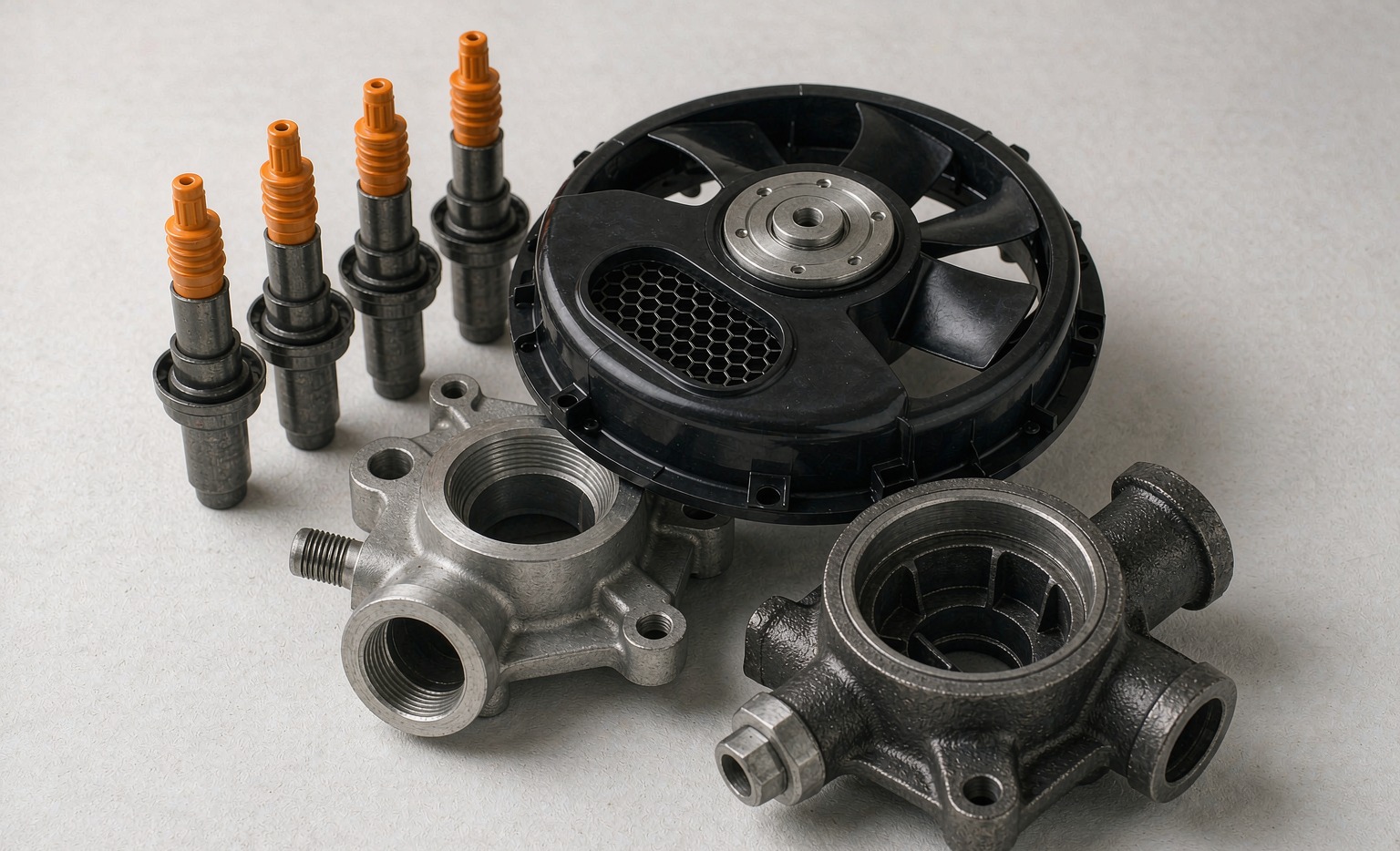
The six parts systems that drive the Hyundai/Kia family wholesale programme are: cooling system (radiator, condenser, cooling fan, thermostat), ignition (ignition coil, spark plug, ignition wires on older applications), engine accessories (alternator, starter, water pump, timing chain), sensors (crankshaft, camshaft, oxygen, MAF), filters (oil, air, cabin, fuel), and suspension top mounts (front strut mount, rear shock mount). Each system carries OE references that vary by vehicle, but the underlying part architecture is largely common across the family.
The table below summarises the OE reference commonality at the system level. The "common" tag means the same OE family series applies across two or more of the four vehicles; "split" means the references diverge by vehicle even though the part function is identical.
| System | OE Commonality | Notes for Wholesale Buyers |
|---|---|---|
| Cooling system (radiator, condenser, fan) | Split by engine code | 1.5L MPI radiator ≠ 1.5T radiator; condenser family common on Sonata/K5 |
| Ignition system (coil, plug) | Common on 1.5T family | Sonata/K5/Sportage 1.5T share ignition coil family; Elantra split |
| Engine accessories (alternator, starter, water pump) | Split by engine code | Higher-output 1.5T alternator ≠ 1.5L NA alternator |
| Sensors (CKP, CMP, O2, MAF) | Common on 1.5T family | Connector types harmonised across the 1.5T platform |
| Filters (oil, air, cabin, fuel) | Partially common | Cabin filter housing dimensions common on Sonata/K5; oil filter split by engine |
| Suspension top mounts (strut mount, shock mount) | Body-specific | Body, not engine, drives the part number — no cross-platform commonality |
The pattern across the table: powertrain-driven systems (cooling, ignition, engine accessories, sensors) split by engine code; body-driven systems (suspension top mounts) split by body. Filters sit in between because the housing dimensions are body-driven but the filter element dimensions are engine-driven. For a distributor building a Hyundai/Kia family parts programme, the practical implication is that a small common-OE set covers the high-turnover service items while body-specific SKUs are needed only for trim and accident-repair work.
04 Cooling System: Radiator, Condenser, Cooling Fan Across the Family
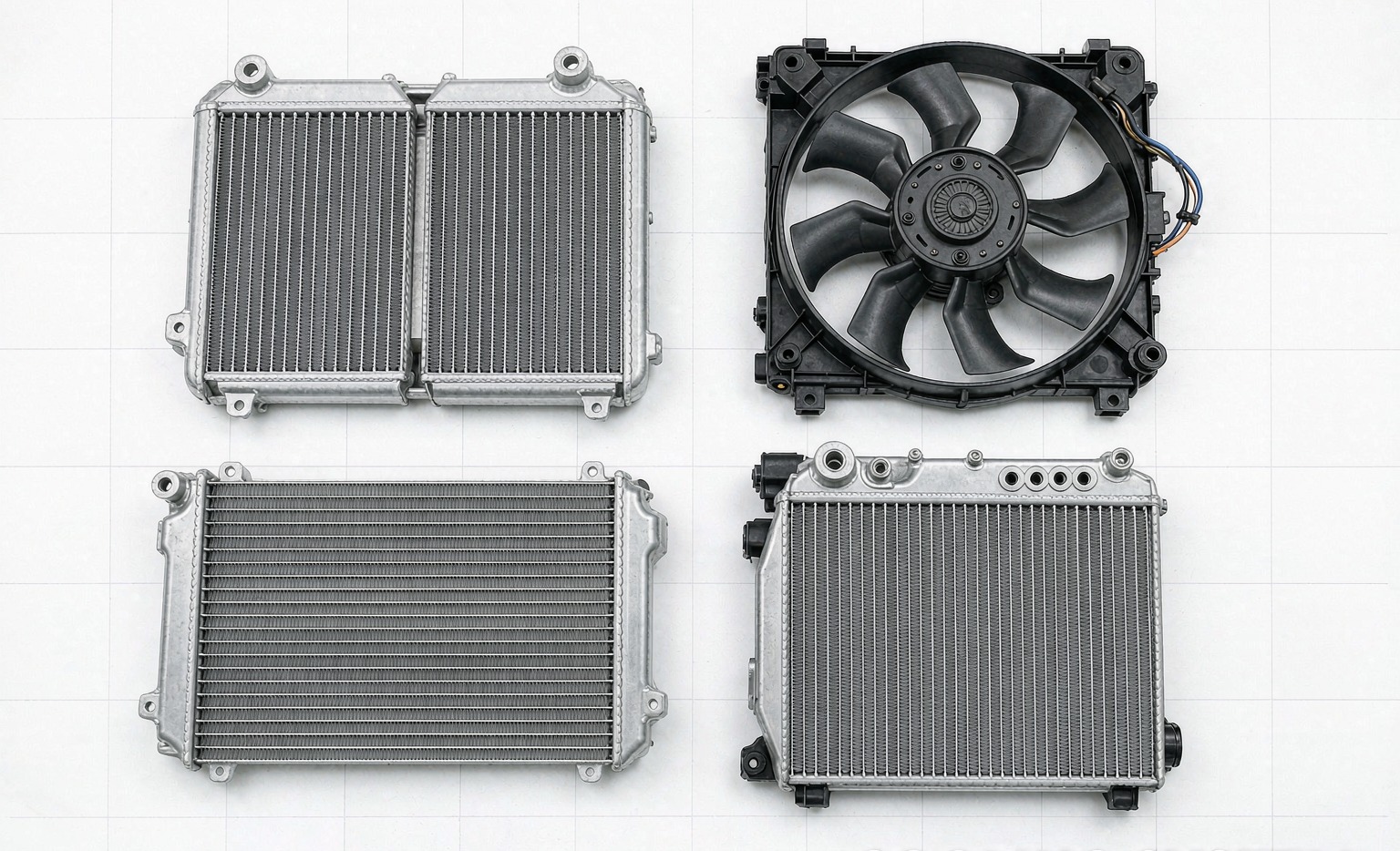
The cooling system is the largest single category of high-turnover parts in the Hyundai/Kia family programme. The radiator splits by engine code (1.5L MPI versus 1.5T Turbo-GDi) because the heat load and packaging differ. The condenser is more portable across the family — the Sonata and K5 share a common condenser family, and the Elantra carries a slightly different but cross-referenced condenser. The cooling fan assembly splits by engine and again by vehicle, because the Sonata fan mounts in a different orientation from the Sportage fan.
| Part | Indicative OE Reference | Where to Verify |
|---|---|---|
| Radiator (Elantra 1.5L MPI) | 25310-XXXXX series · confirm by VIN | Cooling OE library |
| Radiator (Sonata 1.5T) | 25310-XXXXX series · confirm by engine code | Cooling OE library |
| Radiator (K5 1.5T) | 25310-XXXXX series · confirm by engine code | Cooling OE library |
| Radiator (Sportage 1.5T) | 25310-XXXXX series · confirm by engine code | Cooling OE library |
| AC condenser (Sonata/K5 common) | 88450-XXXXX series · confirm by trim | Cooling OE library |
| Cooling fan assembly | 25380-XXXXX series · confirm by engine and vehicle | Cooling OE library |
| Thermostat | 25500-XXXXX series · confirm by engine | Cooling OE library |
| Coolant reservoir tank | 25330-XXXXX series · confirm by vehicle | Cooling OE library |
For a distributor quoting the cooling system across the family, the key OE reference check is the 25310-series radiator. Even within a single vehicle model, the 25310-series splits by production month and market — confirm against the latest Hyundai EPC and the latest Kia EPC at quote stage, and use the chassis (VIN) rather than the model name as the cross-reference key. The Sportage radiator in particular differs from the Sonata radiator (different packaging, different outlet orientation), so do not assume Sonata parts fit Sportage even though both run the same 1.5T engine.
05 Ignition System: Coils, Plugs and the 1.5T Family Commonality
The ignition system is the parts category where the Hyundai/Kia family commonality pays off most clearly. The 1.5T Turbo-GDi engine in the Sonata, K5 and Sportage shares the same ignition coil architecture — typically a pencil-style coil per cylinder — and the same spark plug specification. That means a distributor stocking the 1.5T ignition parts can cover three vehicles from one SKU set. The Elantra 1.5L MPI uses a different ignition coil architecture (and a different spark plug), which is why the Elantra ignition parts sit in their own sub-family.
Indicative OE references for the 1.5T family ignition coil run in the 27301-XXXXX series; for the Elantra 1.5L MPI, the coil reference is in the 27301-XXXXX series but with a different sub-family suffix. Spark plugs cross-reference in the 18841-XXXXX series for the 1.5T family. Always confirm the suffix at quote stage; both Hyundai and Kia publish their EPC regularly, and the references can shift within a single model year.
For workshop owners, the 1.5T ignition coil is the highest-turnover Hyundai/Kia part in the wholesale programme: a misfire under load is the field symptom, the coil replacement is a 30-minute job, and the part is priced at the OEM-grade tier where the margin is right. A distributor building the family programme should lead with the 1.5T ignition coil, then layer in the cooling and engine accessory parts once the volume is established.
06 FOB Guangzhou Price Ladder for Hyundai/Kia Family Parts
Parts pricing from China tiers cleanly with certification, packaging and testing documentation. The figures below are indicative FOB Guangzhou ranges for the three-tier structure most factories quote. Treat them as planning numbers for a wholesale programme, not as a quotation.
| Part Category | Economical Tier | OEM-Grade Tier | Premium / Private Label |
|---|---|---|---|
| Radiator assembly (1.5L / 1.5T) | USD 22-35 | USD 38-58 | USD 65-95 |
| AC condenser | USD 18-30 | USD 32-48 | USD 55-78 |
| Cooling fan assembly | USD 25-42 | USD 45-72 | USD 80-115 |
| Ignition coil (per cylinder) | USD 5-8 | USD 9-14 | USD 16-22 |
| Spark plug (each) | USD 1.5-2.5 | USD 2.8-4.0 | USD 4.5-6.0 |
| Alternator (1.5L / 1.5T) | USD 38-58 | USD 62-95 | USD 110-150 |
| Starter motor | USD 32-50 | USD 55-85 | USD 95-135 |
| Water pump | USD 15-25 | USD 28-45 | USD 50-75 |
| Cabin air filter | USD 2.5-4.0 | USD 4.5-6.5 | USD 7-10 |
| Oil filter | USD 1.2-2.0 | USD 2.2-3.5 | USD 4-6 |
| Front strut mount | USD 8-15 | USD 16-26 | USD 28-42 |
Note what drives the jump between tiers. For cooling parts (radiator, condenser, cooling fan), the premium is driven by aluminium core construction versus aluminium-plastic and by pressure testing documentation. For ignition coils, the premium is driven by winding quality, epoxy encapsulation and thermal cycling certification. For filters, the premium is driven by filter media grade (standard paper versus activated carbon versus HEPA-grade). For alternators and starters, the premium is driven by copper-wound stator quality, bearing grade, and voltage regulator calibration. Across all categories, the OEM-grade tier is where the long-term warranty story lives, and where most distributors concentrate their stock.
07 Container Loading and Mixed-SKU Strategy
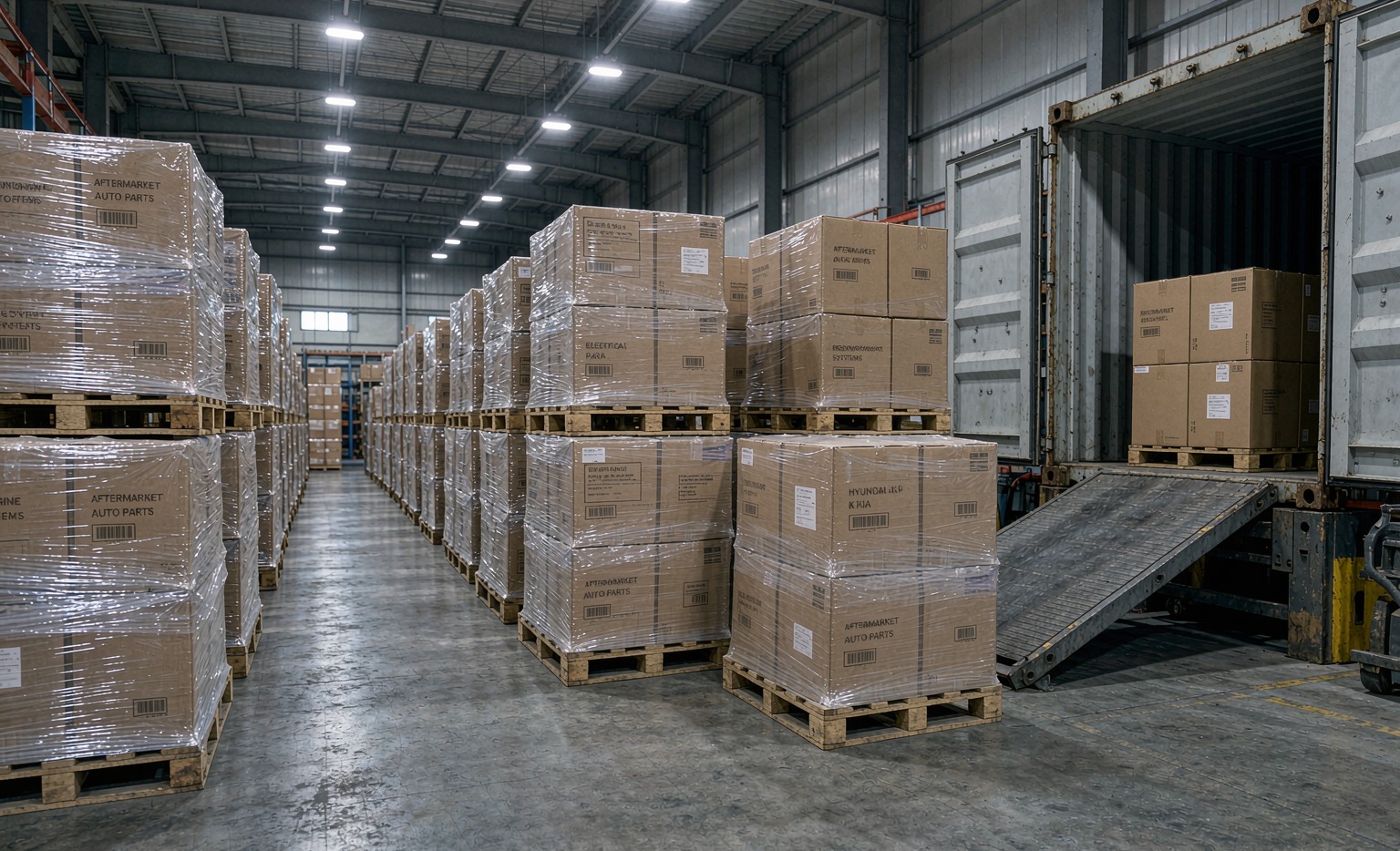
Hyundai/Kia family parts are mid-weight and mid-volume, which makes them well-suited to mixed-SKU containers. A 40HC container of mixed cooling parts, ignition coils and filters maxes out on volume (roughly 18-22 cubic metres of packed parts) before it maxes out on the 26-tonne working payload. Practical loading numbers: roughly 4,000-5,500 radiator assemblies per 40HC in mixed loading; roughly 25,000-30,000 ignition coils per 40HC in coil-only loading; roughly 80,000-100,000 cabin filters per 40HC in filter-only loading. Pair cooling parts with ignition coils in the same container to balance volume and value density.
Mixed-SKU is the standard first-order pattern for a Hyundai/Kia family programme. A typical trial container pairs the four vehicles' high-turnover parts in ratios that reflect the buyer's market: more radiator assemblies for hot-climate markets, more ignition coils for high-mileage taxi fleets, more filters for high-dust environments, more suspension top mounts for rough-road markets. The trial mix is built around 60% cooling parts, 25% ignition parts, and 15% filters plus engine accessories; the second order adjusts the ratios based on the first container's turn-rate data.
For packaging details that matter on ocean transit: VCI bags inside cooling-part boxes, individual plastic sleeves on alternators and starters, stack-strength cartons for spark plugs and filters (these are the highest-volume items by count), and palletised, shrink-wrapped loading with a packing list that maps SKUs to pallet positions. Ask for photos of a mock pallet before the first order ships; factories that pack well are usually factories that do everything else well too.
08 Certification and Pre-Shipment QC
The single most important certification question for Hyundai/Kia family parts from China is the same as for Toyota: whether the factory holds IATF 16949 (the global automotive quality management standard). For a wholesale programme that is shipping to multiple destination markets, additional certifications matter: ECE R90 for braking components (relevant if the programme expands into brake parts), ISO 9001 as the baseline, and for specific markets GCC conformity for the Gulf, GOST-R for Russia, and INMETRO for Brazil. Document the certification against the destination market's regulatory framework at quote stage, because the same part number may carry different certification for different markets.
Pre-shipment QC for Hyundai/Kia parts should run an application-specific checklist. For radiators: pressure test on a sample basis, brazed joint integrity check, core dimensions against OE drawing, and mounting bracket orientation match. For ignition coils: dwell time and peak voltage test under simulated load, thermal cycling at rated temperature, and connector pin integrity check. For alternators: load test at rated amperage, voltage regulator calibration check, bearing inspection, and 12V output ripple measurement. For filters: media integrity check, frame dimensional check, gasket seal check, and airflow rating verification. None of these tests is exotic; the point is that they happen on your order, with your report, before the container is sealed.
09 Frequently Asked Questions
What is the wholesale price of Hyundai Elantra radiator from China?
Indicative FOB Guangzhou ranges: USD 22-35 for the economical tier (25310-series reference), USD 38-58 for the OEM-grade tier, and USD 65-95 for the premium / private-label tier. MOQs typically start at 50-100 assemblies per reference. Confirm the exact OE number against the chassis (VIN) at quote stage because Hyundai splits references by production month and market.
Are Sonata 1.5T and K5 1.5T parts interchangeable?
For powertrain-driven parts (ignition coil, spark plug, alternator, water pump, sensors), the Sonata 1.5T and K5 1.5T are largely interchangeable — both run the same Smartstream 1.5T Turbo-GDi engine. For body-driven parts (radiator, condenser, fan assembly, suspension top mounts), the references split because the Sonata and K5 carry different body structures and different underbonnet packaging. Always cross-reference by VIN.
Do Sportage 1.5T parts share with Sonata 1.5T parts?
Yes for engine-driven parts (ignition coil, spark plug, sensor family, water pump). No for cooling system parts (the Sportage radiator has different packaging and outlet orientation from the Sonata radiator), and no for suspension top mounts (body-driven). The Sportage uses a 7-speed DCT transmission while the Sonata uses an 8-speed automatic, so transmission-related parts are not interchangeable.
What is the FOB Guangzhou price for Hyundai/Kia ignition coils?
Indicative FOB Guangzhou ranges for the 1.5T family ignition coil (27301-series): USD 5-8 per coil in the economical tier, USD 9-14 per coil in the OEM-grade tier, and USD 16-22 per coil in the premium / private-label tier. A typical order ships in coil sets (4 coils per vehicle, 4-6 vehicles per set), so a 24-coil case is the common wholesale unit.
What certification should I demand from a Hyundai/Kia parts supplier?
Ask for four things: the factory's IATF 16949 certificate (verifiable by number at iatfglobaloversight.org), the ISO 9001 certificate, ECE R90 for any braking components in the shipment, and a recent test report for the specific part family (pressure test for radiators, peak voltage test for ignition coils, load test for alternators). For US-bound shipments, add FMVSS compliance confirmation where applicable.
How many Hyundai/Kia parts fit in a 40-foot container?
A 40HC holds roughly 4,000-5,500 radiator assemblies in mixed loading, 25,000-30,000 ignition coils in coil-only loading, or 80,000-100,000 cabin filters in filter-only loading. Mixed-SKU containers that pair cooling parts, ignition parts and filters in ratios tailored to the buyer's market are the standard pattern for the Hyundai/Kia family programme.
Data sources: Hyundai and Kia 2026 export model specifications and OE reference map; Hyundai EPC and Kia EPC parts catalogues (latest revisions); IATF global oversight database (iatfglobaloversight.org); Guangzhou export parts market price assessments, Q3 2026; container loading arithmetic based on standard 40HC export packaging. OE references are indicative and must be confirmed at quote stage against the latest Hyundai/Kia EPC for the specific chassis and production month.
Source 2026 Hyundai/Kia family cooling, ignition and engine parts from Globalucar's Guangzhou programme. OEM-grade radiators, condensers, cooling fans, ignition coils, spark plugs, alternators, starters, water pumps, filters and suspension top mounts across the Elantra, Sonata, K5 and Sportage families. IATF 16949-certified tier with FOB Guangzhou pricing, mixed-SKU containers and pre-shipment inspection coordination. Contact Mr Didi: ucars@global-ucars.com, WhatsApp +86 133 0240 8528, or send your application list and target volumes through the contact page for a same-week quotation. 28F Guangzhou Jianhua Center, Baiyun District, Guangzhou.
Related Articles

Related Products
From our export catalog — parts and vehicles ready for international delivery

Full-Size EREV SUV
2026 Rox Adamas EREV 215km 6-Seat Executive Edition
USD 53,000 FOB Guangzhou
View Details
Full-Size EREV SUV
2026 Rox Adamas EREV 215km 7-Seat All-Terrain Edition
USD 51,500 FOB Guangzhou
View Details
