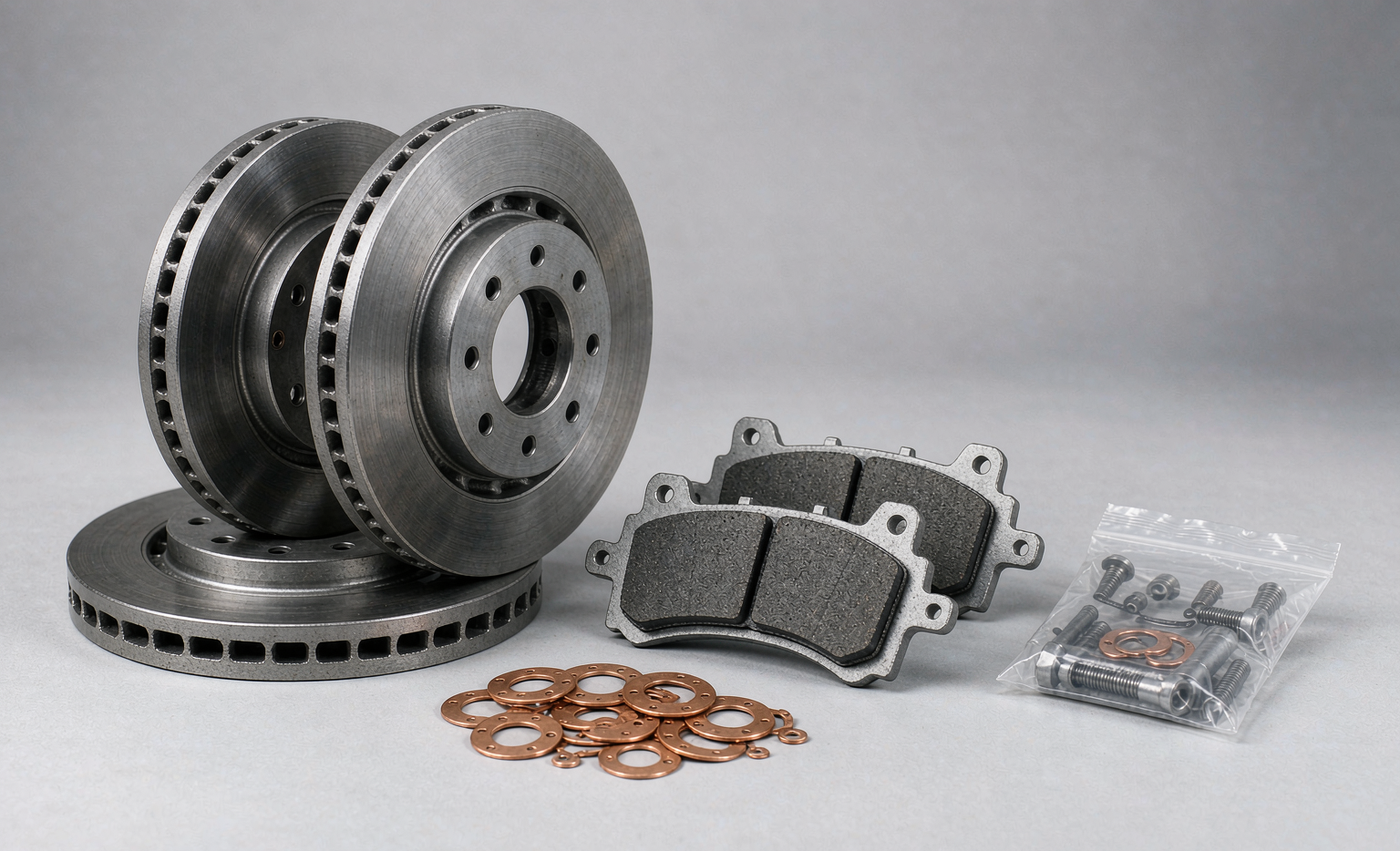
Open the service menu of any independent workshop from Dubai to Lima and count the brake jobs. The Corolla, Camry and RAV4 will appear on that list more often than any other nameplates — which is why Toyota brake pads and brake rotors are the anchor SKUs of nearly every parts wholesale program we quote from Guangzhou. Demand is predictable, the applications span twenty years of vehicles, and the OE references are stable enough that a distributor can build a stocking plan around them.
This guide is written for parts distributors, fleet suppliers and workshop chains sourcing Toyota brake parts from China. It covers the OE number map by generation, friction material grades, what "OEM-grade" certification actually requires, indicative wholesale pricing, rotor types and coatings, packaging and container loading, pre-shipment quality control, and the regional buying patterns that decide which grade to stock. For the broader Toyota program, see our Corolla, Camry and RAV4 parts wholesale guide.
Why Corolla, Camry and RAV4 Brake Parts Anchor a Wholesale Program
Brake friction is a consumable: a taxi Corolla in Cairo or a ride-hailing Camry in Riyadh can consume a set of front pads every 25,000–40,000 km. Multiply that by the tens of millions of Corolla, Camry and RAV4 units sold since 2010 and you get a replacement cycle that keeps reordering itself, quarter after quarter, regardless of new-car sales trends. That is the first reason brake SKUs anchor a program: the demand is contractual in nature even when the purchase orders are not.
The second reason is fitment concentration. Three nameplates cover a disproportionate share of Asian-brand brake jobs, and each generation uses a small, well-documented set of OE references. A distributor can cover the majority of demand with roughly 30–40 fast-moving pad and rotor SKUs, which keeps inventory financing manageable. The third reason is margin behaviour: because brake parts are heavy, bulky and certification-sensitive, they are less exposed to cross-border e-commerce price erosion than sensors or electronics. Wholesale buyers who master brake sourcing tend to keep that margin.
The counterweight is quality risk. Brake parts carry safety liability, and the gap between a good and a bad Chinese pad set is invisible on a photo. That is why this guide spends as much space on certification, testing and QC as on price.
The OE Number Map: Pads, Rotors and Shims by Generation
Every serious brake order starts with OE references, not with vehicle names — a "2019 RAV4" can carry three different front pad sets depending on market and production month. The table below lists the genuine Toyota references we cross-check most often. Treat it as a starting map: always confirm the final fitment against the chassis (VIN) before ordering, because Toyota supersedes numbers and splits references by market.
| Vehicle | Generation / Years | Front Pad Set OE | Front Rotor OE | Shim Kit OE |
|---|---|---|---|---|
| Corolla | E170, 2014–2019 | 04465-02410 | 43512-02270 | 04945 series (confirm by VIN) |
| Corolla | E210, 2019–2024 | 04465-33471 | market-split (confirm by VIN) | 04945 series (confirm by VIN) |
| Camry | XV70, 2018–2024 | 04465-0E060 | 43512-06200 | 04945-0E071 |
| RAV4 | XA40, 2013–2018 | 04465-0R031 | 43512-0R020 | 04945-0R030 |
| RAV4 | XA50, 2019–2024 | 04465-0E060 | 43512-06200 (US-built; Japan-built splits) | 04945-0E071 |
| RAV4 (EU 2.5L) | AVA42, 2015–2018 | 04465-YZZER | 43512-48110 | — |
Two cross-reference facts are worth memorising. First, the Camry XV70 and the US-built RAV4 XA50 share not just the front pad set 04465-0E060 but also the front rotor 43512-06200 — one pad-plus-rotor combination covers two of the three highest-volume Toyotas on the road (Japan-built RAV4 units split to their own rotor references, which is exactly why VIN confirmation matters). Second, the Corolla and RAV4 families share the 04465-02220 / 04465-42160 pad lineage across several production years, so a distributor stocking both references covers overlapping demand. You can verify any Toyota, Hyundai or Kia part number in our free OE number lookup tool and browse cross-referenced numbers in the brake system OE library.
Friction Grades: Ceramic, Semi-Metallic and Low-Metallic
Chinese factories producing for export generally offer three friction grades, and choosing between them is a market decision, not a quality decision — each grade is correct for a different duty cycle. The specification that actually defines quality within a grade is the friction coefficient stability and the wear rate, both of which are testable (more on that in the QC section).
| Grade | Typical Composition | Behaviour | Best-Fit Markets |
|---|---|---|---|
| Ceramic (NAO) | Ceramic fibres, mineral fillers, copper-free | Low dust, quiet, stable at moderate temperatures, gentle on rotors | Middle East, Gulf fleets, urban ride-hailing, quality retail |
| Semi-metallic | Steel wool, graphite, friction modifiers | High fade resistance under load, higher dust and noise | Africa, mountainous routes, loaded commercial use |
| Low-metallic | Organic base with 10–20% metal content | Balanced pedal feel and price point between the two | Latin America, Southeast Asia, mixed-duty fleets |
For the Camry and RAV4, most wholesale buyers default to ceramic for retail packaging and semi-metallic for fleet contracts. For the Corolla — the world's default taxi — semi-metallic and low-metallic dominate because purchase price per set and durability under continuous duty outweigh dust concerns. Copper-free formulations (meeting the increasingly common environmental requirements in North America and Europe) are available on request from the better factories, usually with a small price premium and a longer lead time.
What "OEM-Grade" Actually Means for Brake Parts from China
"OEM-grade" is used loosely in the trade, so it pays to anchor it to verifiable things. A factory that genuinely supplies or mirrors the OE tier will typically hold IATF 16949 certification for its quality management system, produce friction materials that have passed ECE R90 testing (the European regulatory benchmark for replacement brake components, involving performance, sensitivity and fatigue testing on an approved dyno), and — for US-bound shipments — formulate to FMVSS 135 requirements. Documents are checkable: ask for the IATF certificate number and the ECE R90 approval number for the specific friction family, not just for the factory in general.
Product-level markers of the OEM-grade tier include: positive-moulding or at least consistent press density across the pad face; scorching (the high-temperature treatment that burns off uncured resins and reduces bed-in fade); attached or included shim kits engineered for the specific application rather than universal flat shims; chamfered and slotted friction blocks matched to OE noise-reduction geometry; and printed batch numbers that trace back to a production date and compound lot. When we shortlist brake suppliers for our own wholesale program, a missing batch code or "one shim fits all" packaging is an immediate disqualifier.
For rotors, the OEM-grade tier is defined by metallurgy and machining: G3000-grade grey cast iron (the standard the OE tier uses), balanced casting with dense vent-rib geometry, machined to OE runout and thickness tolerances, dynamic balancing on higher-spec references, and anti-rust protection. A rotor that arrives with visible casting porosity on the friction face or more than ~0.03 mm of runout will generate pedal pulsation complaints within months.
Indicative Wholesale Pricing: The FOB Guangzhou Ladder
Brake parts pricing from China tiers cleanly with certification level and packaging. The figures below are indicative FOB Guangzhou ranges for the three-tier structure most factories quote, based on the price bands we see across our supplier base for Corolla, Camry and RAV4 applications. Treat them as planning numbers for a wholesale program, not as a quotation — final pricing depends on compound, coating, packaging and order volume.
| Tier | Pad Set (4 pads, FOB) | Rotor (each, FOB) | Typical MOQ | What You Get |
|---|---|---|---|---|
| Economical | $4.0–5.5 | $9–13 | 100–200 sets | Basic certification, bulk or plain boxes, semi-metallic standard |
| OEM-grade | $5.5–7.5 | $13–18 | 100–300 sets | ECE R90 friction family, scorching, application-specific shims, batch codes |
| Premium / private label | $7.5–9.0 | $18–22 | 300–500 sets | Copper-free ceramic, coated rotors, your branded packaging, barcodes |
Note what drives the jump between tiers: it is rarely the raw friction material alone. Packaging (printed boxes, blister packs, barcode labelling), coating (silver-zinc or Geomet-type anti-rust on rotors), and testing documentation account for much of the premium tier. Many distributors start an order in the OEM-grade tier with neutral packaging, then move to private-label premium packaging once the SKUs prove their turn rate.
Rotor Types: Solid, Vented, Coated and Drilled
Corolla rear and some base front applications use solid rotors; the Camry and RAV4 front rotors are vented, with the RAV4 carrying the heaviest section of the three. Within a type, the export-relevant choice is surface treatment. Uncoated rotors carry the lowest purchase price but will show surface rust within weeks in humid climates — fine for dry-market distribution, a complaint generator in coastal or tropical markets. Silver-zinc coated rotors hold appearance for months in transit and on the shelf; Geomet-type waterborne coatings (the OE-preferred technology, recognisable by its matte grey-green finish) offer the best salt-spray performance and are worth specifying for anything shipping to humid or winter-salt markets.
Drilled and slotted rotors exist in the Chinese catalogues but serve a different customer: performance retail, not wholesale replacement. Our advice for a Corolla/Camry/RAV4 program is straightforward — stock plain machined or coated rotors in OE dimensions, and leave the drilled segment to specialists. Drilled rotors crack under fleet duty cycles, and cracked rotors come back as warranty claims with your logo on the box.
Packaging, Boxing and Container Loading
Brake parts are dense and heavy, which makes freight arithmetic a core part of program economics. Pad sets are light (typically 1.5–2 kg per boxed set); rotors are not — a Camry front rotor weighs roughly 8–9 kg each, so a 40-foot high-cube container of mixed brake parts maxes out on weight (about 26–27 tonnes) long before it maxes out on volume. Practical planning numbers from our loading experience: a 40HC holds roughly 4,000–5,500 rotor pieces when palletised with pad cartons filling the voids, or around 8,000–10,000 pad sets if pads only.
Export packaging details that matter: VCI (volatile corrosion inhibitor) paper or bags inside rotor boxes for ocean transit; individual rotor sleeves or waxed wrap to prevent rotor-to-rotor contact; stack-strength cartons rated for palletised ocean freight; and palletised, shrink-wrapped loading with a packing list that maps SKUs to pallet positions so your warehouse can receive the container without re-counting everything. Ask for photos of a mock pallet before the first order ships — factories that pack well are usually factories that do everything else well too.
Quality Control: Six Checks Before Brake Parts Ship
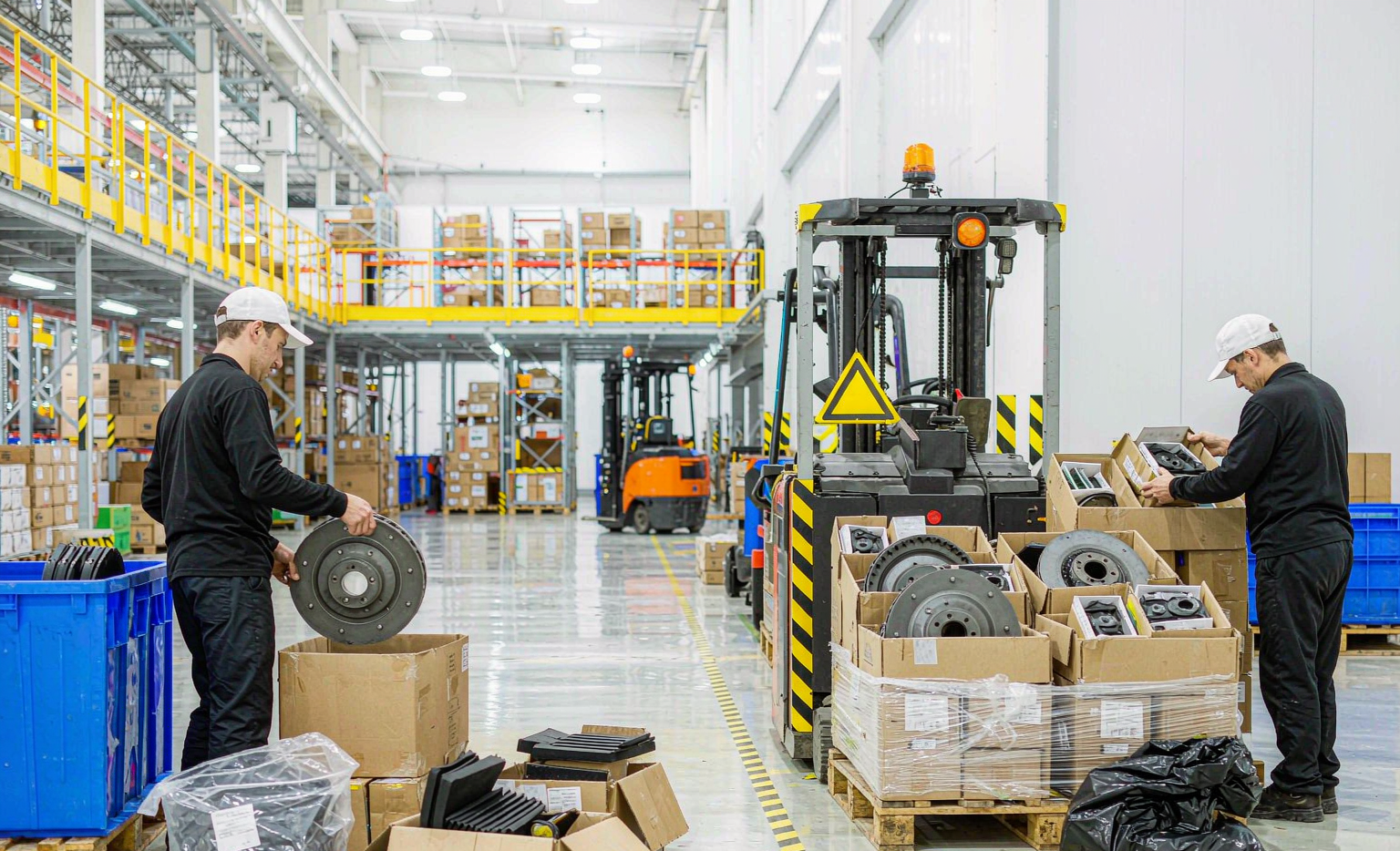
A pre-shipment inspection (PSI) for brake parts should be application-specific, not a generic box-count exercise. The six checks we run or require on brake orders are:
- Dimensional verification against OE drawing: pad thickness and area, backing plate dimensions, rotor diameter, thickness, and hat height — measured with calipers on an AQL sampling basis.
- Runout and thickness variation on rotors: dial-indicator check at multiple points on the friction face; reject lots showing pulsation-grade variation.
- Hardness and material spot checks: Brinell hardness on rotors within the G3000 band; friction coefficient test report for the batch (χ value stability across the temperature range is the number that matters).
- Surface and coating inspection: machining finish, edge burrs, coating adhesion and salt-spray certificate for coated rotors.
- Fitment trial: sample pads seated in the caliper bracket and rotor on the hub of the target application where fixtures allow.
- Packaging and labelling audit: correct OE cross-reference printed, batch codes legible, VCI present, carton markings match the packing list.
None of this is exotic; the point is that it must happen on your order, with your report, before the container is sealed. Third-party inspection agencies can execute this checklist at most Chinese brake factories for a standard man-day fee, and we coordinate such inspections for buyers who order through our Guangzhou program.
Regional Buying Patterns: Which Markets Buy Which Grade
After enough containers, the pattern becomes predictable. Gulf and Middle East buyers — the largest single demand pool for ceramic Corolla and Camry pads — prioritise low dust and quiet operation for retail-branded programs, and order coated rotors for the coastal humidity. African and Central Asian buyers prioritise cost per kilometre: semi-metallic friction, higher MOQs, plain packaging, and uncoated rotors in dry climates. Latin American buyers split between the two, with Brazil's high local tariffs favouring more complete, value-added orders (private label, full kits) shipped less frequently. Russian and CIS buyers in snow-belt regions specify coated rotors and value cold-climate testing documentation, since salted winter roads are the harshest rotor environment a wholesale program will face.
The buying pattern that matters most: almost every experienced distributor starts with a mixed first container — pad sets in two grades for their top ten applications, rotors for the top five — rather than betting the program on one SKU. Turn-rate data from the first container then drives the second order. We structure first orders this way by default; see our Hyundai and Kia brake and suspension sourcing guide for the Korean-nameplate equivalent of the same strategy.
Ordering Process, Lead Times and Mixed SKUs
A standard OEM-grade brake order from a verified Chinese factory runs 20–30 days to production completion for pad sets and 25–35 days for rotors (casting lead time dominates), plus 3–7 days for QC and container loading. Economical-tier stock items can ship in 10–15 days. Mixed-SKU orders — pads, rotors and shim kits for Corolla, Camry and RAV4 in one container — are the norm and are how we quote; braking components combine naturally with the wider Toyota program (mounts, filters, suspension bushings), covered in our engine and transmission mount guide, so one container can carry a full Toyota fast-moving program.
Payment terms for first brake orders typically run 30% deposit with balance against documents; established programs move to more buyer-friendly structures. Ask for the factory's IATF certificate, ECE R90 approval numbers and a recent friction test report with the first quotation — the speed and completeness of that response tells you most of what you need to know about the supplier.
Frequently Asked Questions
What are the genuine OE numbers for Toyota Corolla front brake pads?
The 2014–2019 Corolla (E170) uses front pad set 04465-02410, and the 2019–2024 Corolla (E210) uses 04465-33471, with several superseding references in between. Because Toyota splits some references by production month and market, always confirm the exact number against the VIN before placing a wholesale order.
Do Camry and RAV4 use the same front brake pads?
The 2018–2024 Camry (XV70) and 2019–2024 RAV4 (XA50) share the front pad set 04465-0E060, and on US-built units they also share the front rotor 43512-06200 — a single pad-and-rotor combination that covers two of the highest-volume Toyotas on the road. Japan-built RAV4 units split to separate rotor references, so confirm by VIN before ordering rotors for mixed fleets.
How much do Toyota brake pads cost wholesale from China?
Indicative FOB Guangzhou pricing runs $4.0–5.5 per set in the economical tier, $5.5–7.5 in the OEM-grade tier with ECE R90 friction and application-specific shims, and $7.5–9.0 for premium copper-free ceramic with private-label packaging. MOQs typically start at 100–300 sets per reference.
Are Chinese brake rotors reliable for Toyota applications?
Yes, when sourced from the IATF 16949-certified tier with G3000-grade cast iron, OE-tolerance machining and verified runout. The reliability gap between tiers is real: uncoated, loosely-machined rotors will generate pulsation and rust complaints, while OEM-grade coated rotors perform on par with boxed aftermarket brands at a fraction of the landed cost.
What certification should I demand from a brake parts supplier?
Ask for three things: the factory's IATF 16949 certificate (checkable by number), the ECE R90 approval number for the specific friction family, and a batch friction test report showing coefficient stability across the temperature range. For US-bound shipments, add FMVSS 135 formulation compliance.
How many brake rotors fit in a 40-foot container?
A 40HC maxes out on weight before volume with brake parts: roughly 4,000–5,500 rotors when mixed with pad cartons, or around 8,000–10,000 pad sets in a pads-only load. Most wholesale programs ship mixed containers covering pads, rotors and shims across their top ten applications.
Source Toyota brake pads, rotors and shim kits for Corolla, Camry and RAV4 from Globalucar's Guangzhou program. OEM-grade friction with ECE R90 documentation, coated or uncoated rotors, mixed-SKU containers, pre-shipment inspection coordination and private-label packaging. Contact Mr Didi: ucars@global-ucars.com, WhatsApp +86 133 0240 8528, or send your application list and target volumes through the contact page for a same-week quotation. 28F Guangzhou Jianhua Center, Baiyun District, Guangzhou.
Verify Part Numbers in Our OE Library
Every part covered in this guide has a matching OE number in our reference library — grouped by system with cross-references, so you can source the exact fit for Toyota, Hyundai, Kia and more.
Related Articles
Related Products
From our export catalog — parts and vehicles ready for international delivery

Full-Size EREV SUV
2026 Rox Adamas EREV 215km 6-Seat Executive Edition
USD 53,000 FOB Guangzhou
View Details
Full-Size EREV SUV
2026 Rox Adamas EREV 215km 7-Seat All-Terrain Edition
USD 51,500 FOB Guangzhou
View Details
