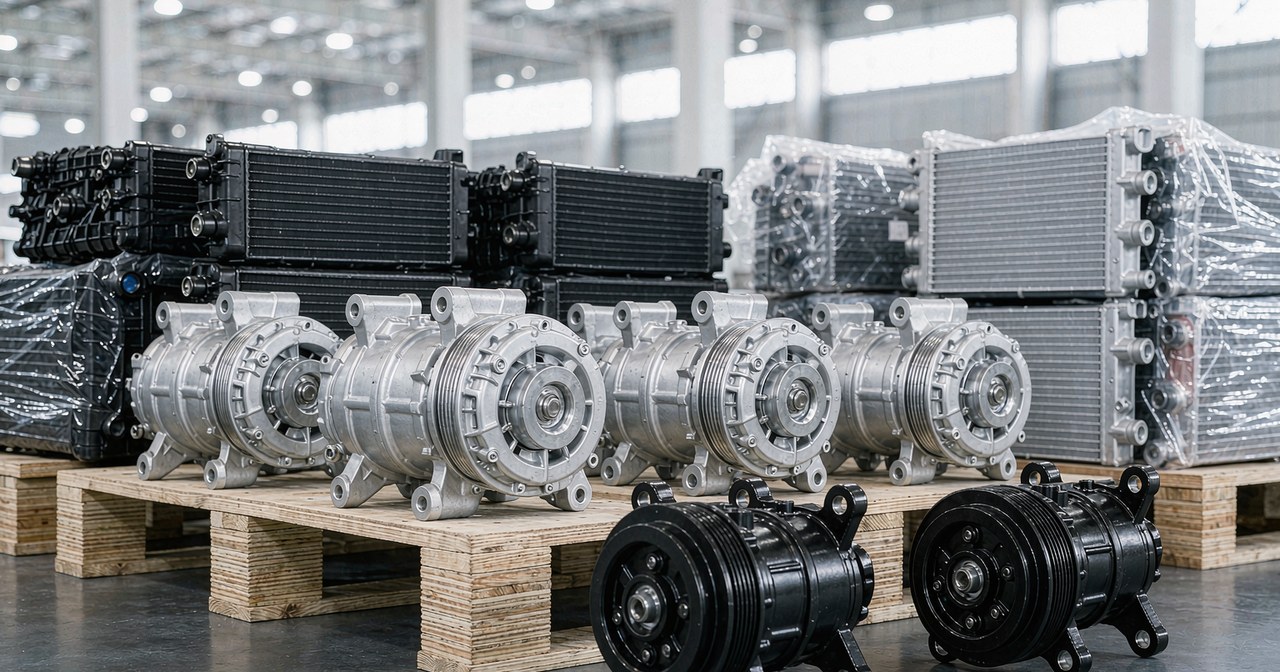
Ask any workshop owner in Dubai, Riyadh or Lagos which repair generates the most customer anger in summer, and the answer is rarely brakes or suspension. It is air conditioning that quit in July. The part at the center of that failure is almost always the AC compressor — and for parts distributors serving the Gulf, Africa and South Asia, it is the single highest-stakes SKU in the climate control category. Getting AC compressor wholesale sourcing right from China means matching OE references precisely, understanding refrigerant compatibility, and timing the order so stock arrives before the season, not after it.
This guide is written for auto air conditioning parts suppliers, regional distributors and fleet maintenance buyers sourcing from China. It covers the OE number map for Toyota, Hyundai and Kia platforms, the supporting components that fail alongside the compressor, the belt-driven versus electric compressor split created by Chinese EV exports, refrigerant compatibility, indicative FOB pricing, quality control and the hot-climate stocking calendar. For the Korean-nameplate deep dive, our Hyundai Kia AC compressor and HVAC parts guide lists 19 additional OE references with fleet mix estimates.
Why Hot-Climate Markets Consume Compressors Faster
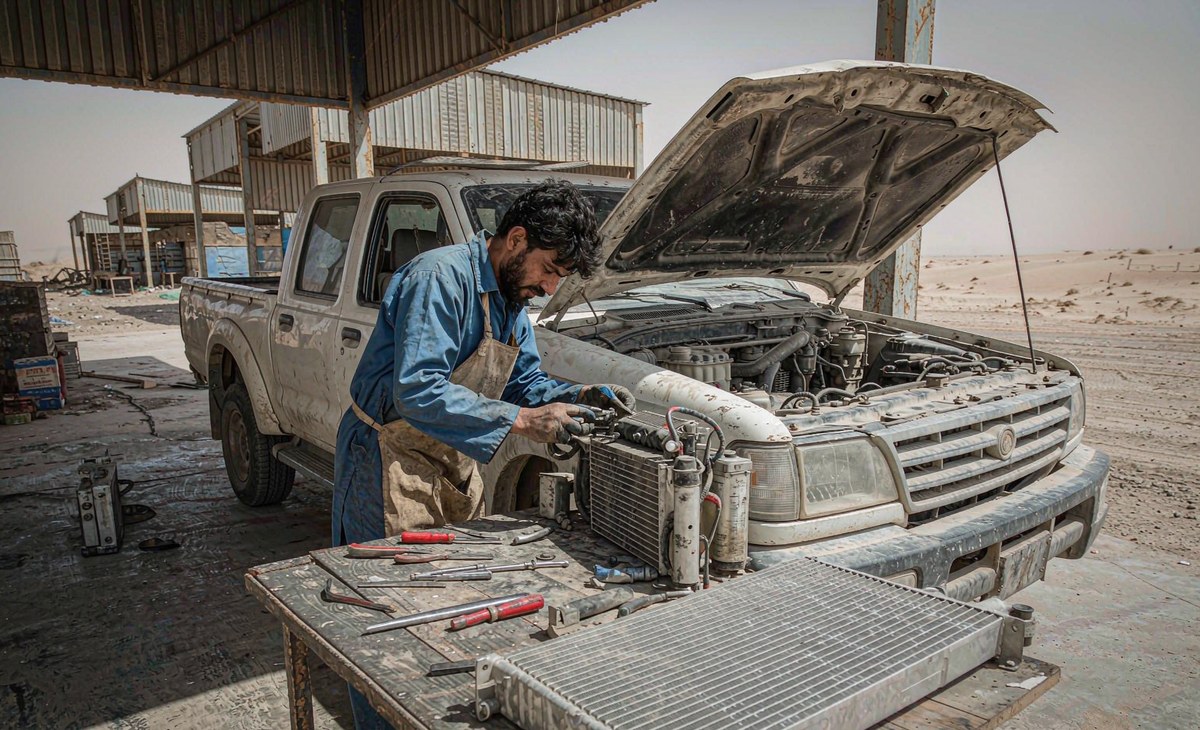
A compressor sized for a European summer works overtime in the Gulf. When ambient temperature reaches 48 °C — a normal July afternoon in Kuwait or interior Saudi Arabia — the high-side pressure on an R134a system climbs toward 25–29 bar, close to the relief valve threshold. The compressor spends long stretches at maximum displacement, shaft seals run hot, and the electromagnetic clutch slips more on every engagement. Field data from regional workshops consistently shows compressor replacement rates in GCC markets running roughly three times those of temperate climates, with the peak clustered in the months after the hottest quarter.
The failure chain usually starts upstream of the compressor itself. Desert dust and insects clog condenser fins, airflow drops, head pressure rises, and the compressor is the component that pays the price. That is why experienced distributors do not sell compressors alone: they pair every compressor with a new receiver-drier, push a condenser flush or replacement as an upsell, and quote the whole job. A workshop that replaces a $120 compressor and reuses a saturated drier is buying a comeback claim — moisture in the system reacts with refrigerant oil, forms acids, and kills the replacement compressor within months.
For a wholesale program, this failure pattern has a commercial consequence: climate control is a kit business, not a single-SKU business. The distributors who anchor their orders on compressors and then fill the container with condensers, driers, expansion valves and blower motors capture the whole repair ticket — and see far fewer warranty claims on the compressors they do sell.
The OE Number Map: Compressors and Condensers by Platform
Every serious air conditioning order starts with OE references. A "2019 Camry" does not define a compressor; the engine and production market do. The table below lists the references we cross-check most often across the Toyota and Hyundai-Kia platforms, all verifiable in our cooling and climate OE library. Treat it as a starting map — confirm final fitment against the VIN, because both makers supersede numbers and split references by production market.
| Platform | Model / Years | Compressor OE | Condenser OE | Notes |
|---|---|---|---|---|
| Toyota | Camry XV40–V50, 2006–2024 | 88310-33250 (V40); 88320-33200 (Aurion/V40) | 88460-06230 (V50); 88460-33100 (Venza/ES) | 88320 series = newer scroll design |
| Toyota | RAV4 / Corolla family, 2010s | 88320-0E030 | per chassis (confirm by VIN) | catalog reference, stock item |
| Toyota | Land Cruiser Prado J150, 2010–2023 | per chassis (confirm by VIN) | 88460-60430 | high-demand GCC application |
| Hyundai | Elantra / Accent, 2011–2020 | 97701-2S500; 97701-1R000 | 97606-1R000 | swash-plate, 6PK or 8PK clutch |
| Hyundai / Kia | Tucson / Sportage, 2015–2021 | 97701-3K125 (confirm by VIN) | 97606-C1000; 97130-GI000 | blower motor 97113-C1000 same platform |
| Kia | Sorento / Carnival, 2015–2020 | 97701-3R200 | 97606-1C100 | confirm pulley groove count |
Two cross-reference habits are worth building. First, on the Hyundai and Kia side, 97701-series compressors are shared across platforms more often than dealers expect — the same compressor assembly can cover an Elantra and a Kia sedan in adjacent years, which lets a distributor cover two brands with one SKU. Second, on the Toyota side, the 88310 and 88320 prefixes both mean compressor, but 88320 generally marks the newer scroll generation; quoting a 88310 number for a car that takes a 88320 unit is the most common ordering mistake we see from first-time buyers. When in doubt, send us the VIN or the plate photo before wiring a deposit — our parts finder resolves platform, engine and year in three clicks.
Beyond the Compressor: The Full Climate Control Kit
The compressor gets the shelf space, but the ticket is won on the supporting cast. A complete hot-climate stocking program covers six component families, and each has its own failure logic:
- Condensers — parallel-flow aluminum cores; the first thing desert dust chokes. Sell coated fins for coastal humidity.
- Receiver-driers / accumulator-desiccants — replace with every compressor; stock three times as many as you think you need.
- Expansion valves and orifice tubes — small, cheap, and the cause of many misdiagnosed "bad compressor" complaints.
- Blower motors and resistors — the 97113 series covers Hyundai and Kia platforms broadly (97113-C1000 fits Tucson TL and Sportage SL); PWM variants like 97235-A8000 serve newer cars.
- Pressure switches and sensors — the low-charge cutout that protects the compressor; a $6 part that saves a $120 one.
- Hose assemblies and O-ring kits — crimped hose failures spike in heat; HNBR O-rings survive R134a service at Gulf temperatures where standard NBR does not.
Kit economics are straightforward: a compressor-condenser-drier-valve kit quotes at roughly 1.8–2.2× the compressor alone but converts a one-line order into a four-line order and locks the workshop out of your competitors for that repair. We quote HVAC programs as kits by default — see our Hyundai Kia cooling system guide for how the engine-cooling half of the same container is built.
Belt-Driven vs Electric: Sourcing for Mixed Fleets and Chinese EVs
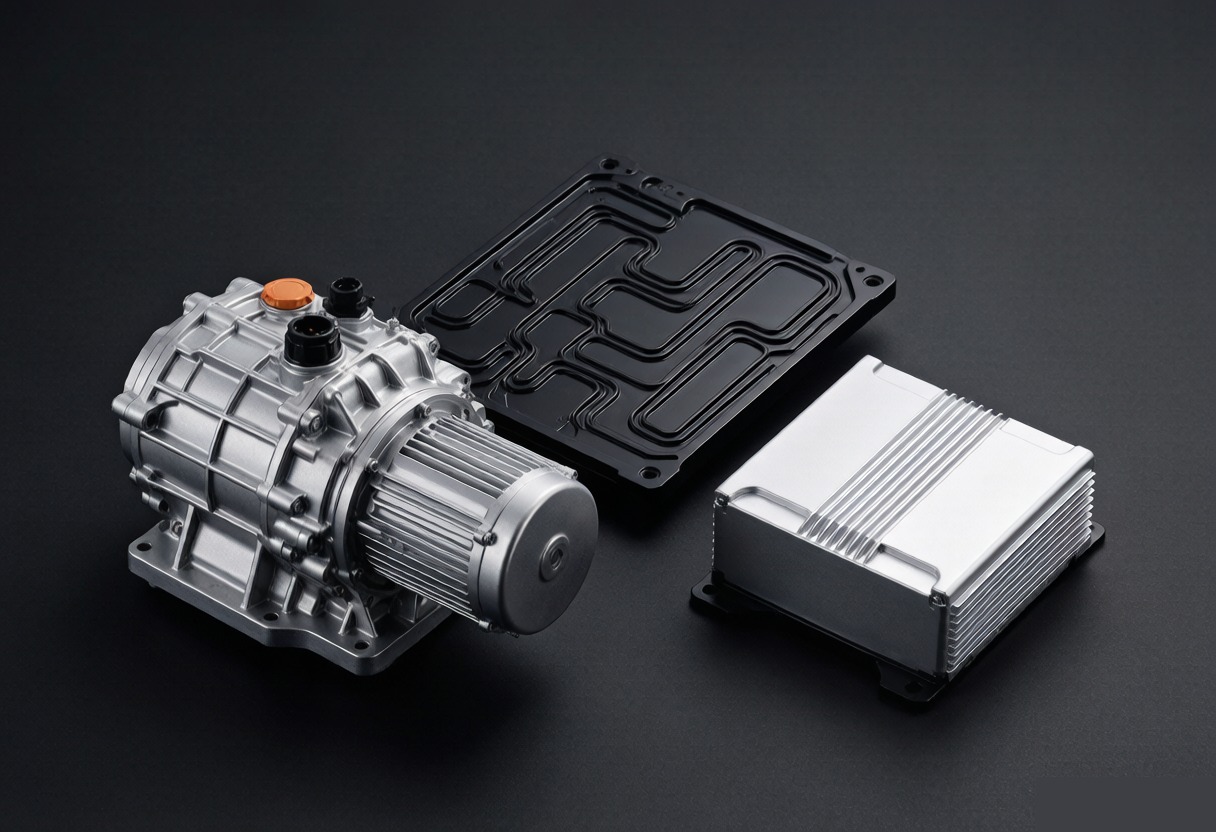
Chinese vehicle exports have added a second compressor technology to every distributor's price list. Conventional cars and PHEVs run belt-driven compressors off the engine; battery-electric vehicles have no engine crankshaft to belt onto, so they run electric compressors — a sealed motor-pump unit fed from the high-voltage DC bus. BYD, Geely, GAC and other Chinese EV export platforms all use them, and the sourcing logic is different in almost every dimension that matters.
| Dimension | Belt-Driven (ICE / PHEV) | Electric (BEV) |
|---|---|---|
| Drive source | Engine serpentine belt + electromagnetic clutch | High-voltage DC motor (400 V or 800 V platform) |
| Speed control | Clutch on/off cycling at fixed ratio | Stepless inverter speed control, quieter cabin |
| Failure modes | Clutch wear, shaft seal leaks, bearing noise | Inverter/motor insulation, bearing, low-voltage control board |
| Typical FOB (aftermarket) | $85–350 | $220–600 (platform-specific, lower volumes) |
| Workshop handling | Standard AC service | Requires HV-trained technicians and insulation procedures |
Two sourcing consequences follow. First, electric compressors are platform-locked in a way belt units never were — a BYD e-compressor reference will not cross to a Geely, so stocking depth matters more than breadth; a distributor serving Chinese EV fleets should pick the two or three platforms their market actually runs (from our Chinese EV parts sourcing guide) and go deep. Second, the 800 V platforms appearing on newer EVs raise insulation requirements; buyers should insist on hipot test reports for every electric compressor batch, a test most economical-tier factories simply do not run.
R134a vs R1234yf: Refrigerant Compatibility When Stocking
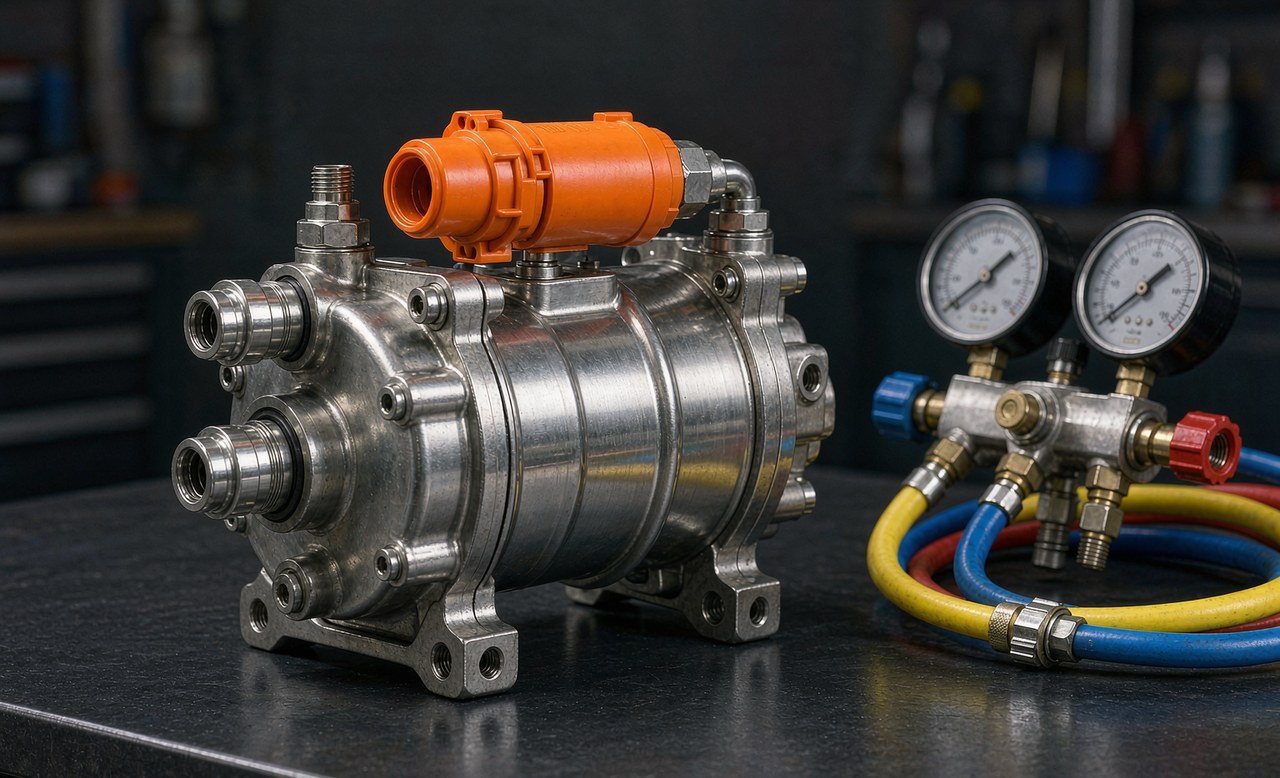
Refrigerant generation is the invisible line that separates usable stock from shelf-rotting stock. The global fleet split is stable: virtually all Toyota, Hyundai and Kia vehicles on Gulf, African and South Asian roads run R134a, while EU-market vehicles from 2017 onward and a growing share of US-market cars run R1234yf (lower global-warming potential, higher refrigerant price, different service fittings and compressor oil). Chinese export-market vehicles overwhelmingly specify R134a as well.
Three practical rules for a wholesale program. One: never quote a compressor into an R1234yf application using R134a oil charge — the POE oil in yf systems is not interchangeable with the PAG oil in 134a systems, and a mismatched charge converts a correct compressor into a callback. Two: check the service port before quoting; yf ports are different-sized by regulation precisely to prevent cross-charging, and a photo of the port settles the question in seconds. Three: stock R134a parts deep and R1234yf parts narrow — for a Middle East or Africa distributor, yf applications are a small slice of the fleet today, but the EU-used-car export wave is starting to move yf vehicles into Gulf and African second markets, so a two-shelf yf trial program is cheap insurance.
What OEM-Grade Means for AC Parts — and the Certificates That Back It
"OEM-grade" in climate control is verifiable in four places. Certification first: a factory supplying the OE tier or its mirror holds IATF 16949 quality-system certification, and for Gulf-bound shipments the parts themselves carry GSO / SASO conformity documentation (Saudi Arabia's SABER platform requires a Certificate of Conformity per shipment); Kenya-bound stock needs a KEBS pre-export verification certificate. Ask for certificate numbers, not logos — the numbers are checkable.
Product-level markers separate the tiers. The table below is the comparison we walk first-time HVAC buyers through before they place a compressor order:
| Check | Genuine / OE Supplier | OEM-Grade (China) | Economical Aftermarket |
|---|---|---|---|
| Shaft seal leak test | 100% helium-tested, certificate per batch | 100% sniffer or pressure-decay, record per batch | Sample only, or none |
| Clutch torque & gap spec | Verified to OE drawing | Verified, printed on box label | Unspecified |
| Internal cleanliness | Nitrogen-purged, sealed ports | Nitrogen-purged, capped ports | Often open or caps missing |
| Core material (condensers) | Brazed parallel-flow, coated fins | Brazed parallel-flow, coating optional | Tube-fin or thin-core variants |
| Traceability | Full OE batch trace | Batch code to production date | Untraceable |
| Indicative price index | 100 | 45–60 | 25–35 |
The price index line is the commercial argument: OEM-grade compressors land at roughly half the price of dealer-channel genuine units while carrying the same test records a workshop can show its own customers. Economical-tier stock skips most of this — which is why its compressors run fine for six months and then return as seal leaks. Our three-tier structure and what each tier includes are detailed in our Santa Fe and Sorento wholesale guide, and the same logic applies across HVAC lines.
Indicative FOB Pricing and Container Loading
Climate control parts price cleanly by tier, and because compressors are dense while condensers are bulky, a mixed HVAC container balances weight and volume well. The figures below are indicative FOB Guangzhou ranges from our supplier base — planning numbers, not a quotation.
| Part | Economical FOB | OEM-Grade FOB | Typical MOQ | Container Notes |
|---|---|---|---|---|
| A/C compressor (belt-driven) | $60–110 | $85–350 (platform-dependent) | 10–30 pcs | ~4–7 kg each; 40HC takes 1,500–2,200 pcs mixed with cartons |
| Electric compressor (EV) | — | $220–600 | 10–20 pcs | platform-locked; confirm voltage class before quoting |
| Condenser | $18–40 | $28–95 | 30–50 pcs | bulky but light; volume-limited, not weight-limited |
| Receiver-drier / accumulator | $4–9 | $6–15 | 100 pcs | seal integrity = shelf life; check cap seals on receipt |
| Expansion valve / orifice tube | $5–12 | $8–20 | 50–100 pcs | highest-margin kit filler |
| Blower motor (97113 series) | $12–22 | $18–45 | 30–50 pcs | PWM variants price at the top of the band |
As a planning anchor: a mixed 40-foot high-cube HVAC container — compressors for six platforms, condensers for ten, driers, valves and blowers to match — lands around $28,000–38,000 of invoice value and, at Gulf rates, carries a landed retail value several times that. For car AC condenser export orders to the Middle East, condensers are the volume filler that makes the freight math work: they are light, they stack flat, and they sell alongside every compressor. Compressors palletise well; condensers should ship in individual cartons stacked flat with corner protection, since a bent header tank is an instant return. We build first orders as mixed-platform containers precisely so distributors can read their own turn-rate data before committing shelf depth — the same first-container strategy we apply to brake and suspension programs.
Quality Control: Seven Checks Before an AC Order Ships
A pre-shipment inspection for climate control is a functional test, not a box count. The seven checks we run or require:
- Clutch engagement test — apply rated voltage, measure engagement gap and listen for drag; reject lots with inconsistent pull-in.
- Shaft seal leak check — sniffer or pressure-decay test on every sampled compressor, not just the golden sample.
- Rotation smoothness — hand-turn or low-speed run; grinding or notchy bearings are the single most common economical-tier defect.
- Internal cleanliness and purge — confirm nitrogen charge holds and port caps are sealed; a hiss on opening is good news.
- Condenser leak test certificates — 100% test record per batch, plus fin-coating adhesion for coated cores.
- Fitment trial — pulley groove count, bracket bolt pattern and port orientation checked against a sample application or OE drawing.
- Label and document audit — OE cross-reference printed, batch codes legible, GSO/SASO or KEBS documents matching the shipment.
Third-party inspection agencies execute this checklist at most Chinese HVAC factories for a standard man-day fee, and we coordinate it for buyers ordering through our Guangzhou program. The cost is trivial against the value of a container; the comeback claims it prevents are not.
The Hot-Climate Stocking Calendar
Timing decides whether HVAC stock sells at full margin or sits until next year. The demand curve in Gulf and African markets peaks from March through June and stays heavy through September — air conditioning is not a comfort purchase there, it is the reason the vehicle runs at all. Working backwards: workshops start stocking in January, regional distributors order in November–December, and factories need 20–30 days of production plus 18–28 days of ocean transit to Jebel Ali, Dammam or Mombasa.
That arithmetic puts early December as the last comfortable order date for a January arrival, and any order placed after mid-December should assume the first weeks of the peak season will be missed. Auto air conditioning parts suppliers who order compressors and condensers in October–November — right after this article publishes — consistently capture the season's first repair wave at full price, while late buyers spend the peak discounting stock that arrives in May. This year the calculus has one extra wrinkle: Red Sea routing adjustments have lengthened some Middle East transits, which moves the real order deadline earlier, not later.
Frequently Asked Questions
What are the genuine OE numbers for Toyota AC compressors?
For the Camry XV40 generation, compressor 88310-33250; the Aurion and later Camry V40 series use 88320-33200; the RAV4 and Corolla family reference 88320-0E030 as the catalog item. Toyota supersedes numbers by production market, so confirm against the VIN before ordering a wholesale quantity.
Which OE references cover Hyundai and Kia AC compressors?
The 97701 series covers most applications: 97701-2S500 and 97701-1R000 for Elantra and Accent, 97701-3R200 for Sorento and Carnival platforms, and 97701-3K125 for Tucson and Sportage generations (VIN confirmation required). The same platform shares condensers in the 97606/97130 series and blower motors in the 97113 series.
How much does an OEM-grade AC compressor cost wholesale from China?
Indicative FOB Guangzhou pricing runs $85–350 for belt-driven compressors depending on platform and clutch configuration, and $220–600 for electric EV compressors, which are platform-specific. MOQs start at 10–30 pieces per reference in the OEM-grade tier.
Can I use R134a parts in an R1234yf system?
No. The systems use different refrigerants, different oils (PAG versus POE) and different service fittings by regulation. Supplying a 134a-charged compressor into a yf application converts a correct part into a warranty claim. Check the service port size or the under-hood label before quoting.
Do Chinese EVs use the same AC compressors as petrol cars?
No. Battery-electric vehicles use electric compressors driven from the high-voltage bus — no belt, no clutch — with stepless speed control. They are platform-locked (a BYD unit will not cross to a Geely) and require hipot insulation test reports for every batch, a check worth demanding from any supplier.
When should Middle East and Africa distributors place their AC compressor orders?
Order in October–November so production completes by December and containers land in January, ahead of the March–June repair peak. Early December is the last comfortable order date for a January arrival, and current Red Sea routing adjustments add transit time, which pushes the effective deadline earlier.
Data sources: Globalucar / Kingmay Guangzhou supplier price and loading records (October 2026); SASO SABER and GSO conformity requirements (public platforms); GCC and East Africa workshop failure-rate observations across the 2024–2026 seasons.
Source AC compressors, condensers and complete climate control kits for hot-climate markets from Globalucar's Guangzhou program. OEM-grade Hyundai Kia 97701-series and Toyota 88310/88320-series compressors, EV e-compressors, mixed-platform containers, GSO/SASO and KEBS documentation, and pre-shipment inspection coordination. Contact Mr Didi: ucars@global-ucars.com, WhatsApp +86 133 0240 8528, or send your application list through the contact page for a same-week quotation. 28F Guangzhou Jianhua Center, Baiyun District, Guangzhou.
Verify Part Numbers in Our OE Library
Every compressor, condenser and blower motor referenced in this guide has a matching page in our OE number library — grouped by system with cross-references, so you can source the exact fit for Toyota, Hyundai, Kia and more.
Related Articles

Related Products
From our export catalog — parts and vehicles ready for international delivery

Full-Size EREV SUV
2026 Rox Adamas EREV 215km 6-Seat Executive Edition
USD 53,000 FOB Guangzhou
View Details
Full-Size EREV SUV
2026 Rox Adamas EREV 215km 7-Seat All-Terrain Edition
USD 51,500 FOB Guangzhou
View Details
