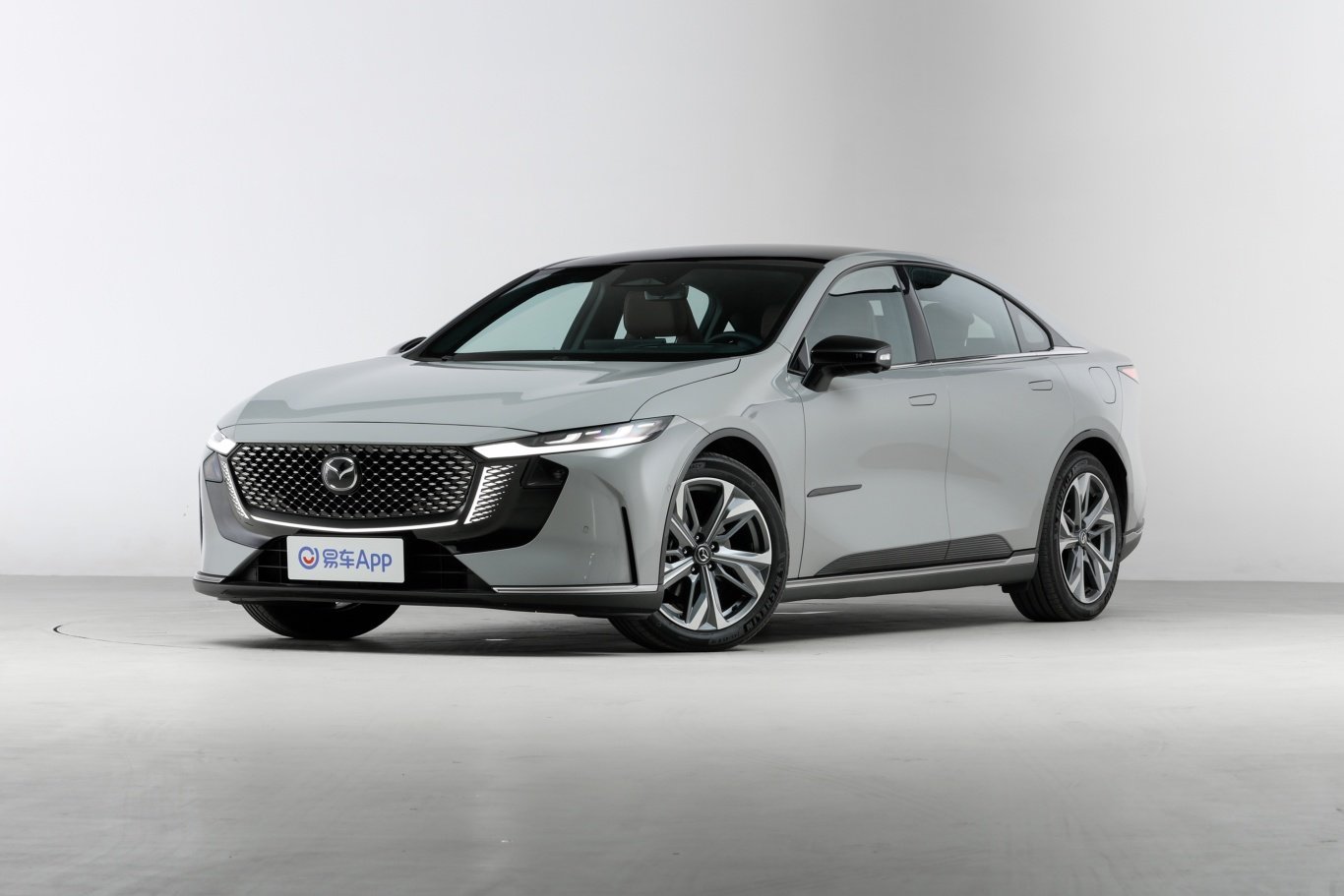
Why the Mazda EZ6 EREV Fits Emerging-Market Export
The 2026 Mazda EZ6 EREV (Extended Range Electric Vehicle) is the product of the Changan-Mazda joint venture — a sedan that pairs Mazda's KODO design language and premium cabin materials with Changan's established range-extender powertrain. For export buyers, this combination solves two problems at once: the Mazda badge carries brand equity that Chinese-only brands cannot match in Africa, the Middle East, and Southeast Asia, while the EREV architecture eliminates the charging-infrastructure barrier that has slowed BEV adoption in those same markets.
At USD $21,778 FOB Nansha, the EZ6 EREV occupies a strategic gap. It undercuts mid-size BEV sedans like the BYD Seal 06 EV ($19,390 FCA, but with 605km range and no fuel backup) while offering 1,100+ km of total range — a figure no pure EV in this price band can match. For buyers in markets where public charging is sparse, power grids are intermittent, or distances between cities exceed 300 km, the EREV configuration is not a compromise; it is the correct powertrain choice.
The EZ6 also fills a gap in Mazda's global lineup. Mazda does not currently sell a mass-market electrified sedan in most African or Middle Eastern markets. Importers who bring the EZ6 into those territories are offering a vehicle that local Mazda dealers cannot source — and at a price point that undercuts the imported Mazda3 sedan by 15-25% in markets like Kenya and Nigeria.
EREV Powertrain: How It Actually Works
An Extended Range Electric Vehicle (EREV) is fundamentally an electric car with a fuel-powered generator onboard. The wheels are driven exclusively by the electric motor — the 1.5L gasoline engine never connects to the driveshaft. Instead, when the battery depletes below a threshold, the engine starts and spins a generator that feeds electricity to the motor and recharges the battery.
This architecture gives the EZ6 three operating modes:
| Mode | How It Works | Typical Use Case |
|---|---|---|
| Pure EV | Battery powers the motor; engine off | Daily city driving under 200 km |
| Hybrid (Charge-Sustaining) | Engine runs as generator to feed motor + trickle-charge battery | Highway driving beyond EV range |
| Sport Mode | Battery + engine generator both feed motor for peak output | Highway overtaking, 0-100 sprints |
The advantage over a conventional PHEV is that the engine operates at a fixed, efficient RPM regardless of vehicle speed — there is no mechanical gear ratio to manage. The advantage over a pure BEV is that you can drive 1,100+ km without stopping at a charger, using only gasoline that is available at any fuel station.
Engine, Motor & Full Specifications
The EZ6 EREV uses Changan's JL473QJ 1.5L naturally aspirated inline-4 as the range extender, paired with a rear-mounted permanent magnet synchronous motor. The motor delivers 180 kW (245 hp) and 380 Nm of torque — output figures that put the EZ6 in the same performance bracket as a Mazda3 2.5L turbo, but with instant electric torque delivery from zero RPM.
| Specification | 2026 Mazda EZ6 EREV 200km Max Sport Edition |
|---|---|
| Manufacturer | Changan Mazda Joint Venture (chassis: CAM7202BEV2) |
| Body Style | 4-Door Sport Sedan |
| Energy Type | EREV (Extended Range Electric Vehicle) |
| Range Extender Engine | 1.5L NA Inline-4 (JL473QJ) — 65 kW, generator only |
| Electric Motor | Permanent Magnet Synchronous, rear-mounted |
| Motor Power | 180 kW (245 hp) |
| Motor Torque | 380 Nm |
| Battery Type | Lithium Iron Phosphate (LFP) — 28.1 kWh |
| Pure EV Range (CLTC) | 200 km |
| Total Range (CLTC) | 1,100+ km |
| 0-100 km/h | 7.0 seconds |
| Fuel Consumption (Charge-Depleted) | 4.8 L/100 km |
| Fuel Tank | 45 litres |
| Drive Type | RWD (rear-wheel drive) |
| Transmission | Single-speed reduction gear (electric drive) |
| Dimensions (L x W x H) | 4,919 x 1,890 x 1,475 mm |
| Wheelbase | 2,895 mm |
| Ground Clearance | 132 mm |
| Curb Weight | 1,810 kg |
| Seating Capacity | 5 |
| Tire Size | 225/55 R19 |
| Suspension (F/R) | McPherson Strut / Multi-Link Independent |
| Brakes (F/R) | Ventilated Disc / Solid Disc |
| Airbags | 6 (Front, Side, Curtain) |
| ADAS | Adaptive Cruise, LKA, AEB, 360 Camera, TPMS |
| AC Charging | ~4.5 hours (7 kW AC, 0-100%) |
| DC Fast Charge | ~25 minutes (30-80%) |
| Emission Standard | China VI b |
| Warranty | 3 yr/100,000 km vehicle + 8 yr/120,000 km battery |
| MIIT Announcement | MN5020XGJCA14 |
The 2,895 mm wheelbase is 85 mm longer than the current Mazda3 sedan (2,725 mm), giving the EZ6 near-executive-class rear legroom — a critical selling point in markets where sedans are often used as executive transport or ride-hailing vehicles. The 132 mm ground clearance is low by emerging-market standards; importers should flag this to buyers who regularly drive on unpaved roads, though it is typical for the sport-sedan category.
FOB Pricing, Packing & Container Loading
The 2026 Mazda EZ6 EREV Max Sport Edition is offered at USD $21,778 per unit FOB Nansha (equivalent to RMB 156,800 domestic). Single-unit trial orders are accepted (MOQ 1). Volume pricing applies at 5+ units and 20+ units. The FOB price includes standard export packing, MIIT documentation, and CCC certificate.
| Order Quantity | FOB Price per Unit (USD) | Container Loading |
|---|---|---|
| 1-4 units | $21,778 | 3 units / 40ft HQ |
| 5-19 units | $21,450 | 3 units / 40ft HQ |
| 20+ units | $21,150 | RoRo recommended |
| Bulk 50+ | $20,850 (contract) | RoRo or bulk vessel |
A 40-foot HQ container fits 3 EZ6 sedans with standard export packing (protective film, wheel chocks, battery disconnect). For orders above 20 units, roll-on/roll-off (RoRo) shipping from Nansha reduces per-unit transport cost to $380-$520 versus $1,200-$1,500 for a shared 40ft HQ container. Lead time from order to vessel departure is 14-20 days for single-container orders, 22-28 days for bulk RoRo, including CCC translation, VGM submission, and pre-shipment inspection.
6-Country Landing Cost: Africa, Middle East & Asia
FOB is only the starting point. The table below estimates landed cost across six target markets, using August 2026 freight rates and published tariff schedules. All figures assume single-unit FOB pricing; volume buyers can subtract 3-5%.
| Destination | Sea Freight + Insurance | Import Duty | VAT / GST | Registration + Other | Estimated Landed Cost |
|---|---|---|---|---|---|
| UAE (Jebel Ali) | $650 | 5% = $1,089 | 5% = $1,143 | $350 | $25,010 |
| Saudi Arabia (Jeddah) | $580 | 5% = $1,089 | 15% = $3,429 | $300 | $27,176 |
| Kenya (Mombasa) | $820 | 25% = $5,444 | 16% = $3,484 | $450 | $32,176 |
| Nigeria (Lagos) | $950 | 20% = $4,356 | 7.5% = $1,633 | $500 | $29,217 |
| Thailand (Laem Chabang) | $420 | 30% = $6,533 (if not EV-certified) | 7% = $1,742 | $200 | $30,673 |
| Philippines (Manila) | $480 | 10% = $2,178 | 12% = $2,613 | $250 | $27,299 |
Thailand's 30% import duty applies because the EZ6 EREV does not qualify for the Thailand EV incentive scheme (which requires a BEV with specific local-content thresholds). Importers in Thailand should verify whether the EREV classification allows any duty reduction under the ASEAN-China FTA — the China VI b EREV may qualify for a partial reduction under HS code 8703.80. Kenya's 25% duty is the standard MFN rate for passenger vehicles; the EZ6 does not qualify for the Kenya EV duty waiver because it carries a fuel tank.
Mazda EZ6 vs BYD Seal 07 DM-i vs Toyota Corolla Hybrid
To position the EZ6 EREV for buyers, compare it against the two closest competitors in the export market: the BYD Seal 07 DM-i (PHEV, $21,755 FCA) and the Toyota Corolla 1.8L HEV (strong hybrid, $19,000 Est.).
| Specification | Mazda EZ6 EREV | BYD Seal 07 DM-i | Toyota Corolla 1.8L HEV |
|---|---|---|---|
| Powertrain | EREV (1.5L generator + electric motor) | PHEV (1.5L engine + electric motor) | HEV (1.8L engine + electric motor) |
| Motor Power | 180 kW (245 hp) | 160 kW (214 hp) | 72 kW (97 hp) |
| System Torque | 380 Nm | 325 Nm | 142 Nm |
| Pure EV Range | 200 km (CLTC) | 150 km (CLTC) | ~2 km (very short) |
| Total Range | 1,100+ km | 1,050 km | ~950 km |
| 0-100 km/h | 7.0 s | 7.3 s | 9.2 s |
| Fuel (Charge-Depleted) | 4.8 L/100 km | 4.5 L/100 km | 3.8 L/100 km |
| Battery | 28.1 kWh LFP | 17.6 kWh LFP | 1.3 kWh NiMH |
| Drive | RWD | FWD | FWD |
| Body Length | 4,919 mm | 4,800 mm | 4,630 mm |
| FOB Price | $21,778 | $21,755 | $19,000 |
| Brand Origin | Japanese (JV with Changan) | Chinese | Japanese |
The EZ6 wins on pure EV range (200 km vs 150 km for the Seal 07), rear-wheel-drive sport dynamics, and brand perception in markets where Mazda carries more trust than BYD. The Seal 07 DM-i is marginally cheaper ($23 difference) and has slightly better charge-depleted fuel economy, but its FWD layout and Chinese-only branding are disadvantages in markets where buyers associate RWD with premium positioning. The Corolla Hybrid is $2,778 cheaper and has the strongest brand of the three, but it cannot drive in pure EV mode for meaningful distances and its performance figures are far behind.
Target Markets: Where the EZ6 Wins
UAE and Saudi Arabia: Mazda has a 4-6% passenger-car market share in the GCC, and the EZ6's 4,919 mm length and premium cabin position it as an executive sedan alternative to the Lexus ES at roughly half the price. The 1,100 km total range is a significant advantage for inter-city driving in the GCC (Dubai to Abu Dhabi is 140 km; Riyadh to Dammam is 395 km). The RWD layout is a positive in the GCC, where rear-wheel-drive sedans (BMW 5 Series, Mercedes E-Class) are status markers.
Nigeria and Kenya: Mazda's brand presence in West and East Africa is smaller than Toyota's or Hyundai's, but importers who position the EZ6 as a "premium tech sedan with Japanese DNA" can target buyers who want differentiation from the Camry/Corolla default. The 200 km EV range covers daily city driving in Lagos or Nairobi on electricity alone (average daily distance: 25-40 km), with the fuel engine as backup for grid outages and long-distance travel.
Philippines and Thailand: In Southeast Asia, the EZ6 competes against the Toyota Corolla Altis Hybrid and the Honda Civic e:HEV. The EZ6's longer body, higher power output, and 200 km EV range are differentiators. However, Thailand's 30% import duty on non-EV-certified vehicles makes the landed cost uncompetitive unless the importer can secure an EREV duty classification under HS 8703.80.
Charging Strategy & EREV Ownership Model
The EZ6 EREV is designed for owners who may not have reliable access to public charging. In pure EV mode, the 28.1 kWh LFP battery delivers 200 km of range — enough for 3-5 days of typical urban driving on a single charge. Home charging via a standard 7 kW AC wallbox takes about 4.5 hours for a full charge (0-100%). DC fast charging from 30% to 80% takes approximately 25 minutes when a compatible charger is available.
For markets where home charging is not feasible (apartment dwellers, unreliable grid), the EREV architecture means the vehicle still functions normally — the driver simply uses gasoline, and the engine's generator keeps the battery at a minimum charge level. This is the core EREV value proposition: electric driving when charging is available, gasoline driving when it is not, with no range anxiety either way.
The 4.8 L/100 km charge-depleted fuel consumption is better than any conventional gasoline sedan of comparable size and power. For comparison, a 2.0L Toyota Camry consumes 7.0-8.0 L/100 km in similar conditions. Over 1,000 km of charge-depleted driving, the EZ6 uses approximately 48 litres of fuel (about $40 at typical African gasoline prices), versus 75 litres ($63) for a Camry — a 36% fuel cost saving even when the battery is never charged.
FAQ: 2026 Mazda EZ6 EREV Export from China
What is the FOB price of the Mazda EZ6 EREV?
The 2026 Mazda EZ6 EREV 200km Max Sport Edition is priced at USD $21,778 per unit FOB Nansha Port, Guangzhou. Volume pricing drops to $21,450 at 5+ units and $21,150 at 20+ units. The price includes standard export packing, MIIT documentation, and CCC certificate. Single-unit trial orders are accepted.
Is the Mazda EZ6 made by Mazda or Changan?
The EZ6 is manufactured by the Changan Mazda joint venture in Nanjing, China. The vehicle uses Mazda's KODO design language, interior craftsmanship standards, and chassis tuning, paired with Changan's EPA platform and 1.5L range-extender powertrain. The export chassis code is CAM7202BEV2, and the MIIT announcement number is MN5020XGJCA14. Mazda engineers participated in the suspension tuning and NVH calibration.
How far can the Mazda EZ6 EREV drive on electricity alone?
The EZ6 EREV has a CLTC-rated pure electric range of 200 km from its 28.1 kWh LFP battery. In real-world urban driving conditions (25-40 km/day), this translates to 4-6 days between charges. When the battery depletes, the 1.5L range extender starts automatically and provides electricity to the motor, extending total range to 1,100+ km. The driver can also manually hold battery charge for later use in city zones where EV-only operation is preferred.
Does the Mazda EZ6 qualify for EV import tax incentives?
This depends on the destination country's tariff classification. In the UAE and Saudi Arabia, the EZ6 qualifies for the 5% hybrid/EV duty rate (versus 5% standard — no difference). In Kenya, the EZ6 does not qualify for the EV duty waiver because it has a fuel tank. In Thailand, the EREV may fall under HS 8703.80 (hybrid vehicles), which carries a 30% duty versus the 0% BEV rate — importers should confirm with their customs broker. In the Philippines, the EZ6's 10% MFN duty applies regardless of powertrain type.
What is the warranty on the Mazda EZ6 EREV?
The EZ6 EREV comes with a 3-year / 100,000 km vehicle warranty and an 8-year / 120,000 km battery warranty. The LFP battery chemistry is the same type used in BYD's Blade Battery and is known for high thermal stability and long cycle life (2,000+ cycles to 80% capacity). Export buyers should confirm whether the warranty is honored by local Mazda dealers or requires claims through the original exporter.
How does the Mazda EZ6 compare to the BYD Seal 07 DM-i?
The EZ6 EREV and BYD Seal 07 DM-i are priced within $23 of each other ($21,778 vs $21,755 FOB). The EZ6 has 50 km more pure EV range (200 vs 150 km), 31 more horsepower (245 vs 214 hp), 55 Nm more torque (380 vs 325 Nm), and a 119 mm longer body (4,919 vs 4,800 mm). The Seal 07 has slightly better charge-depleted fuel economy (4.5 vs 4.8 L/100 km) and a lower curb weight. The decisive factor for most buyers is brand: Mazda carries higher brand equity in Africa and the Middle East, while BYD has stronger EV-specific brand recognition and after-sales support in Southeast Asia.
Export the Mazda EZ6 EREV with Globalucar. We are the Guangzhou-based vehicle export arm of Globalucar Group, shipping Changan-Mazda joint venture vehicles from Nansha Port to 50+ countries. Single-unit trial orders accepted. Contact Mr Didi on WhatsApp +86 133-0240-8528 or email ucars@global-ucars.com for FOB quotes, container loading plans, and export documentation. Office: 28F Guangzhou Jianhua Center, Baiyun District, Guangzhou.
Verify Part Numbers in Our OE Library
Every part covered in this guide has a matching OE number in our reference library — grouped by system with cross-references, so you can source the exact fit for Hyundai, Kia, GM Korea and more.
Related Articles

Related Products
From our Vehicle Export catalog — new & used cars ready for international delivery

Full-Size EREV SUV
2026 Rox Adamas EREV 215km 6-Seat Executive Edition
USD 53,000 FOB Guangzhou
View Details
Full-Size EREV SUV
2026 Rox Adamas EREV 215km 7-Seat All-Terrain Edition
USD 51,500 FOB Guangzhou
View Details