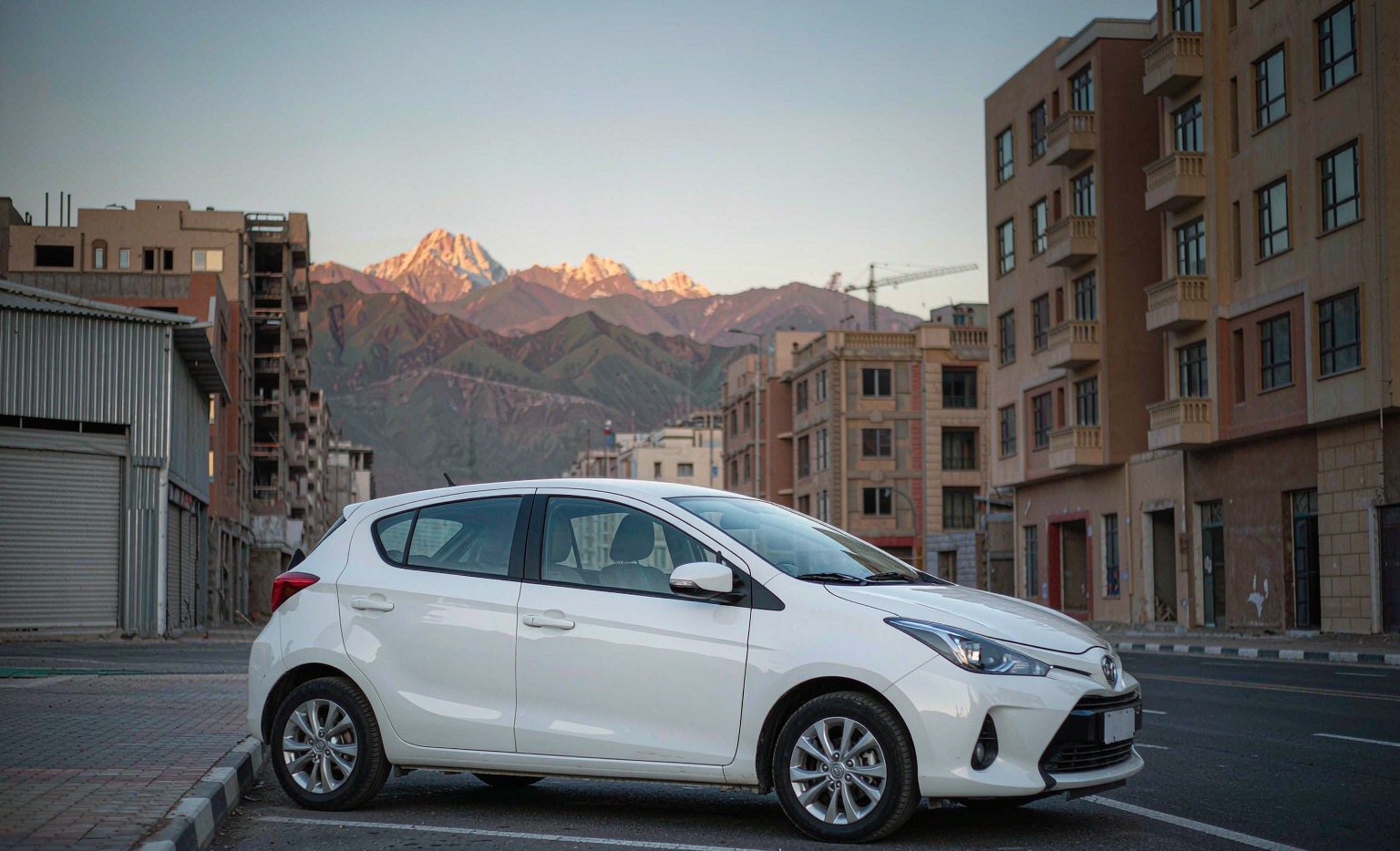
If you sell wholesale vehicles out of Guangzhou, the question of the year from October 2025 onward is no longer "do you have Chery for Central Asia" — it is some version of "do you have Japanese badged stock for Iran". The shift did not come from a policy change in Tehran. It came from three pressures meeting in the same month: Iran's daily gasoline shortfall expanded to fourteen to fifteen million litres per day, the rial fell toward 1,810,000 IRR per dollar, and Toyota issued two Middle East production cuts in quick succession after Hormuz shipping disruptions. By August 2026 the Iranian vice president for energy optimisation, Esfahjani, was on national television saying publicly that locally-assembled Chinese cars were "unreasonably priced, with poor quality stability and high running cost", and that importing Japanese complete vehicles "would have given citizens a better driving experience and a lower total cost". The remark was a political venting point, not a market signal — but the demand underneath it is real, and it is now reshaping the wholesale lane that runs from Chinese ports to Bandar Abbas.
1. Why Iran Suddenly Cannot Stop Talking About Japanese Cars Again
The "Japan is better" line in Tehran is older than the current sanctions cycle, but it has come back with force in 2026 for three reasons that have nothing to do with sentiment and everything to do with operating reality. The first is the fuel math. Iran's daily gasoline consumption hit roughly 145 million litres at peak, while domestic refining capacity sits near 121 million litres. The shortfall, fourteen to fifteen million litres per day, is structural — Iran's maritime fuel import channel has been choked since 2018 and no replacement is on the horizon. The second is the rial. By late April 2026 the rial had fallen to 1,810,000 per dollar, and the twelve-month average inflation was already past fifty per cent. A car, in that environment, is no longer a discretionary purchase — it is the most liquid hard asset an Iranian family can hold. The third is the auto stock itself. Roughly five to seven million of the passenger vehicles on Iranian roads are second-generation Toyota Corollas, first-generation Kia Rio/Hyundai Elantra, and first-gen Toyota RAV4. Most are over ten years old, none are being replaced on schedule, and every workshop in Tehran keeps a permanent shelf of parts for them.
The vice president's remarks on 16 August 2026 were unusual only because they were made on a live broadcast rather than a closed cabinet meeting. The same calculation runs in every Iranian household that owns a car: which vehicle will still be cheap to run, easy to repair, and worth something on the second-hand market five years from now? Japanese cars answer that question today. Chinese cars, which briefly held a 19.7 per cent share of the Iranian passenger market in 2025, are losing that share in 2026 not because their engineering is poor but because the CKD-assembly quality inside Iran is inconsistent, the spare-part pipeline is fragile, and the residual values are being marked down by local dealers in anticipation of even more supply cuts.
2. The Iranian Car Market at a Glance: 1.08M Units, Two Local Giants, a Shrinking Chinese CKD Presence
Iran produced roughly 1.078 million passenger and light commercial vehicles in 2024 according to OICA, making it one of the largest single-country automotive markets in the Middle East after Turkey and Egypt. Roughly seventy per cent of that volume is split between two state-linked assemblers — Iran Khodro (IKCO) and SAIPA — whose product lines are mostly pre-2015 platforms that the sanctions have prevented them from refreshing. Chinese brands filled the gap between 2018 and 2025 by shipping complete knock-down kits into Iran for local assembly, peaking at 19.7 per cent market share in 2025, with Chery the largest single foreign brand by volume. That run peaked and then reversed. Geely terminated its CKD and SKD operations in Iran in January 2026, including the closure of its local sales network. The joint Changan-SAIPA assembly project was wound down over the same period. As of October 2026, only Chery maintains a meaningful local presence, and that presence is now asset-light — small-volume whole-vehicle imports plus spare-parts supply, not factory build.
| Player | 2024 share | 2026 posture | Channel to Iran |
|---|---|---|---|
| Iran Khodro (IKCO) | ~38% | Pre-2015 platforms, slow refresh | Domestic |
| SAIPA | ~32% | Pre-2015 platforms, slow refresh | Domestic |
| Chery | ~8% | Asset-light imports + parts | CKD legacy + direct |
| Other Chinese (Geely, Changan, JAC) | ~12% (2025) | Geely exited 2026-01; Changan-SAIPA ended | Reduced |
| Toyota / Nissan (new) | ~1-2% (official) | Reappearing in 2025-2026 official import list | Whole vehicle, limited |
| Imported Japanese / Korean (wholesale lane) | n/a | Growing from Chinese ports | Cross-border wholesale |
The wholesale lane — the one in which distributors buy containers of vehicles from a Chinese port, document them at Bandar Abbas or a partner port, and on-sell to local dealer networks inside Iran — is the one that has grown the most in 2026. That is the lane this guide is written for.
3. Why Japanese Cars Fit Iran's Operating Reality: Fuel Economy, Durability, Resale Value
There are three operating-cost arguments that drive an Iranian household toward a Toyota or Hyundai/Kia and away from a locally-assembled Chinese crossover, and they are measurable.
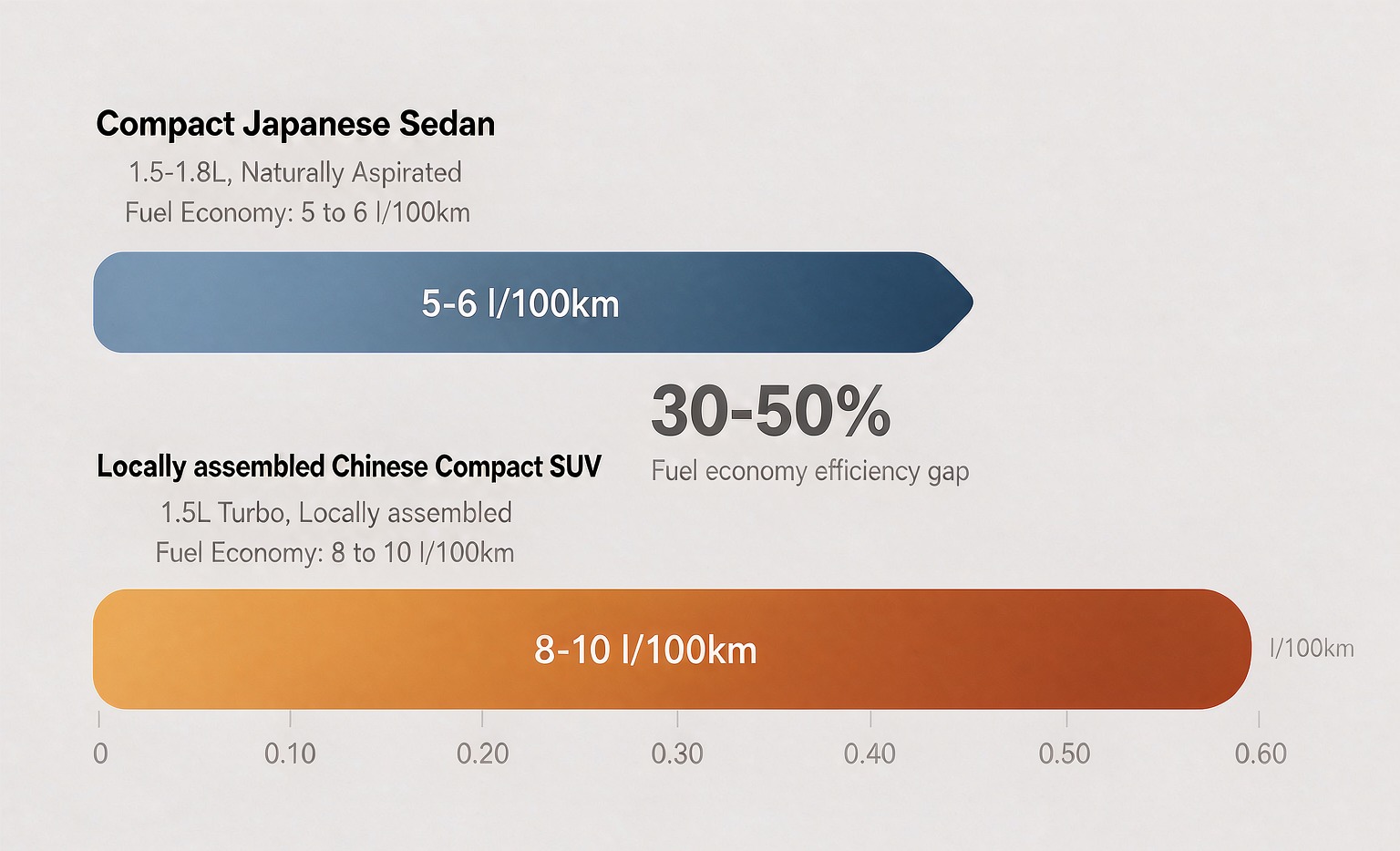
First, fuel economy. The current consensus among Iranian taxi drivers and corporate fleet operators is that a compact Japanese sedan with a naturally-aspirated 1.5 to 1.8 litre engine returns five to six litres per 100 kilometres in Tehran traffic, while the typical Chinese-assembled small SUV with a 1.5 turbo returns eight to ten. The gap is thirty to fifty per cent, and at the new fuel pricing tiers inside Iran — where the government-supplied quota is still cheap but every litre above the quota is roughly sixteen times the quota price — the gap is paid out in cash every month. A taxi driver covering 1,000 km a month saves 30 to 50 litres of premium-priced fuel by running the smaller, lighter Japanese car. At Tehran street prices that is a meaningful share of a working-class monthly food budget.
Second, durability and repair simplicity. Iranian workshops are calibrated to Japanese cars from three decades of accumulated practice. A 2007 Toyota Corolla can be diagnosed, partly disassembled and reassembled on the side of the road with basic hand tools. The same is not true of a 2023 Chery Tiggo 7 assembled at the SAIPA plant, where body-panel gaps vary unit to unit, the wiring loom is locally sourced, and the diagnostic port speaks a protocol that most independent workshops do not have the tool for. Spare parts for a 2010 Corolla in Tehran's basements are still readily available. Spare parts for a 2023 Tiggo 7 CKD, in some configurations, are not.
Third, residual value. The Iranian second-hand market prices Japanese cars at a structural premium that the rial's decline has only widened. A 2014 Corolla bought new for 600 million rial in 2014 sells for 35 to 40 billion rial today, because that is what the market will pay for a vehicle that still has parts availability and a known reliability profile. A 2019 Chinese-assembled sedan of equivalent new price is not priced the same way. In an environment where the local currency is losing a meaningful share of its value every quarter, the choice of new car is in part a bet on which car will still be liquid in five years. Japanese is the safer bet.
| Operating dimension | Compact Japanese sedan (1.5-1.8L NA) | Locally-assembled Chinese compact SUV (1.5T) | Why it matters in Iran 2026 |
|---|---|---|---|
| Real-world fuel economy | 5-6 L/100km | 8-10 L/100km | Premium fuel tier is ~16x the quota price |
| Independent-workshop repair | Standard practice, decades of know-how | Limited; proprietary diagnostics often required | Repair wait times are a household concern |
| Spare-parts availability | Deep, including legacy basements and bazaars | Patchy, especially for CKD-only variants | Older stock outlasts the parts pipeline |
| Five-year residual value (rough) | Strong, premium segment | Discounted in 2026 amid CKD-quality concerns | Car is the most liquid hard asset for families |
| Insurance and registration | Standard | Standard but harder for newer CKD variants | Lower friction at point of sale |
4. The 2026 Supply Squeeze: Hormuz Disruptions and Toyota's Middle East Production Cuts
The wholesale lane to Iran is not a stable flow. It is a flow that depends on Toyota, Nissan and Hyundai's Middle East production remaining above a certain floor, and in 2026 that floor has been missed twice. The first cut came after shipping disruptions in the Strait of Hormuz earlier in the year — Toyota announced a production adjustment for the Middle East market, with the cumulative scale running into the tens of thousands of units. The second cut was smaller but timed worse: it landed at the moment Iranian dealers were refilling inventory ahead of the late-2026 wedding season. Several Tehran distributors have reported waiting more than two months for replacement vehicles from the official Toyota channel. Some of them have rebooked into the Chinese-port wholesale lane, paying roughly the same landed cost as the official importer, and accepting a different documentary profile in exchange for delivery certainty.
| Disruption event | Period | Estimated impact on Iran-bound Toyota stock | Wholesale-lane response |
|---|---|---|---|
| Hormuz shipping disruption | 2026-Q1 / Q2 | Tens of thousands of units cut across Middle East allocation | Iranian dealers rebook to Chinese-port wholesale |
| Second Toyota Middle East production cut | 2026-Q3 | Smaller volume, late-2026 wedding season collision | 2+ month wait reported at multiple Tehran distributors |
| Geely exit from Iran | 2026-01 | Removes a CKD competitor in sedan/SUV segments | Frees up dealer showroom space for Toyota/Hyundai/Kia |
| Changan-SAIPA joint project wind-down | 2025-Q4 to 2026-Q1 | Removes an additional CKD competitor | Same as above |
The result is a market in which the official channels are running short and the wholesale channels are running hot. The market signal is no different from any other supply-constrained commodity: price-discovery happens where stock actually moves, and in 2026 that means the cross-border lane more than the official one.
5. What Iran's Import Lists Actually Show: Toyota and Nissan Reappearing in 2025-2026
It is a common misreading, in wholesale marketing, to assume that because Japan and Iran do not have a fully normalised trade relationship, no Japanese complete vehicles enter Iran. They do, and the official import lists published through 2025 and 2026 confirm it. The 2025 import list included Toyota and Nissan badged vehicles registered for sale inside Iran, and the July 2026 update added another round of Toyota and Nissan models. The volumes are small in absolute terms — Iran is not running a quota of 50,000 Japanese cars a year the way the Gulf states do — but the precedent is the relevant fact. The official import window is open, and the wholesale lane is the unofficial extension of that window for distributors who need more volume than the official channel can supply on a reliable schedule.
6. The Paradox of Official Channels vs Ground-Reality Demand
What an Iranian dealer on a Tehran sidewalk sees is not the same as what the Iranian customs data shows. The customs data shows a small stream of officially imported Japanese complete vehicles. The Tehran dealership reality is a continuous demand for Japanese badged stock at a price point the official channel cannot serve on a steady schedule, and a secondary market of high-mileage used Japanese cars imported through neighbouring jurisdictions and consolidated for sale inside Iran. The wholesale lane out of Chinese ports serves both flows: the official dealer who needs a 2026 model he cannot get from the official Toyota allocation, and the larger secondary-market consolidator who needs bulk supply. The pricing between the two flows has narrowed in 2026, which is itself a signal that the wholesale channel has become the effective marginal source.
7. Sourcing Japanese and Korean Badged Vehicles from China Ports: Models, Prices, Terms
For a wholesale distributor serving the Iranian market, the practical answer in 2026 is to source Japanese and Korean badged vehicles out of Chinese ports — Khorgos dry port on the Kazakhstan/China border for the overland route through Central Asia, and Nansha port in Guangzhou for the deep-water route via the Gulf. The price ladder as of October 2026 from Globalucar's live catalogue is shown below.
| Model | Trim / powertrain | Port | Price (USD) | Notes |
|---|---|---|---|---|
| Toyota RAV4 2026 | Dual Engine 2.5L 4WD Luxury | FOB Khorgos | 21,880 | Top-seller for the dual-engine AWD lane |
| Toyota RAV4 2026 | Dual Engine 2.5L 4WD Flagship | FOB Khorgos | 22,880 | Flagship equipment pack |
| Toyota RAV4 2026 | NEW Face 2.0L Gasoline 2WD Deluxe | EXW Nansha | 22,500 | Petrol-only entry, facelift body |
| Toyota RAV4 2026 | 2.0L Hybrid AWD | (see catalogue) | 25,400 | Strong fuel-economy story for Iran |
| Toyota Corolla 2026 | 1.8L Hybrid Pioneer | EXW Nansha | 14,000 | The anchor nameplate in Iran |
| Toyota Corolla Cross 2026 | 2.0L Intelligent Hybrid Elite | FOB Khorgos | 16,850 | Compact SUV body, hybrid powertrain |
| Toyota Frontlander 2026 | 2.0L Intelligent Hybrid Luxury | FOB Khorgos | 18,050 | China-exclusive trim, strong equipment level |
| Hyundai Elantra | 2023 1.5L CVT GLX Elite | FOB Khorgos | 11,200 | Lowest entry-price on the list, taxi-fleet favourite |
| Hyundai Sonata | 1.5T Max (full option) | EXW Nansha | 20,000 | Full-option sedan |
| Kia K5 | 1.5T Deluxe (full option) | EXW Nansha | 21,500 | Sport-trim sedan |
| Kia Sportage | 1.5L Turbo 2WD Comfort | EXW Nansha | 19,000 | Compact SUV, turbo petrol |
The 40HQ container loading arithmetic on these nameplates is the same as for any other small to mid-size passenger export: four to five units per 40HQ depending on whether the run is sedan-only or mixed sedan/SUV, and one to two units of premium trims such as the RAV4 2.0L Hybrid AWD if the dealer is paying a higher per-unit price. The documentary profile is the standard export commercial invoice, packing list, certificate of origin, and a buyer-nominated destination port — which the buyer is responsible for handling in line with their own jurisdiction's import and sanctions rules.
8. Hybrid as the Sweet Spot for Fuel-Scarce Markets
One of the most useful pieces of intelligence for any distributor weighing the Iranian route in 2026 is the technical fit of the hybrid powertrain. Iran's fuel problem is not theoretical. The country imports roughly fourteen to fifteen million litres of refined gasoline per day more than it can produce, and the public distribution network cannot make up the gap. Pure EVs are not a solution in the current infrastructure context: Iran's grid is ageing, residential supply is intermittent, and there is essentially no public charging network. The fit that the operating data points toward is the hybrid — both the conventional hybrid (HEV) such as the Toyota Hybrid System II fitted to the Corolla, Corolla Cross, Frontlander and the RAV4 2.0L Hybrid, and the dual-engine setup on the RAV4 2.5L AWD. HEV returns real-world economy in the five to six litres per 100 km range even under Tehran traffic, charges no external infrastructure, and the service network for the Toyota hybrid system in Iran is already established.
For a distributor pricing the Iran-bound container, the practical recommendation is a 60/40 mix of HEV trims to petrol-only trims, with the HEV carrying the higher FOB premium and the petrol-only trims carrying the higher unit volume. That mix tracks the underlying demand structure: a smaller but price-insensitive premium HEV segment that wants the fuel-economy story, and a larger price-sensitive base segment that wants the Toyota nameplate at the lowest entry price.

9. Compliance First: What Exporters and Buyers Must Verify
A wholesale guide for the Iranian market is not complete without an explicit statement on compliance. The export of passenger vehicles to Iran is governed by a layered set of rules that vary by jurisdiction of origin, jurisdiction of transhipment, and jurisdiction of the buyer. United States-origin components, software and finance channels may attract separate OFAC rules regardless of where the vehicle is finally delivered. European Union export controls apply separately. The buyer's own sanctions and import licensing rules in their jurisdiction are the buyer's responsibility to verify, not the seller's. A standard cross-border wholesale transaction between a Chinese port and an Iranian buyer will typically be documented under a third-country finance and insurance structure, and the legal characterisation of that transaction is not a matter a wholesale export desk should be giving legal advice on.
Globalucar's standing position is to deliver vehicles to the buyer-nominated destination port under the standard ICC Incoterms 2020 terms the buyer selects, against the buyer's letter of credit or an equivalent instrument, with the buyer responsible for import licensing, sanctions verification and customs clearance in the destination jurisdiction. Buyers and importers must independently verify applicable sanctions, export-control and import regulations for their destination market and consult qualified trade-compliance counsel before any booking. That is not boilerplate: in 2026 it is the most important sentence on this page.
10. Frequently Asked Questions
Why are Japanese cars back at the centre of the Iranian market in 2026?
Three operating pressures — a fourteen-to-fifteen-million-litre daily gasoline shortfall, a rial at 1,810,000 per dollar, and an aging fleet of pre-2015 Toyota and Hyundai/Kia nameplates — combined with two Toyota Middle East production cuts in 2026 to make Japanese badged vehicles the most resilient and most liquid hard asset in the Iranian passenger market. The Iranian vice president for energy optimisation, Esfahjani, summarised the household-level logic on national television on 16 August 2026: locally-assembled Chinese cars are "unreasonably priced, with poor quality stability and high running cost", whereas importing Japanese complete vehicles "would have given citizens a better driving experience and a lower total cost". The wholesale market is responding to that calculation regardless of the political framing.
How much Japanese badged stock is actually reaching Iran today?
Two streams run in parallel. The official import list published by the Iranian customs authority in 2025 and updated in July 2026 includes Toyota and Nissan badged vehicles, in limited but recurring volumes. The unofficial cross-border wholesale lane out of Chinese ports runs in addition to that, in larger volumes and on a different documentary profile. The two streams together now account for a small but growing share of the Iranian passenger market, while Chinese CKD-assembly brands such as Geely have exited the country in 2026 and Changan's joint project with SAIPA has been wound down.
Can a wholesale buyer in China actually source Toyota badged vehicles?
Yes. Toyota badged vehicles are produced for the global market, and the Chinese dealer network supplies wholesale quantities to certified export channels on a recurring basis. The constraint is not supply; the constraint is documentary. Each Toyota, Hyundai or Kia badged vehicle for export out of China carries the standard export commercial invoice, packing list, certificate of origin, and the manufacturer-issued export documentation that the buyer's destination jurisdiction may require. Pricing as of October 2026 ranges from USD 11,200 (Hyundai Elantra 2023 1.5L CVT GLX Elite FOB Khorgos) to USD 25,400 (Toyota RAV4 2026 2.0L Hybrid AWD) per unit, FOB or EXW depending on the port.
What is the right port to ship from for the Iranian market?
Two options. Nansha port in Guangzhou is the deep-water option for the Gulf route, with onward shipping to Bandar Abbas and the southern Iranian coast. Khorgos dry port on the Kazakhstan/China border is the overland option for cross-border consolidation through Central Asia. The Khorgos lane is typically used for higher-volume sedan runs where the per-unit inland cost is amortised across four to five vehicles per 40HQ. The Nansha lane is typically used for mixed sedan/SUV containers, premium trims, and buyers who need the original B/L straight from a deep-water port.
Why is hybrid the right answer for Iran in 2026?
Iran's fuel shortage is structural and will not be resolved by changes in the global oil price. The country imports roughly fourteen to fifteen million litres of refined gasoline per day more than it can produce, and the public distribution network is constrained. Pure EVs are not a solution because Iran's grid is ageing and there is essentially no public charging infrastructure. The hybrid — both the conventional HEV on the Toyota Hybrid System II and the dual-engine setup on the RAV4 2.5L AWD — returns five to six litres per 100 km in real-world Tehran traffic, charges no external infrastructure, and benefits from a Toyota hybrid service network in Iran that already exists.
What does a wholesale buyer need to verify before booking?
Three things, in this order. First, the buyer's own jurisdiction's import licensing and sanctions rules — including any U.S. OFAC reach, any EU export-control rules, and any destination-country registration requirements. Second, the documentary profile of the transaction — Incoterms 2020 terms, letter of credit or equivalent instrument, third-country finance and insurance if applicable. Third, the technical fit of the vehicle to the destination market's operating environment — fuel availability, parts pipeline, local workshop compatibility, residual value. Globalucar will support the documentary and technical side of the booking; the legal characterisation of the transaction is a matter for the buyer's own trade-compliance counsel.
Related Articles
Related Products
From our export catalog — parts and vehicles ready for international delivery

Full-Size EREV SUV
2026 Rox Adamas EREV 215km 6-Seat Executive Edition
USD 53,000 FOB Guangzhou
View Details
Full-Size EREV SUV
2026 Rox Adamas EREV 215km 7-Seat All-Terrain Edition
USD 51,500 FOB Guangzhou
View Details
